
Advertisement

- Updated on April 15, 2026
- IST 8:15 am

Imagine this: Raj, a 29-year-old software engineer from Bengaluru, had built his entire side hustle around prompt engineering. In 2024, he was the go-to guy in his IT firm for crafting flawless prompts that squeezed magic out of ChatGPT and Claude. Clients paid premium rates, his LinkedIn glowed with “AI Whisperer” badges, and he dreamed of scaling his freelance gig into a full agency. But by early 2026, everything flipped. AI agents started handling entire workflows autonomously—research, drafting, even client follow-ups. Raj’s prompts became obsolete overnight. His inbox dried up, projects vanished, and panic set in. “I mastered the skill everyone said would change everything,” he told his college WhatsApp group, “but now it feels like I bet on a horse that stopped running.”
Now, picture Meera, 31, a product manager from Hyderabad who saw the writing on the wall early. Instead of doubling down on prompts, she pivoted to AI ethics governance and human-AI collaboration strategies. She enrolled in IndiaAI Mission workshops, started advising startups on responsible AI deployment, and even landed a consulting role with a Mumbai-based fintech unicorn. Six months later, she’s leading workshops for 200+ professionals, her salary has jumped 40%, and she’s fielding offers from global firms eyeing India’s booming AI sector. “It wasn’t about fighting the machines,” Meera shares over chai during a virtual catch-up. “It was about learning to lead them—like a conductor guiding an orchestra of agents.”
So, what’s the truth? Is prompt engineering truly dead, or just evolving? With AI tools becoming smarter, faster, and more autonomous every quarter, can old-school prompting still pay the bills? Or are entirely new billion-dollar skills emerging that Indian professionals aged 15-45 need to master right now to stay ahead? In this blog, we’ll unpack the shift, explore the risks of clinging to yesterday’s hype, and spotlight the high-value skills that will define careers in 2026 and beyond. We’ll draw from real Indian journeys, government initiatives like the IndiaAI Mission, and practical desi-friendly strategies to future-proof your career. Let’s dive in and figure this out together—because in the AI race, the ones who adapt early win big.
Understanding the AI Shift: From Commands to Collaboration
Let’s start with the basics. Prompt engineering exploded in popularity around 2023-2024 as the “secret sauce” for getting useful outputs from large language models. It was all about crafting the perfect instructions—clear, detailed, iterative—to make AI do exactly what you wanted. Think of it like learning a new language to boss around a super-smart but literal-minded intern. For millions of Indian IT grads, freshers in Tier-2 cities, and even marketing folks, it felt like a golden ticket: low barrier to entry, high demand, and quick wins.
But AI didn’t stand still. By 2025-2026, we’ve entered the era of agentic AI—systems that don’t just respond to prompts but plan, reason, use tools, and execute multi-step tasks on their own. Models now remember context across sessions, pull real-time data, and even self-correct. The result? Basic prompt tweaking is becoming as outdated as teaching someone to use dial-up internet in the 5G world. Gartner and industry reports highlight that humans are shifting from “operators” (typing prompts) to “policy designers” and “orchestrators” who set the rules, oversee outcomes, and ensure alignment with business and ethical goals.
For young Indians entering the workforce—whether in Bengaluru’s tech parks, Hyderabad’s GCCs, or remote gigs from smaller towns—this shift is massive. India is projected to need over a million AI-skilled professionals by 2026, fueled by $200+ billion in investments from Reliance, Adani, Microsoft, OpenAI, and Tata. The government’s IndiaAI Mission is pouring resources into skilling, yet the real winners won’t be those who code prompts—they’ll be those who govern, collaborate with, and strategically deploy AI at scale. It’s no longer about what you ask the AI; it’s about why, how safely, and in alignment with human values.
The Big Debate: Does Prompt Engineering Still Matter—or Is It Dead?
Here’s where opinions split sharply among experts, recruiters, and working professionals. Some say prompt engineering is simply evolving into something deeper, while others declare it dead as a standalone skill. Let’s break it down fairly.
The Pros: Why It Still Has Some Life
- Foundation for Literacy: Mastering prompts builds essential AI intuition—understanding model strengths, hallucinations, and biases. It’s like learning basic arithmetic before tackling calculus. Many entry-level roles in content, customer support, and junior development still value it.
- Quick Wins in Niche Areas: In creative fields or rapid prototyping, refined prompting can boost productivity by 30-50% for specific tasks.
- Bridge to Advanced Work: It teaches critical thinking and problem-framing, skills that transfer to higher-value roles.
Take Raj’s early success—he used it to land gigs and impress managers. For freshers in India’s competitive job market, it remains a low-cost way to showcase AI fluency on resumes or LinkedIn.
The Cons: Why It’s No Longer the Billion-Dollar Ticket
- Automation Overload: Agentic systems and no-code platforms now generate, refine, and chain prompts automatically. Why spend hours tweaking when an AI agent can iterate 100 times faster?
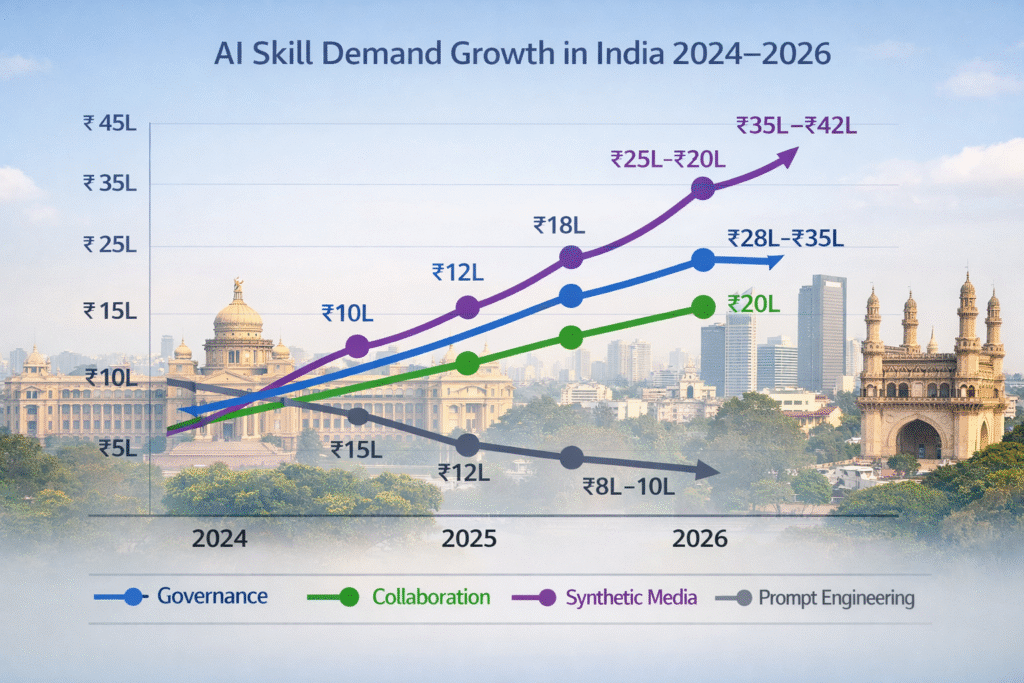
- Commodity Skill: What was rare in 2023 is now table stakes. Job postings in 2026 rarely list “prompt engineering” as a core requirement; instead, they demand governance, evaluation, and leadership.
- Limited Scalability: Prompts don’t handle complex, real-world accountability—like bias in hiring algorithms or regulatory compliance under India’s upcoming Digital India Act influences. Clinging to it leaves you vulnerable as AI handles the grunt work.
- Job Market Reality: Recruiters from Infosys, TCS, and global GCCs report that pure prompt experts are struggling while those skilled in ethics, orchestration, and human-AI teaming command 2-3x higher packages.
Meera’s story proves the point: she moved beyond prompts and into governance, turning uncertainty into opportunity. The debate boils down to this—prompting is a tool, not a career. The real billion-dollar skills lie in what comes next.
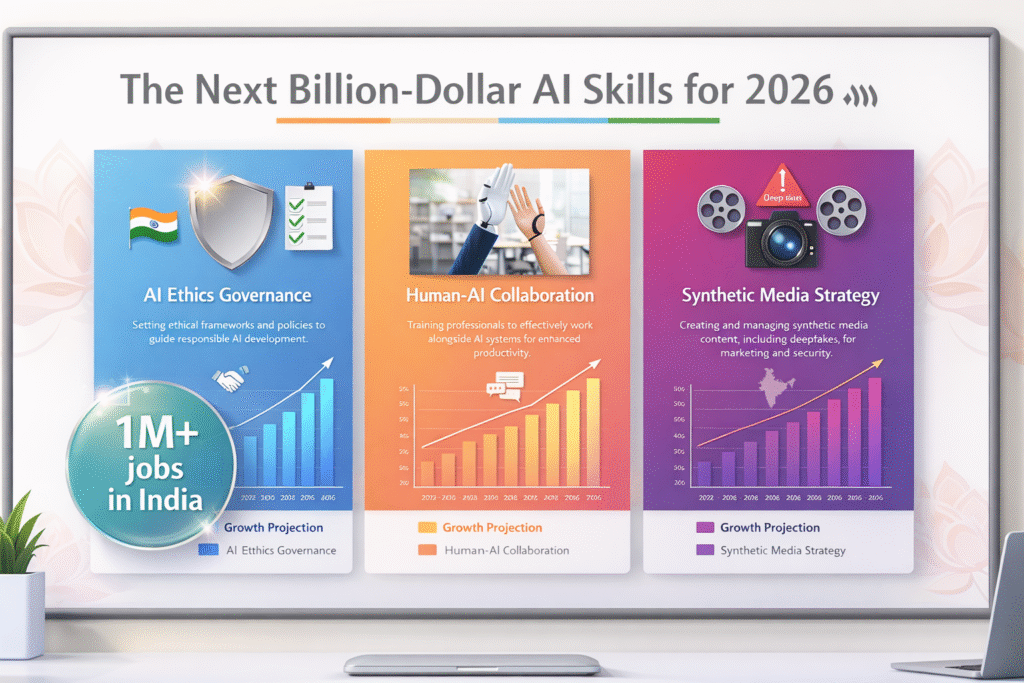
The Next Billion-Dollar Skills: AI Ethics Governance, Human-AI Collaboration, and Synthetic Media Strategy

As AI matures, three interconnected skills are emerging as the high-value plays for 2026. These aren’t niche—they’re set to create entirely new job categories with massive demand in India’s $126 billion AI market by 2030.
- AI Ethics Governance: The Trust Architect Role
This is about embedding fairness, transparency, accountability, and compliance into every AI system. Think of it as the “compliance officer” for intelligent machines—auditing for bias, ensuring regulatory adherence (like EU AI Act parallels or India’s responsible AI guidelines), and building trust frameworks. Demand has skyrocketed: responsible AI mentions in job postings grew from near-zero in 2019 to nearly 1% of all AI roles globally by 2025, with even faster growth in India’s fintech and healthcare sectors.
In practice, you’ll design policies, run bias audits, manage vendor risks, and advise on “Sovereign AI” initiatives. Salaries for AI governance leads in India can hit ₹25-50 lakhs, especially in Mumbai and Bengaluru startups. It’s perfect for law grads, MBAs, or engineers who love big-picture strategy over coding.
- Human-AI Collaboration Management: The Orchestra Conductor
Forget solo prompting—this skill is about treating AI as a teammate. You’ll design workflows where humans provide judgment, creativity, and empathy while AI handles scale and speed. Key competencies include role definition (who decides what?), skill-gap bridging, and measuring outcomes like innovation velocity or employee engagement. The World Economic Forum estimates human-AI collaboration could unlock $15.7 trillion in economic value by 2030.
For Indian professionals in GCCs or product teams, this means orchestrating agentic systems for customer service, code review, or marketing campaigns. It blends leadership, emotional intelligence, and domain expertise—skills that AI can’t replicate.
- Synthetic Media Strategy: The Creative Guardian
With generative AI creating hyper-realistic images, videos, voices, and deepfakes, this skill focuses on ethical creation, rights management, detection of misuse, and strategic deployment. Roles like Synthetic Media Creative Director or Deepfake Detection Specialist are exploding in media, advertising, and education. In India’s booming content economy (think YouTube, Instagram Reels, and OTT platforms), you’ll craft campaigns using virtual influencers while safeguarding against misinformation.
It’s creative yet technical—perfect for designers, marketers, and filmmakers who want to ride the wave instead of being replaced by it.
These skills aren’t replacements; they’re multipliers. Master them, and you become irreplaceable.
The Indian Twist: AI Meets Bharat’s Ambition
Fasting—wait, no, AI adoption isn’t new to us Indians. From UPI’s digital revolution to Aadhaar’s scale, we’ve always blended tech with jugaad. But traditional IT service roles (BPO, basic coding) are under pressure as AI automates routine tasks. The good news? India’s AI strategy—backed by billions in investments and the IndiaAI Mission—positions us to lead in responsible, inclusive AI. Skilling programs like SOAR and TechSaksham target women and youth, while startups in Gurugram and Pune are hiring governance experts faster than prompt specialists.
Our desi diets of rote learning must evolve. A 12-hour “learning window” (daily upskilling via free government portals) paired with practical projects beats endless prompt tutorials. The trick? Focus on high-context Indian problems—like multilingual AI for rural healthcare or ethical governance for fintech serving 1.4 billion people.
Real Stories: Triumphs and Tumbles
Let’s hear from those living it.
- Arjun, 27, Pune: He burned out perfecting prompts for a content agency. When clients switched to agentic tools, he pivoted to human-AI workflow design via Coursera. Now he manages AI teams at a SaaS firm and doubled his income. “Prompts were the spark; collaboration is the fire.”
- Sneha, 34, Chennai: As a former journalist, she trained in synthetic media strategy through IndiaAI workshops. She now consults for regional news outlets on deepfake detection, turning threat into a thriving freelance business. “I protect truth in the AI age.”
These tales show one thing: the shift isn’t optional. How you adapt matters.
Safe Strategies to Build These Skills: Tips to Get It Right

Ready to level up? Here’s a practical playbook tailored for Indian professionals:
- Start Small: Dedicate 12-14 hours weekly. Begin with free IndiaAI or Microsoft Learn modules on governance before tackling full certifications.
- Build Domain + AI: Combine your existing expertise (finance, healthcare, marketing) with ethics or collaboration training. Hybrid skills win.
- Practice with Real Tools: Use open-source agents on Hugging Face or LangChain. Simulate governance audits on public datasets.
- Track Progress: Monitor metrics like projects completed or feedback from mock client reviews. Adjust if burnout hits.
- Seek Mentorship: Join LinkedIn communities or NASSCOM forums. Network at India AI Impact Summit events.
- Balance Life: Stress kills creativity. Pair learning with yoga or family walks—cortisol down, focus up.
Desi Hacks: Upskilling Smart in 2026
Make it fit your Indian lifestyle:
- Morning Routine: 30-minute AI ethics podcast while commuting via metro.
- Budget-Friendly Resources: Free NPTEL courses, YouTube channels by Indian AI leaders, or ₹500/month Udemy bundles.
- Group Learning: Form WhatsApp study circles with colleagues—share case studies on synthetic media in Bollywood marketing.
- Monetize Early: Offer micro-consulting on Fiverr or Upwork for AI workflow audits to Indian SMEs.
- Avoid Pitfalls: Skip generic prompt courses; prioritize those with governance capstones.
Steer clear of hype-driven “get rich quick” AI gurus. Focus on sustainable, value-driven growth.
Wrapping It Up: To Adapt or Get Left Behind?
So, is prompt engineering dead? Not entirely—but as a standalone billion-dollar skill, yes, it’s fading fast. For Indian women and men navigating the AI boom, the real game-changers are AI ethics governance, human-AI collaboration management, and synthetic media strategy. These skills aren’t just future-proof; they’re future-creating, unlocking leadership roles, higher pay, and impact in a $1.7 trillion GDP-contributing sector.
If the AI wave tempts you, dip your toes in today. Start with one skill, watch your career signals, and lean on community and experts. The future isn’t about outrunning machines—it’s about partnering with them wisely. You’re tougher and more creative than any algorithm. What’s your move? Tried pivoting from prompts? Drop your story in the comments below—let’s swap notes, share resources, and lift each other up in this exciting new era!
You May Like This



Advertisement
You May Like This








Advertisement
Advertisement

Advertisement