
Advertisement

- Updated on November 12, 2026
- IST 3:57 pm
Rosemary oil for hair growth has some evidence behind it, but much less than social media suggests. The claim rests largely on one 2015 trial of 100 people with pattern hair loss, which found rosemary oil and 2% minoxidil produced similar hair-count gains after six months. That trial had no placebo group and has not been independently repeated, so dermatologists say it is a promising signal, not proof.
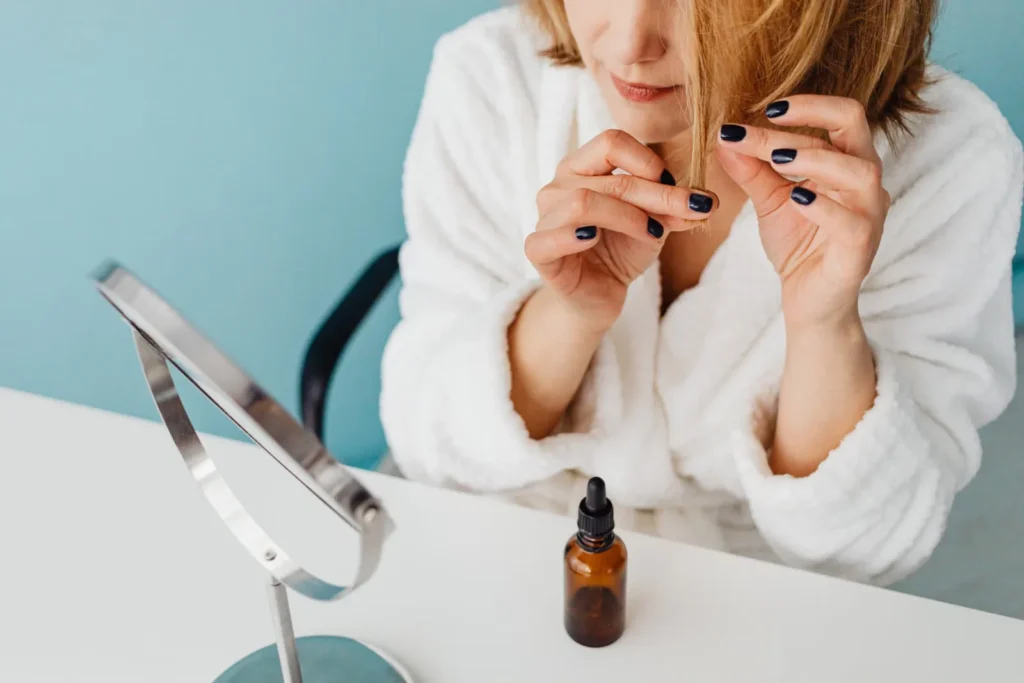
Does rosemary oil really regrow hair? What the 2015 trial found
Almost every rosemary reel traces back to one paper: a randomised comparative trial by Panahi and colleagues, published in the journal Skinmed in 2015. According to its PubMed abstract, the researchers took 100 people with androgenetic alopecia (the common, inherited pattern hair loss) and split them into two groups of 50. One group used rosemary oil and the other used 2% minoxidil, the standard over-the-counter treatment, for six months.
Hair counts were measured from standardised microphotographs at the start, at three months and at six months. At three months, neither group showed a significant change. By six months, both groups had a significant increase in hair count compared with the start, and the difference between the two groups was not significant at either point. The authors concluded that rosemary oil is an effective treatment for androgenetic alopecia.
It is a real, peer-reviewed result. It is also one small, short study.
Is rosemary oil better than minoxidil?
No study has shown it is better. The 2015 trial found the two were similar, which is not the same thing, and the design leaves several gaps.
- No placebo group. The trial compared rosemary with minoxidil only. Without an untreated or dummy-oil group, it is hard to say how much of the gain came from the oils themselves. A September 2026 explainer by Acibadem, a hospital group, notes the study lacked a placebo arm and has never been replicated.
- A weaker comparator. The same explainer points out that the trial used the weaker of minoxidil’s two common over-the-counter strengths.
- Short and narrow. Six months is short for hair, and the study covered only pattern hair loss. Gains appeared only at the six-month mark, and long-term effects are unknown.
- Not the bottle on your shelf. Acibadem notes the rosemary oil used was a prepared formulation used under medical supervision, not neat essential oil.
Minoxidil, by contrast, has decades of trial data. Dr Hadley King, a New York dermatologist quoted by Harper’s Bazaar India, called minoxidil “the most proven OTC option” that “works for both men and women”.

What do dermatologists and reviews say about rosemary oil?
The expert view is cautious. Dr Sharon Wong, a consultant dermatologist and president of the Institute of Trichologists in London, told Patient.info that the comparison study has “several flaws” and that “there is currently no data that can confirm if rosemary oil works on any other forms of hair loss”. Patient.info, in a version updated on 7 October 2026, concludes there is no solid evidence that rosemary oil definitely works or should replace standard treatments.
Dr Ryan Turner, a New York dermatologist, told PureWow that the hair gains in the 2015 study were “very minimal—we’re talking a few hairs”, adding: “We need more research to discover if rosemary oil [and other] botanical-based products can really regrow hair.”
A review of herbal hair-loss remedies in Skin Appendage Disorders, published online in January 2025, describes rosemary oil as a potential natural alternative, comparable to minoxidil in that one trial. It also flags that the supporting animal work was done in mice over just five weeks, and says “further well-designed randomized trials with larger sample sizes are required” to confirm the efficacy of herbal remedies.
A similar pattern runs through newer actives such as PDRN serums: a plausible mechanism and early data, followed by marketing that runs ahead of the evidence.
Can rosemary oil cause side effects?
Yes, for some people. In the 2015 trial itself, scalp itching increased in both groups, though it was more frequent with minoxidil. Dry hair, greasy hair and dandruff did not change significantly.
Rosemary essential oil is concentrated. Patient.info, peer-reviewed by a GP, says some people may be allergic to it and that those with sensitive skin may get irritation or rashes. It advises against applying essential oil directly to the scalp, recommends diluting it in a carrier oil and doing a patch test first, and says people who are pregnant or breastfeeding should not use it unless a doctor advises otherwise. Onmanorama, citing dermatologists, adds that poorly diluted oil can irritate the skin and that anyone on blood-thinning medicines should check with a doctor first.
There is also a bigger point. Rosemary oil has only been tested in pattern hair loss, and Dr Wong notes there is no data for other forms. Hair fall can have several different causes, so persistent shedding is a reason to see a dermatologist rather than switch oils.

Why did rosemary oil go viral, and why does it matter in India?
Rosemary oil became a social media staple through hair-care videos on TikTok and Instagram. In March 2024, the US site PureWow headlined an explainer with the claim that rosemary oil had 1.3 billion views on #Hairtok. The pitch is easy to share: a kitchen herb said to match a pharmacy drug, backed by a real study.
In India, the trend landed on a market that already treats hair oiling as routine. Big brands moved in. In December 2023, Dabur launched Vatika Rosemary Hair Growth Oil with hibiscus and coconut oil, priced at ₹550 for 200 ml; the company said it was co-created with dermatologists. In September 2026, Brillare launched single-dose Rosemary Oil Shots with 20 per cent rosemary oil, and the brand claims that “7 out of 10 users saw visible hair growth in four weeks”. The coverage did not give the size or method of that test.
The money is real too. Marico’s value-added hair oils grew 21 per cent in the July–September quarter, and Myntra’s Gen Z beauty report shows young buyers are quick to try new, ingredient-led products. For readers aged 18 to 40 dealing with early thinning, the risk is spending months on a product whose label promises more than the science does, while a treatable cause goes unchecked.
Key numbers and what to watch
- 100 people in the 2015 rosemary-versus-minoxidil trial, 50 per group
- 6 months: when hair counts rose in both groups; no significant change at 3 months
- 2%: the minoxidil strength used as the comparator
- 0 placebo groups in that trial
- ₹550: launch price of Dabur Vatika’s 200 ml rosemary oil (December 2023)
- 20 per cent: rosemary oil in Brillare’s Rosemary Oil Shots, per the brand
What to watch: a larger, placebo-controlled trial is the missing piece, and none has yet been widely reported. Watch also brand claims: “hair growth” labels and percentage results from in-house tests deserve the same scrutiny as the 2015 study.
Frequently asked questions
Does rosemary oil really regrow hair?
One 2015 trial of 100 people with pattern hair loss found hair counts rose after six months of use. Dermatologists say the evidence is too thin to call it proven.
Is rosemary oil better than minoxidil?
No study shows that. The 2015 trial found the two were similar against 2% minoxidil, with no placebo group, and the result has not been replicated.
Can rosemary oil cause side effects?
Yes. It can cause allergy, itching or irritation, especially undiluted. Patient.info advises a patch test and diluting it in a carrier oil.
How long does rosemary oil take to show results?
In the 2015 trial, there was no significant change at three months; gains appeared only at six months.
Sources
- PubMed (Skinmed): Rosemary oil vs minoxidil 2% for the treatment of androgenetic alopecia: a randomized comparative trial (2015-01-01)
- Skin Appendage Disorders (Karger): Herbal Remedies for Hair Loss: A Review of Efficacy and Safety (2025-01-20)
- Patient.info: Does rosemary oil actually help hair grow? (2026-10-07)
- Acibadem International: Rosemary Oil vs Minoxidil: The Study Everyone Cites, Read Carefully (2026-09-23)
- PureWow: Rosemary Oil Has 1.3 Billion Views on #Hairtok. But Is It Really Effective? A Dermatologist Explains (2024-03-22)
- Harper's Bazaar India: Does rosemary oil help with hair growth? Here's what experts say (2023-06-13)
- Onmanorama: Is rosemary oil making your hair fall out? Possible reasons explained (2025-03-27)
- Dabur India: Dabur Vatika launches Rosemary Hair Growth Oil with Hibiscus and Coconut Oil (2023-12-05)
- Onmanorama: Brillare Rosemary Oil Shots bring a concentrated 20% Rosemary approach to haircare (2026-09-22)
You May Like This




Advertisement


You May Like This




Advertisement


Advertisement


Advertisement