Four juries looked at the same year of Indian cinema. They named three different Best Films.
Nobody asked the people who bought the tickets.
The disagreement, laid out
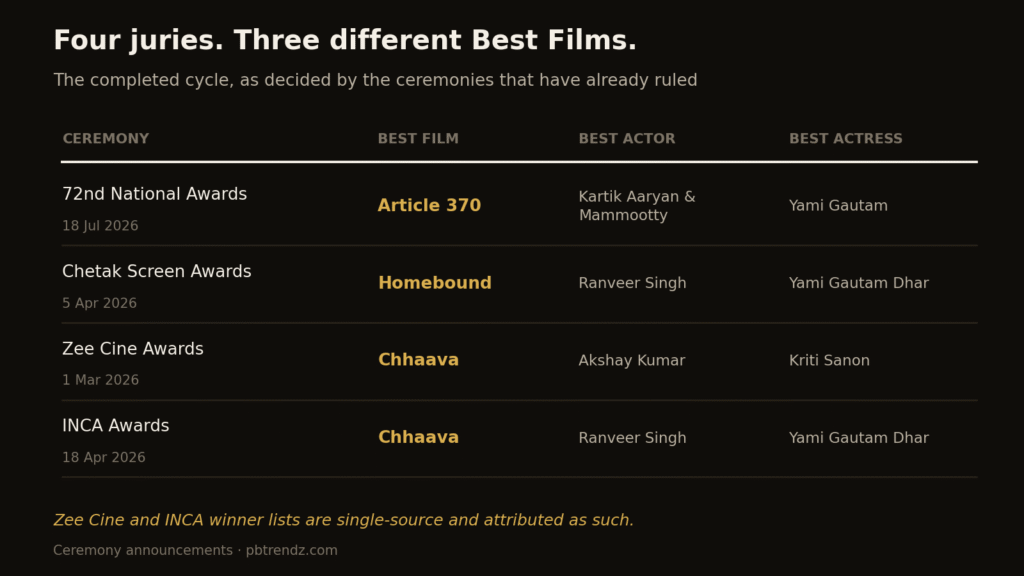
Four separate juried ceremonies have already ruled on the most recent completed cycle of Indian film. Here is what they decided.
72nd National Film Awards, announced 18 July 2026. Best Film: Article 370. Best Actor: Kartik Aaryan and Mammootty, shared. Best Actress: Yami Gautam.
Chetak Screen Awards, 5 April 2026. Best Film: Homebound. Best Actor: Ranveer Singh for Dhurandhar. Best Actress: Yami Gautam Dhar for Haq.
Zee Cine Awards, 1 March 2026. Best Film: Chhaava. Best Actor: Akshay Kumar for Kesari Chapter 2. Best Actress: Kriti Sanon for Tere Ishk Mein.
INCA Awards, 18 April 2026. Best Film: Chhaava. Best Actor: Ranveer Singh for Dhurandhar. Best Actress: Yami Gautam Dhar for Haq.
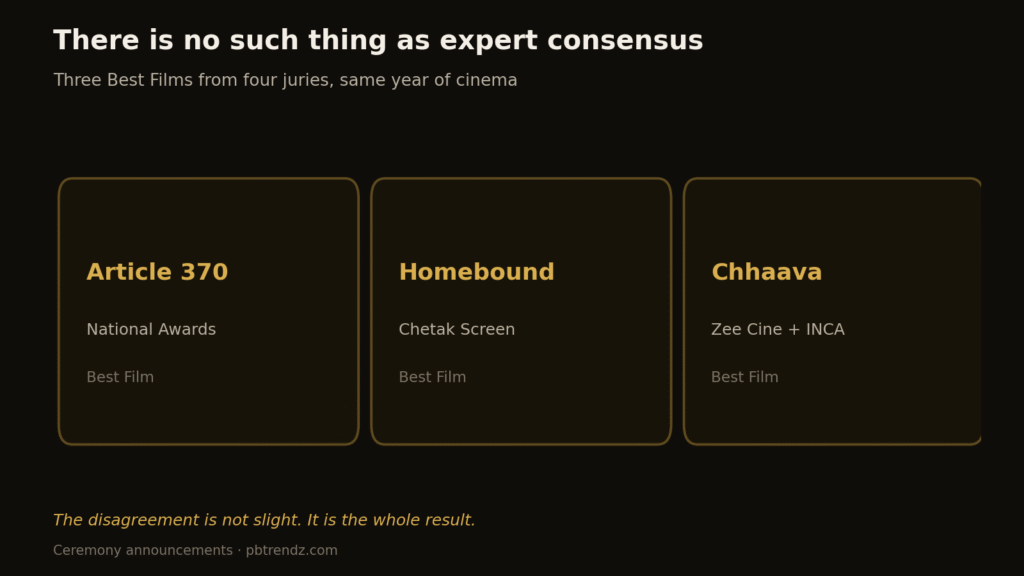
Three different Best Films. Three different Best Actors. Same year, same films, four rooms full of experts.
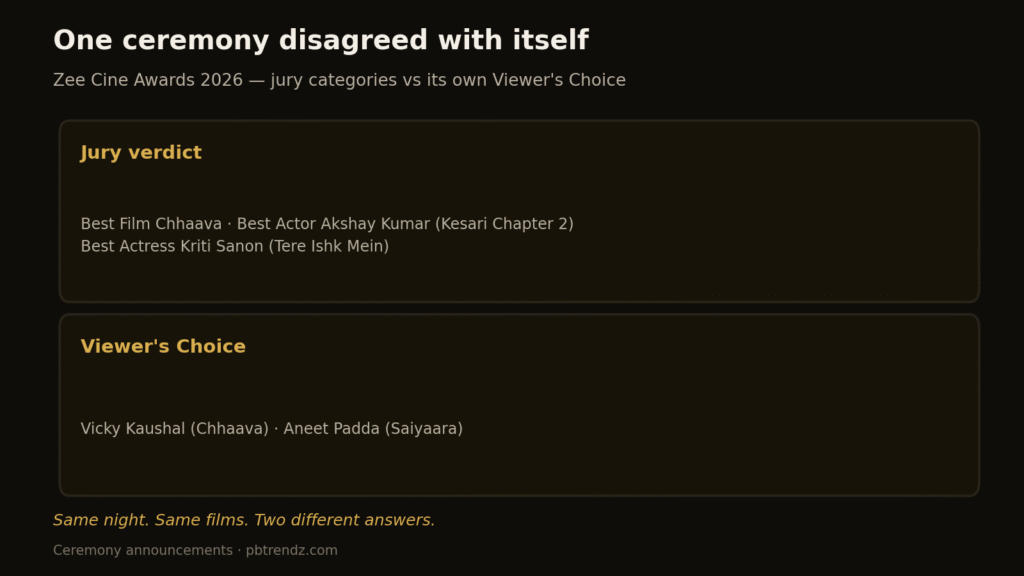
And the sharpest detail is inside a single ceremony. Zee Cine ran a separate Viewer’s Choice category alongside its jury awards — and it produced different winners from its own jury. Vicky Kaushal for Chhaava. Aneet Padda for Saiyaara. One night, one set of films, two verdicts, from the same organisation.
That is the whole thesis, delivered by an awards show that did not intend to make the argument.
What this does and does not prove
It does not prove the juries were wrong. Four thoughtful groups can weigh the same year differently and all be defensible. Article 370, Homebound and Chhaava are not obviously comparable films and there is no arithmetic that settles between them.
What it does prove is narrower and more useful: there is no such thing as expert consensus here. When an award is described as the verdict of people who know, this is what that verdict looks like in practice — a spread, not a point. The confidence in the phrasing is not matched by agreement in the results.
Once you accept that, the question changes. It stops being “which method finds the right answer” and becomes “which method is honest about what it is measuring.” A jury measures the opinion of that jury. It just isn’t usually described that way.
The performance the country could not agree on
Ranveer Singh in Dhurandhar 2 was the most-discussed performance of the year and the most divided. Early reviews called it career-best work, breathing fire. Gulf News’s full review called it overly heroic and hyper-masculine. The film sits at 35 per cent on Rotten Tomatoes while being the second-highest-grossing Indian film ever made.
Critics and ticket-buyers were not looking at the same object.
The cleanest split of the year, though, is critic against critic. On Rani Mukerji in Mardaani 3, NDTV’s Saibal Chatterjee wrote of “a power-packed, unblemished star turn that should rank among the finest of her 30-year acting career.” In the Indian Express, Shubhra Gupta wrote that she “can’t do much with the degree of over-writing.”
Same performance. Same week. Two of the most respected critics in the country.
Even the numbers are contested
You might expect the box office at least to be objective. It isn’t.
Main Vaapas Aaunga is a sleeper hit according to Sacnilk and a losing proposition according to Koimoi. Mardaani 3 is a success to Pinkvilla and a losing affair to Koimoi. On India net collections for the same films, Koimoi runs systematically ₹8–33 crore above Sacnilk, and neither publishes its methodology.
We are saying this against our own interest, because we quote those trackers too, and we will keep quoting them — while naming which one, every time. There is no unimpeachable number in Indian entertainment. There are sources with different methods, and the honest thing is to say so rather than to launder an estimate into a fact.
What IFTA does differently
Not a better jury. No jury.
India suggests the nominees. Every name is verified against independent third-party sources. India votes, one OTP-verified vote per person per category. And then — the part that matters most — the vote counts are published alongside the winners.
From IFTA 2022: Shershaah won Most Popular Bollywood Film on 5,201 votes. Sidharth Malhotra took Lead Actor on 3,744. Rohit Shetty took Director on 1,760. Mayank Arora, a supporting actor in a daily soap, drew 3,969 — more than twice the director’s count.
You may disagree with every one of those outcomes. You cannot claim not to know how they were reached. Nobody else in Indian awards shows their arithmetic, and the reason for that is not technical.
The year is still open
Several major ceremonies have not yet ruled on this cycle — the 71st Filmfare Awards, IIFA, the Dadasaheb Phalke announcement. None of them has a confirmed date we can verify, so we are not going to state one.
Which means the argument is still live. Four juries have spoken and disagreed with each other. The rest have not spoken at all. And the only group nobody has consulted is the one that paid for all of it.
IFTA 2026 voting opens on 30 August. Nominations are open right now — comment on the nomination post for your category at @ifta.official on Instagram. Forty-nine categories across Bollywood, OTT, Television and Music. No jury, no award fixing — just India voting.
Award results as announced by the respective ceremonies; Zee Cine Awards 2026 and INCA Awards 2026 winner lists are single-source and attributed as such. Box-office comparisons drawn from Koimoi, Sacnilk and Pinkvilla, which disagree.