

Advertisement
- Updated on August 23, 2026
- IST 11:58 pm
The award show cuts to a commercial before the dialogue award. The cinematographer’s name goes past in six-point type, somewhere between the caterer and the colourist.
IFTA puts screenplay, dialogue, action design and choreography on the same public ballot as Lead Actor. That is easy to claim and harder to earn, so this is the article that does the work: the year’s best craft, named, with the evidence attached — including the places where the evidence is thin, and one place where it does not exist at all.
Screenplay
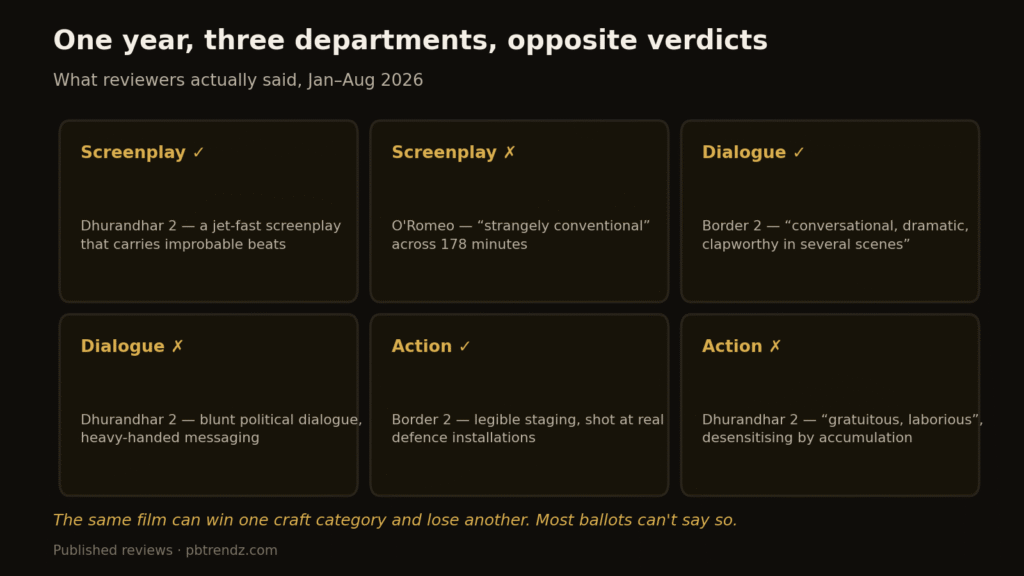
The most-praised screenplay of the half belongs to Dhurandhar 2: The Revenge, and the praise is specific: reviewers repeatedly described a jet-fast screenplay that carries improbable plot beats by refusing to let the audience stop and inspect them. That is a real craft achievement and a slightly disreputable one, which is what makes it interesting.
The counter-case is O’Romeo. Across a large and mostly unfavourable set of reviews, the screenplay was the near-universal complaint — “strangely conventional,” in The Hollywood Reporter India’s phrase, across 178 minutes. When the box-office post-mortems were written, the script was the reason cited. A Vishal Bhardwaj film with Shahid Kapoor recovering 64 per cent of a ₹130 crore budget is not a marketing failure. It is a writing one.
Two films, opposite verdicts, same department. That is what a screenplay category is supposed to be able to distinguish between, and almost none of them do.
Dialogue
Border 2 drew the year’s warmest dialogue notices — Bollywood Hungama called the writing “conversational, dramatic and also clapworthy in several scenes,” which is a fair description of what a war film’s dialogue has to do: sound like people, then land like a speech.
The counter-case is again Dhurandhar 2, whose dialogue was criticised as blunt and its messaging heavy-handed — by some of the same reviewers who admired its screenplay. Structure and speech are different crafts and can come apart inside one film. Very few ballots let you say so.
Cinematography
Three names from the half.
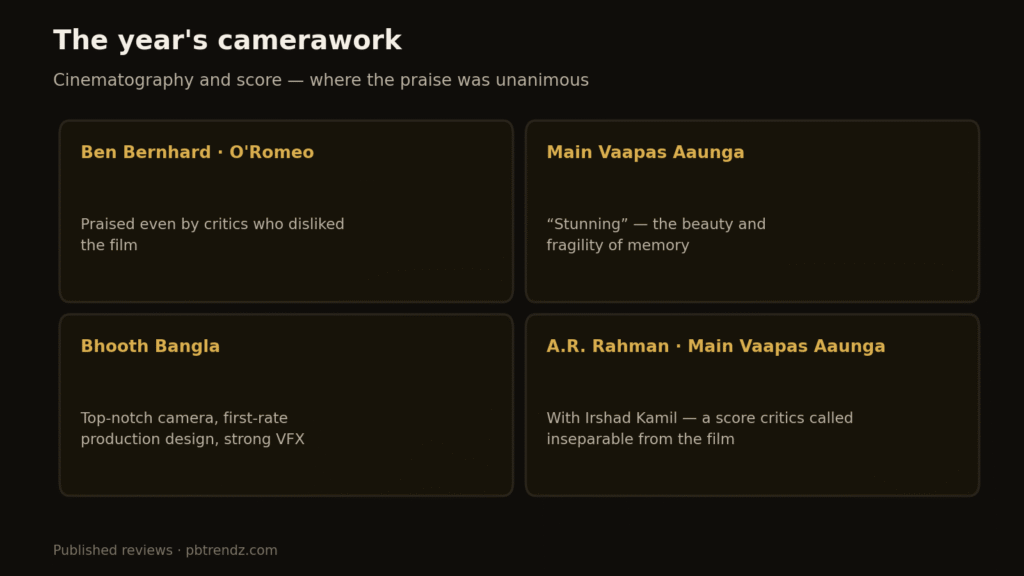
Ben Bernhard’s work on O’Romeo was praised even by critics who disliked the film — the most reliable signal there is in film criticism, because nobody hands out a compliment they don’t have to.
Main Vaapas Aaunga was described as stunning, with the camera credited for capturing “the beauty and fragility of memory.” For a film that opened at ₹1.15 crore and then grew every week, the look of it was doing real persuasive work.
Bhooth Bangla drew notices for top-notch camerawork, first-rate production design and genuinely impressive VFX — a horror-comedy that was technically better made than its genre usually bothers to be.
Action design
Border 2‘s action was praised for engaging viewers without confusing them, which sounds like faint praise until you have sat through a modern action sequence and been unable to tell who is winning. It was shot partly at real defence installations, including INS Vikrant. The same reviews called the naval VFX sub-par — so the staging was strong and the finishing was not, and those are two different departments taking two different verdicts.
Dhurandhar 2‘s action went the other way: described as gratuitous and laborious, desensitising by accumulation, in a film most reviewers wanted thirty-plus minutes cut from. It is the second-highest-grossing Indian film of all time. Scale and craft are not the same measurement.
Music and score, as a craft rather than a chart
A.R. Rahman with lyricist Irshad Kamil on Main Vaapas Aaunga produced the half’s clearest example of a score that is inseparable from its film — not songs placed in a film, but music the film cannot be described without. Reviewers named it among the picture’s greatest strengths, and it is difficult to explain that film’s extraordinary week-two-beats-week-one curve without it.
Choreography — and the gap that proves the point
Here is where this article has to be honest.
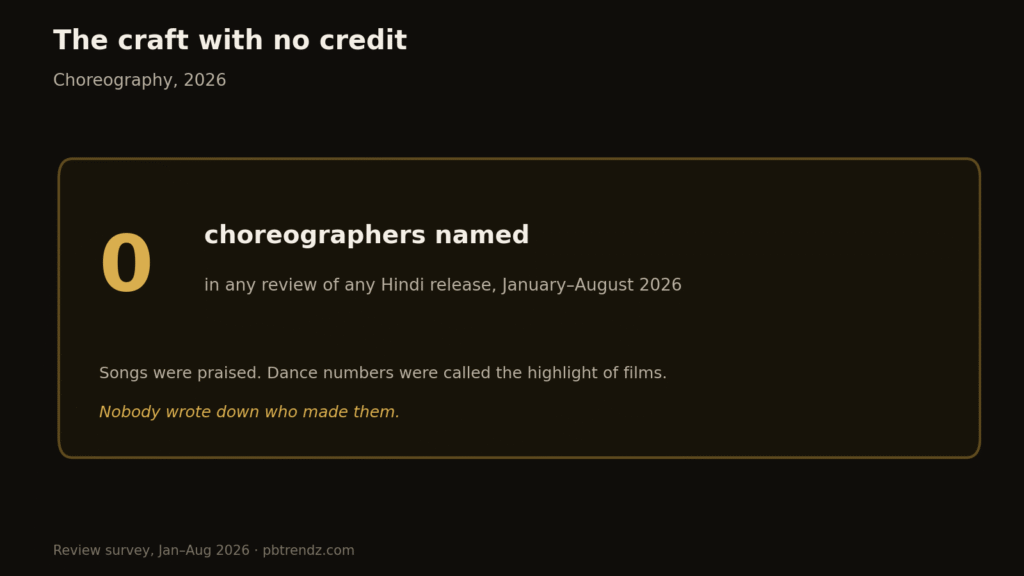
Across every review of every Hindi release between January and August 2026 that we could find, no choreographer was named. Not once. Songs were praised. Dance numbers were called the highlight of films. Nobody wrote down who made them.
The only sourceable choreography credit in the current award cycle is Vijay Ganguly’s win at the Chetak Screen Awards in April, for “Shararat” — a 2025-cycle honour.
We could have filled the gap with a plausible name. We would rather report the gap, because the gap is the entire argument of this article. An entire craft, responsible for some of the most-watched thirty-second stretches of Indian cinema, went a year without a single named credit in the coverage. That is not an oversight by any one publication. It is a structural blind spot, and it is exactly why the category belongs in front of an audience rather than a jury — audiences remember the dance. Reviewers, apparently, do not remember who made it.
What the award cycle already decided
For reference, the craft record from the ceremonies that have already ruled on the previous cycle.
Chetak Screen Awards 2026, held 5 April, where Dhurandhar took fourteen trophies: Cinematography, Vikash Nowlakha. Action, Aejaz Gulab and team. Choreography, Vijay Ganguly for “Shararat.” Dialogue, Aditya Dhar. Story and Screenplay, Basharat Peer, Neeraj Ghaywan and Sumit Roy for Homebound. Editing, Shivkumar V. Panicker. Sound Design, Bishwadeep Chatterjee. Production Design, Saini S. Johray. Background Score, Shashwat Sachdev. Hair and Make-up, Preetisheel Singh D’souza. VFX, Envision. Costume, a tie between Smriti Chauhan and Sheetal Iqbal Sharma. Lyrics, Gulzar.
The 72nd National Film Awards, announced 18 July: Cinematography, Shehnad Jalal for Bramayugam. Editing, R. Kalaivannan for Amaran. Sound Design, Manas Choudhary. Action Direction, Anl Arasu for Maharaja. Production Design, Nitin Zihani Choudhary for Kalki 2898 AD.
Read those two lists together and notice how little they overlap. Two sets of experts, one year of cinema, almost no shared conclusions.
Why these categories are on a public ballot
The standard objection writes itself: audiences cannot judge cinematography, they do not know what an editor does, craft belongs to the professionals.
Except audiences do notice. They notice when a film looks beautiful, when a fight is legible, when a line gets a whistle in a single screen, when a song makes a hall move. They just are not usually asked, and when they are not asked, these awards get decided in rooms by people with working relationships with the nominees.
IFTA asks. Screenplay, dialogue, action design and choreography sit on the same ballot as Lead Actor, with the vote counts published next to the winners.
Nominations for IFTA 2026 are open now. If a piece of craft stayed with you this year, name it — comment on the nomination post for that category at @ifta.official on Instagram. Voting opens 30 August.
Critical assessments summarised from published reviews in The Hollywood Reporter India, Bollywood Hungama, NDTV and others. Award winners as announced by the respective ceremonies.
You May Like This
1


Advertisement
You May Like This








Advertisement
Advertisement
Advertisement