

Advertisement
- Updated on August 23, 2026
- IST 11:57 pm
On 27 January, India’s most-streamed singer said he would take no more playback assignments. By August, the five biggest songs in the country were not from any film at all.
Both facts point the same way, and neither of them is on most awards ballots.
The retirement that held
Arijit Singh’s statement was not ambiguous: “I am not going to take any new assignments as a playback vocalist from now on.” He would finish what he had already committed to, releases would continue through 2026, and he would go on making music — just not for films.
The scale of what he was stepping away from is hard to overstate. Forbes cites 171 million Spotify followers, 50.7 million monthly listeners, a most-streamed track above 633 million plays, and a global Spotify ranking of ninth in December 2025. Vishal Bhardwaj publicly criticised the decision, having recorded three Arijit tracks for O’Romeo before the announcement.
Then came July, and a small masterclass in how music news gets reported.
On 21 July he released “Yeh Awarapan,” the title track of Awarapan 2. Outlets ran “Arijit Singh returns to playback” headlines. His team corrected them the following day: “He is just completing the projects that were finalised before the retirement was announced. Arijit isn’t doing a comeback in playback singing. These are old commitments.”
The retirement stands. And the song went to number 100 on Spotify India and was the number one trending video in the country on 7 August. A nation that has been told he is finished is streaming him harder than ever.
Which makes 2026 a last-call year. Whatever is on this year’s ballot in the male playback category is, in a real sense, the end of something.
The charts moved without asking Bollywood
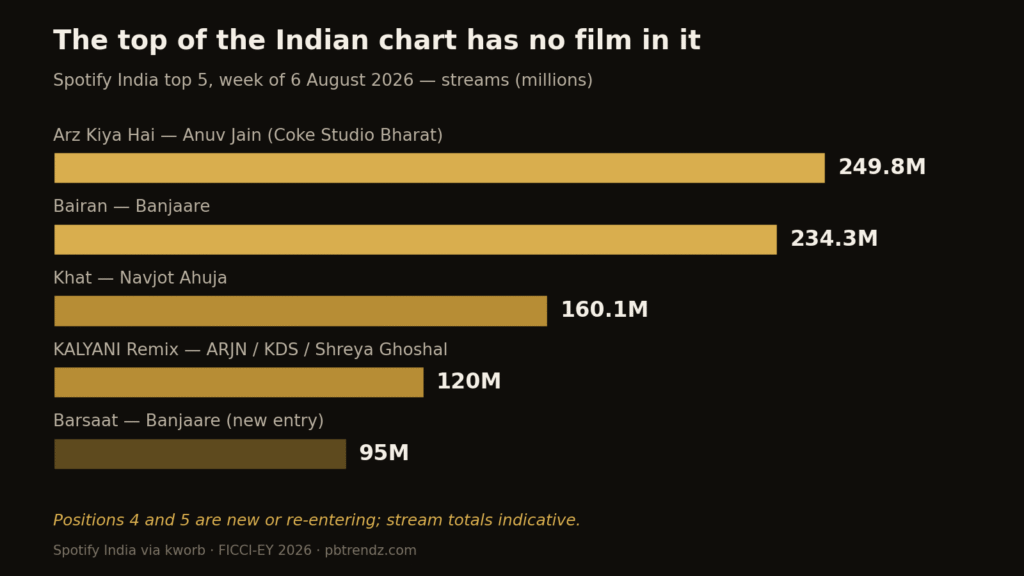
Look at the top five on Spotify India for the week of 6 August 2026.
“Arz Kiya Hai” by Anuv Jain, from Coke Studio Bharat — 249.8 million streams. “Bairan” by Banjaare — 234.3 million. “Khat” by Navjot Ahuja — 160.1 million. “KALYANI Remix” by ARJN, KDS and FIFTY4 with Shreya Ghoshal. “Barsaat,” a new entry, also Banjaare.
Not one of them is from a film.
“Arz Kiya Hai” is the first Coke Studio Bharat track ever to reach number one in India, which it did in July. “Khat” held number one on Spotify’s Global Viral 50 for 30 consecutive days — reported by ANI as the longest such run by an Indian artist, though that specific record claim comes from a single source.
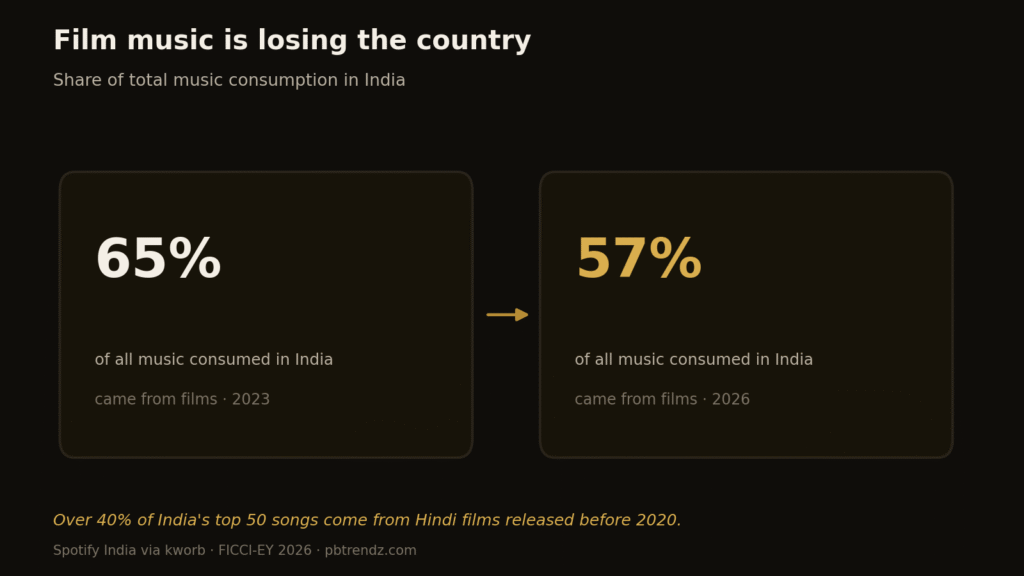
The structural number behind all of this is in the FICCI-EY 2026 report: film music has fallen to 57 per cent of all music consumed in India, down from 65 per cent in 2023. Hindi has fallen to 59 per cent of listening from 64 per cent. And over 40 per cent of India’s top 50 songs came from Hindi films released before 2020.
Read that last one again. The single largest bloc on the chart is not new film music. It is old film music.
One more, from the 2025 data, because it reframes everything: streams of the Hanuman Chalisa were 1.5 times those of the year’s biggest film hit, the Saiyaara title track — with a 35 per cent spike every Tuesday. India’s actual listening habits are considerably stranger and more devotional than any awards ballot has ever acknowledged.
What film music did do
None of which means film songs stopped mattering. They just stopped owning the top.
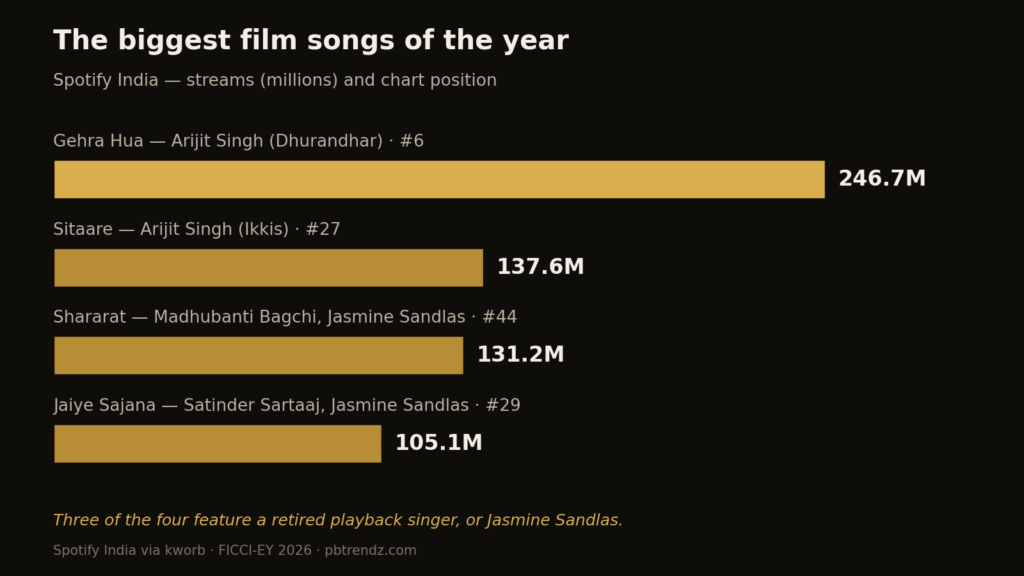
“Gehra Hua,” sung by Arijit Singh and composed by Shashwat Sachdev for Dhurandhar, sits at number six with 246.7 million streams — the biggest romantic film song on Indian charts in 2026. “Sitaare,” again Arijit, from Ikkis, is at 27 with 137.6 million, making it the biggest song from a film actually released this year. “Jaiye Sajana” by Satinder Sartaaj and Jasmine Sandlas from Dhurandhar: The Revenge is at 29 with 105.1 million. “Shararat,” by Madhubanti Bagchi and Jasmine Sandlas, is at 44 with 131.2 million and is the year’s biggest film dance track.
Jasmine Sandlas is on that list twice, and on several more besides — “LAAVAN,” “Aari Aari,” “Main Aur Tu,” “Jithe Mera Ghar.” No female voice has been more ubiquitous in Indian music this year, and she has not been the headline artist on any of them.
As albums: Dhurandhar: The Revenge, scored by Shashwat Sachdev, charted in Canada, Ireland, New Zealand and the UK and appeared on Billboard’s Soundtracks and World Albums charts. Cocktail 2, by Pritam with Amitabh Bhattacharya, put three songs into the Spotify India top 100 simultaneously — the best multi-track showing of any Hindi album this year, from a film that underperformed.
The argument the industry had out loud
Border 2‘s soundtrack was built largely on recreations of the 1997 original. Javed Akhtar refused to participate, calling recreations “intellectual and creative bankruptcy.” Sonu Nigam contributed the one new song and defended the approach.
Both positions are defensible and the disagreement is real. It is also not the kind of question a jury of industry professionals is well placed to settle, given that most of them have a commercial position on it.
And the part of music nobody awards at all
Live music is now the fastest-growing segment of Indian media and entertainment: up 44 per cent in 2025 to ₹145 billion, per the FICCI-EY 2026 report. Some 5.6 lakh Indians travelled between cities to attend concerts. Coldplay’s Ahmedabad run alone generated an estimated ₹641 crore in economic impact across 222,000-plus attendees.
That is a larger cultural event than most of what gets a trophy, and there is essentially no award for it.
Seven categories, and an honest problem
IFTA’s music section runs to seven categories. A music award that looks only at Bollywood playback is now measuring 57 per cent of what India listens to and shrinking — and the fastest-moving part of the market is happening on independent labels, in Coke Studio sessions, and in stadiums.
We would rather say that out loud than pretend otherwise. A public vote is the only mechanism that can register a shift like this in real time, because voters do not consult a category definition before deciding what they had on repeat.
IFTA 2026 nominations are open. Tell us what actually soundtracked your year — comment on the nomination post for the music categories at @ifta.official on Instagram. Voting opens 30 August.
Chart positions via Spotify India weekly charts as tracked by kworb and Soundcharts, week of 6 August 2026. Consumption-share and live-music figures from the FICCI-EY India M&E report 2026.
You May Like This
1



Advertisement
You May Like This








Advertisement
Advertisement
Advertisement