India’s newest kind of home internet, 5G fixed wireless access, has quietly gone rural. TRAI’s September data shows 13.61 million 5G FWA connections, and 51.89 per cent of them are outside cities. The service has doubled in about eighteen months, but the monthly additions are now slowing.
What the September data shows
The Telecom Regulatory Authority of India’s subscription data for September 2026, published at the end of October, puts India’s 5G fixed wireless access (FWA) base at 13.61 million, up from 13.45 million in August. Reliance Jio accounts for 9.52 million of these connections and Bharti Airtel for 4.09 million.
The split is the surprise. According to MediaNama’s reading of the TRAI data, 7.06 million 5G FWA connections, or 51.89 per cent, are rural, and 6.54 million, or 48.11 per cent, are urban. Rural users first edged ahead in July, when they made up 50.31 per cent of the base, BW Businessworld reported.
Only Jio and Airtel report 5G FWA connections; their figures add up to the full 13.61 million. Jio dominates by size, holding about seven of every ten connections, but Airtel has been growing faster. In July, Airtel’s 5G FWA base grew 3.06 per cent in the month against Jio’s 1.71 per cent, according to BW Businessworld’s analysis of TRAI data. Vodafone Idea and BSNL, with 131 million and 28.55 million broadband connections respectively, have no presence in the category.
FWA means home broadband delivered over the air: a 5G receiver is fixed at the house and turns the mobile signal into a Wi-Fi connection. There is no fibre cable to lay to each home.
Why villages are taking to it
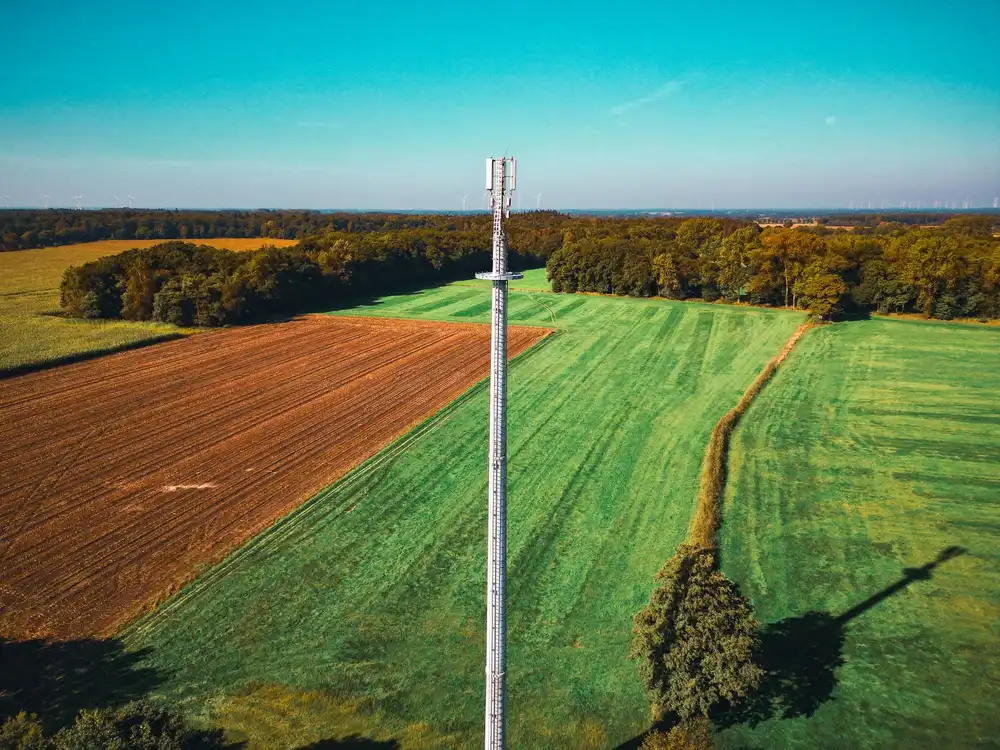
That last point explains much of the rural lead. Laying fibre to scattered homes is slow and expensive. Where a 5G tower already exists, an operator can connect a household without digging a single trench.
The growth has been fast. TRAI’s annual performance report for 2025-26 shows 5G FWA subscribers rose from 6.77 million at the end of March 2025 to 12.32 million at the end of March 2026, an increase of about 82 per cent. By September the base had roughly doubled from the March 2025 level.
Jio also runs a separate fixed wireless service on unlicensed-band radio (UBR), which grew from 5.37 million to 5.58 million connections in September. Counting both technologies, India now has about 19 million fixed wireless broadband connections.
Fibre is growing too
FWA is not replacing wired broadband; both are expanding. TRAI counted 48.89 million fixed wired broadband connections in September. Its annual report shows wireline subscribers rose 30.25 per cent in 2025-26, from 37.04 million to 48.25 million, with 11.21 million connections added in the year.
Within that market, the state-owned BSNL is losing ground. Its share of wireline subscribers fell from 20.74 per cent to 15.46 per cent over 2025-26, while Jio held 31.58 per cent and Airtel 23.67 per cent at the end of March 2026.
Home broadband is still small next to mobile data. India had 1,107.68 million broadband connections in September, and 1.039 billion of them were on mobile. Wired and fixed wireless together are well under a tenth of the total.
The wider market is just as concentrated. Jio and Airtel together held 83.96 per cent of all broadband connections in September, with 541.17 million and 388.86 million respectively. India’s total telephone connections reached 1,367.93 million, taking overall teledensity to 95.52 per cent.
The slowdown inside the growth
The monthly pace is easing. In July the 5G FWA base grew by 272,820 connections. In September it grew by about 152,000, or 1.13 per cent. That is still growth, but at a little over half the July rate.
TRAI’s data does not say why. A likely factor is that the early adopters, households already looking for a home connection, have signed up first. Mobile, meanwhile, is still growing on a much larger base: Jio added 2.713 million mobile subscribers and Airtel 2.692 million in September, according to Business Standard, while Vodafone Idea and BSNL added 5,50,000 and 6,26,000 respectively.
There is a measurement caveat too. TRAI’s wireless totals include Airtel’s machine-to-machine SIMs from December 2025, so some growth in wider wireless figures reflects reclassification rather than new people. The 5G FWA numbers are reported separately and are not affected in the same way.
What to watch
TRAI’s October data will show whether the September slowdown was a blip or a trend. The rural share is worth tracking too: if it keeps rising, FWA is becoming India’s main route for bringing home broadband to villages, and the speed and price at which operators expand 5G towers in rural districts will matter more than the fibre rollout for those households.