

Advertisement
- Updated on May 11, 2026
- IST 10:14 am
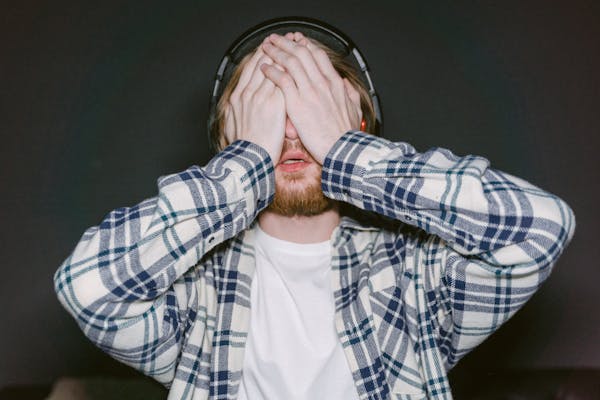
Imagine this: It’s a humid March evening in Bengaluru. 22-year-old Aarav, a software engineer buried under back-to-back deadlines, doom-scrolls through his feed one last time before bed. His anxiety is through the roof—another panic attack lurking just around the corner. He’s tried apps, therapy sessions, even those 5-minute meditations that never stick. Then a friend drags him to something called “Sitar for Mental Health.” “Bro, it’s just a guy with a sitar,” Aarav thinks. “How is this going to fix my burnout?”
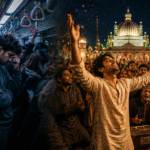
Fast-forward three hours. Aarav is sitting in a packed arena, eyes closed, as the first notes of Rishab Rikhiram Sharma’s sitar ripple through the air like a gentle wave washing over a chaotic shore. The stress melts. His breathing slows. For the first time in months, his mind feels… quiet. No phone notifications. No pressure to perform. Just pure, resonant sound. By the end of the night, he’s texting his friend: “This wasn’t a concert. It was therapy with strings.”
Now picture Priya, 35, a marketing professional from Mumbai who grew up listening to her grandmother’s old Ravi Shankar records. She always loved classical music but thought it belonged in textbooks and temple halls—definitely not in a stadium filled with Gen Z kids waving phone lights. Yet here she is, standing shoulder-to-shoulder with college students half her age, swaying to a sitar rendition that somehow blends ancient ragas with modern beats. Tears stream down her face as the final notes fade. “I never thought classical music could feel this alive,” she whispers to her husband.
So what’s the truth? How did one young sitarist turn an instrument once reserved for the most elite gharanas into India’s hottest ticket—grossing over ₹50 crore, pulling in more than 1 lakh fans across 10 cities in the 2026 “Sitar for Mental Health” India Tour? In this deep dive, we’ll unpack Rishab Rikhiram Sharma’s extraordinary journey, the ancient science of sound healing he’s reviving, the genius fusion that’s winning Gen Z hearts, real stories from the audience, and what this cultural phenomenon means for the future of Indian music. Whether you’re a die-hard classical fan, a stressed-out millennial, or a curious Gen Z’er looking for something deeper than the latest EDM drop, this story might just change how you hear music—and maybe even how you heal.
Who Is Rishab Rikhiram Sharma? The Heir to a Legendary Legacy
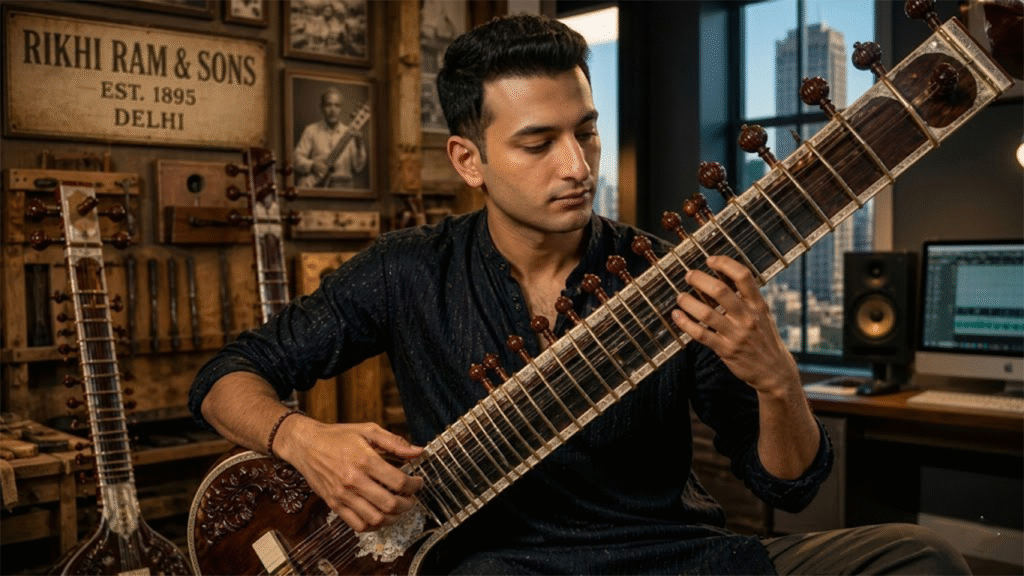
Born on September 17, 1998, in Delhi, Rishab Rikhiram Sharma didn’t just pick up a sitar—he was born into its very DNA. He belongs to the illustrious Rikhi Ram family, fourth-generation luthiers (master instrument makers) whose creations have been played by global legends for decades. His father, master craftsman Sanjay Rikhiram Sharma, became his first guru when Rishab was just 10 years old.
The turning point came in 2011 when a young Rishab’s performance caught the ear of the late sitar maestro Pandit Ravi Shankar himself. Public archival footage and family accounts show Panditji publicly introducing 13-year-old Rishab as his youngest disciple in 2012 at a special event. It was a full-circle moment: the Rikhi Ram family had built instruments for Ravi Shankar for over seven decades. Rishab became not just a student but the torchbearer of a sacred guru-shishya tradition.
At 17, Rishab moved to New York to study music production and economics. There, he soaked up jazz clubs, hip-hop beats, and the city’s electric energy—while never letting go of his classical roots. He started posting sitar covers of everything from Bollywood hits like “Tumhi Dekho Naa” to the Game of Thrones theme. They went viral. Suddenly, the sitar wasn’t just “old music”—it was cool, shareable, and emotionally raw.
But success wasn’t just about clicks. Rishab’s own battles with grief—losing a beloved family member—pushed him deeper. Music, therapy, and self-reflection became his lifeline. He realized the sitar wasn’t merely an instrument; it was a tool for healing. Thus, “Sitar for Mental Health” was born in 2021 as a movement to use Indian classical music for mindfulness, emotional balance, and open conversations around mental wellness.
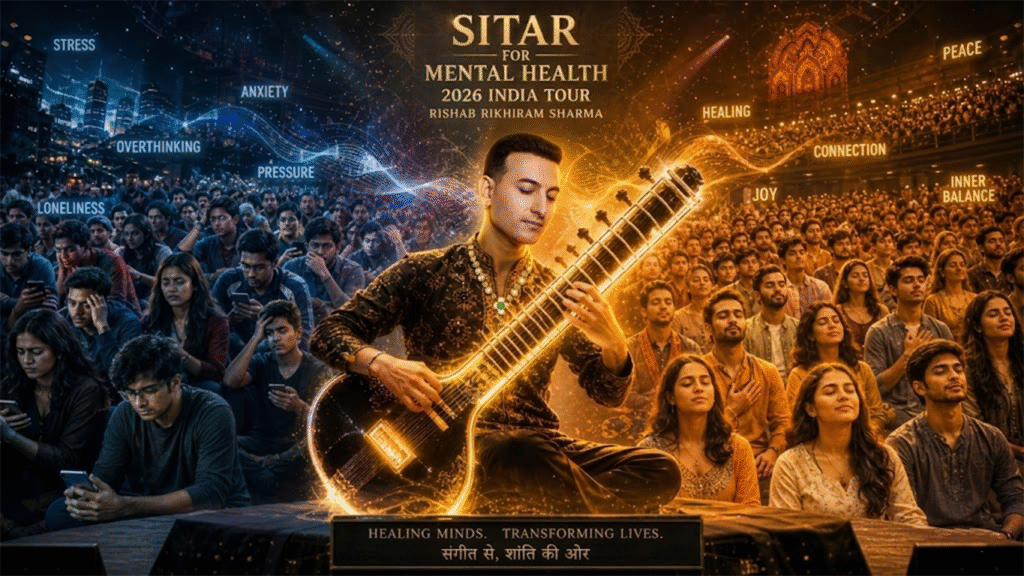
Understanding Sitar for Mental Health: Ancient Wisdom Meets Modern Wellness
At its core, “Sitar for Mental Health” isn’t a gimmick—it draws from the ancient Indian practice of Raga Chikitsa (music therapy). Vedic texts and Ayurvedic traditions have long held that specific ragas can influence emotions, balance doshas, and even support physical well-being. Certain morning ragas energize; evening ones calm the mind; others ease anxiety or lift mood.
Rishab takes this timeless knowledge and makes it accessible. His concerts aren’t passive listening sessions. They’re immersive experiences: guided breathing exercises at the start, soul-stirring ragas that wash over the audience like a sonic meditation, and thoughtfully curated neo-classical pieces that blend traditional sitar with contemporary production—think subtle lo-fi beats, electronic textures, and even trap influences on an electric sitar he helped conceptualize.
The result? A concert that feels like group therapy without the awkward couch. No lyrics demanding interpretation. Just pure sound vibrations that bypass the overthinking mind and speak directly to the soul. In a country where mental health challenges affect millions of young Indians—exacerbated by academic pressure, urban hustle, and post-pandemic anxiety—this approach hits different.
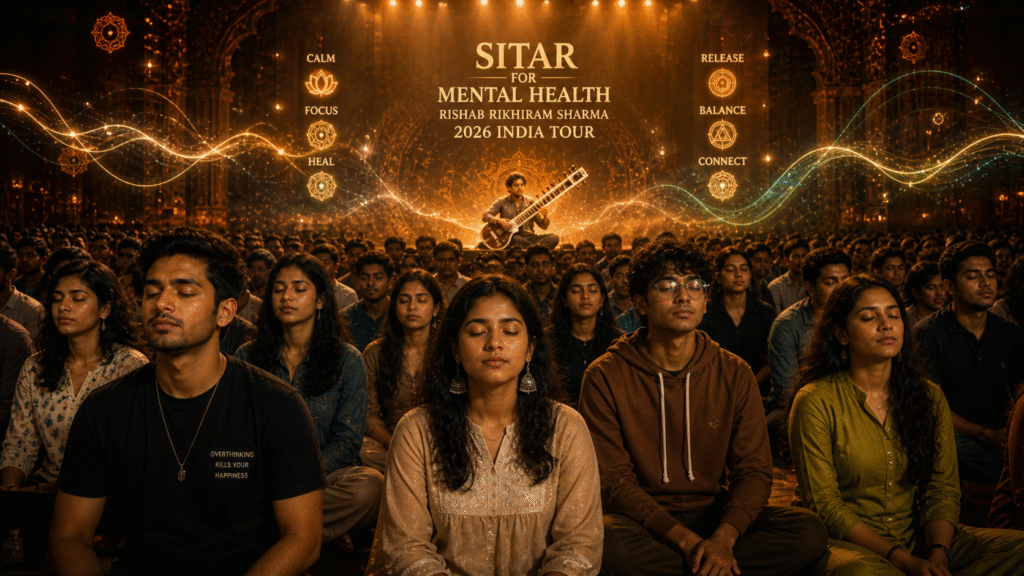
The ₹50 Crore Phenomenon: How One Tour Rewrote the Rules of Indian Concerts
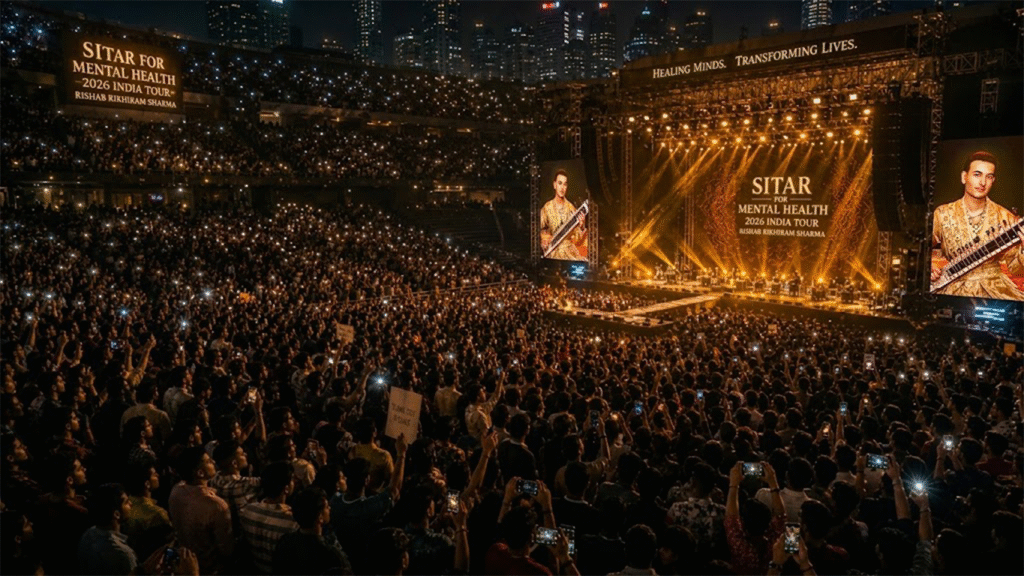
Let’s talk numbers, because they’re staggering. The 2026 “Sitar for Mental Health” India Tour spanned 10 major cities—Bengaluru (kicking off March 15), Mumbai, Pune, Hyderabad, Jaipur, Chennai, Ahmedabad, Chandigarh, Kolkata, and New Delhi—running through mid-April. Over 1 lakh fans showed up. Ticket revenue alone crossed ₹50 crore, setting a new benchmark for purpose-driven live events in India.
What made it sell out arenas that usually host Bollywood stars or international pop acts? Production value was next-level: stunning visuals, immersive lighting, costume changes, and moments of pure spectacle. Yet the heart remained the music—raw, unplugged sitar in one half, electrifying fusions in the other. Parents attended with teens. IT professionals came alone. Families bonded over shared silence.
Compare this to traditional classical concerts, which often draw intimate, older crowds in smaller halls. Rishab flipped the script. He made classical music stadium-ready without diluting its essence. Social media amplified everything—clips of him playing Tandavam, Chanakya, Shiv Kailash, or mashups of Harry Potter and Game of Thrones themes racked up millions of views. Gen Z wasn’t just attending; they were evangelising.
The Big Debate: Is This Classical Revival or Clever Commercialisation?
Not everyone is on board. Some purists argue that blending ragas with modern production dilutes the purity of Hindustani classical music. “Where’s the depth if you’re chasing virality?” a few traditional voices ask. Others point out high ticket prices and question if the wellness angle is more marketing than medicine.
Rishab’s response? He’s never claimed to replace therapy or doctors. He’s clear: this is a complementary tool—sound as a gateway to mindfulness. And the proof is in the feedback. Fans report better sleep, reduced anxiety, and renewed appreciation for their cultural roots. Medical interest in music therapy is growing globally; Raga Chikitsa studies show measurable effects on heart rate, cortisol levels, and mood.
The balanced truth? Innovation always sparks debate. Ravi Shankar himself took sitar to the West and fused it with Western genres, facing similar criticism—yet he globalised Indian classical forever. Rishab is doing the same for a new generation, proving classical music can evolve without losing its soul.
Real Stories: How the Sitar Is Changing Lives Across India
Let’s hear from the fans themselves.
Meera, 28, from Pune: “I was skeptical. But during the breathing exercise in Jaipur, something shifted. For 90 minutes, my racing thoughts stopped. I left feeling lighter than I had in years. My therapist actually recommended I keep listening to his recordings.”
Rahul, 19, Bangalore college student: “I only knew Bollywood remixes. Rishab’s sitar cover of a popular track mixed with classical improvisation blew my mind. It made me curious about ragas. Now I meditate to his music before exams. Gen Z needed this bridge.”
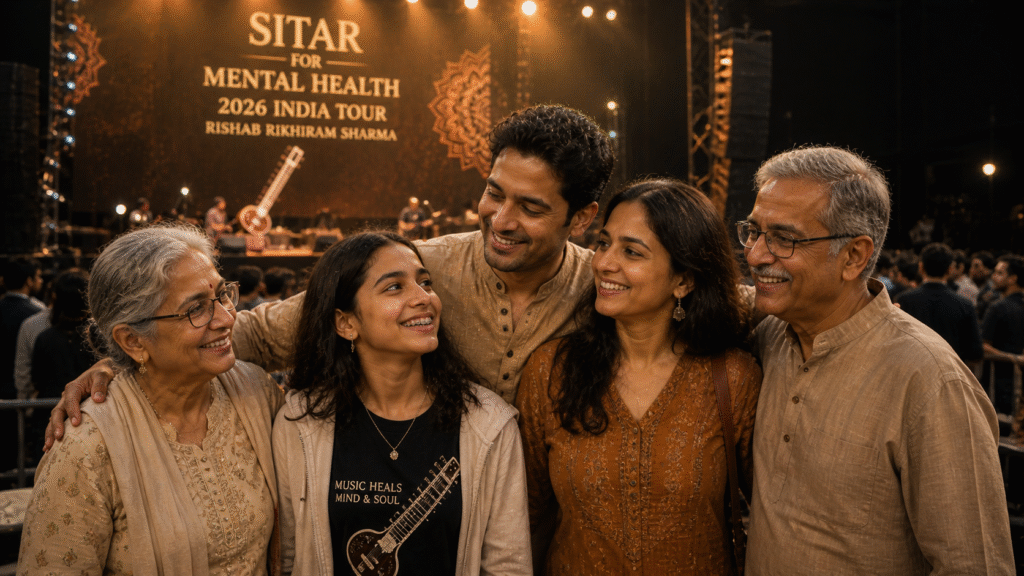
A family from Kolkata shared: “We brought our teenage daughter who’s been struggling with social media anxiety. The concert felt like a reset button for all of us. No phones out half the time—just presence.”
These aren’t isolated tales. Across cities, the tour created spaces where vulnerability was celebrated, not hidden. Parents opened up about their own mental health struggles. Young professionals found community.
The Gen Z Factor: Why Young India Is Rediscovering the Sitar
India’s Gen Z (and young millennials) grew up in a hyper-connected, high-pressure world. Yoga and mindfulness apps are everywhere, but many crave something authentic and rooted. Rishab delivers exactly that: ancient wisdom wrapped in modern packaging. His social media presence—raw, relatable, never preachy—makes classical music approachable.
He’s part of a larger neo-classical wave, but stands out because of the mental health mission. In an era of doom-scrolling and burnout, a sitar concert offers something revolutionary: silence, presence, and emotional release. It’s not escapism; it’s reconnection—to self, to culture, to something bigger.
Safe Ways to Experience the Magic (Even If You Can’t Attend Live)
You don’t need a ₹5,000 ticket to start your own “Sitar for Mental Health” journey:
- Begin small—listen to one 10-minute raga track before bed.
- Pair it with breathwork: Inhale for 4 counts, hold 4, exhale 6 while the sitar plays.
- Explore his originals and fusions on streaming platforms.
- Attend local classical events or online sessions.
- Talk about it—share how music moves you with friends or family.
- Consult a professional if you’re dealing with serious mental health issues; use music as support, not a substitute.
Desi Diet Hacks for the Soul? Wait, No—But Here’s How to Make Music Part of Your Daily Wellness Routine
Just like a balanced thali nourishes the body, intentional listening nourishes the mind. Create a playlist mixing Rishab’s live recordings with traditional artists. Use it during commutes, workouts, or quiet evenings. Light a diya, dim the lights, and let the strings work their magic.
Wrapping It Up: To Listen or Not to Listen? The Choice Is Yours
The ₹50 crore sitar isn’t just about ticket sales or sold-out shows. It’s proof that India’s youth are hungry for depth, healing, and cultural pride in a noisy world. Rishab Rikhiram Sharma didn’t just revive classical music—he made it relevant, therapeutic, and undeniably cool for millions.
Whether you’re a longtime fan rediscovering your roots or a complete newbie curious about the buzz, one thing is clear: the sitar is having its moment. And it’s bigger than one artist or one tour. It’s a movement reminding us that sometimes the oldest traditions hold the newest answers to modern problems.
So, what’s your take? Have you attended a Sitar for Mental Health concert or discovered Rishab’s music online? Did it shift something inside you? Drop your story in the comments below—let’s keep the conversation (and the healing vibrations) going. Share this with someone who needs a sonic reset. Follow Rishab’s journey, stream his tracks, and who knows? Maybe the next big cultural phenomenon starts with you hitting play.
In a fast world, sometimes the slowest, most resonant notes are the ones that change everything.
You May Like This
1



Advertisement

You May Like This





Advertisement
Advertisement
Advertisement