
Advertisement

- Updated on April 17, 2026
- IST 2:37 am

Imagine this: Meena, a 34-year-old software engineer from Bengaluru, once kept her savings tucked away in fixed deposits and gold, just like her mother did. Life felt secure but stagnant—until a friend’s casual chat about mutual funds sparked something. She downloaded a simple app, started a ₹5,000 SIP in 2022, and watched her portfolio grow through market ups and downs. By early 2026, she’s not just investing; she’s confidently allocating to equities, reviewing quarterly reports over chai, and even advising her cousins. “I used to think the stock market was for men in suits,” she laughs. “Now it feels like my own backyard.”
Now picture Ritu, 29, a homemaker from Lucknow who inherited a small sum after her father’s passing. Traditional advice urged her to park it in safe deposits. But inspired by online webinars and women-led finance groups, she took a bolder step—diversifying into blue-chip stocks and ETFs. Six months later, her portfolio had outpaced inflation, giving her the confidence to fund her daughter’s education dreams independently. “It’s not just money,” she says. “It’s power I never knew I had.”
So, what’s happening here? Is this a fleeting trend or a full-blown revolution? In 2026, Indian women are rewriting the rules of wealth creation. A new wave of high-net-worth women (HNI) is tilting heavily toward equities, embracing risk with sophistication, and closing long-standing gender gaps in investing. This blog dives deep into the data, the stories, the challenges, and the smart strategies powering this shift. Whether you’re a college student eyeing your first SIP or a mid-career woman ready to level up, let’s explore how female investors in India are taking control of the stock market—and how you can too.
Understanding the Shift: From Passive Savers to Active Stakeholders
For generations, Indian women were taught to save, not invest. Gold bangles, fixed deposits, and recurring deposits felt “safe.” But 2026 looks very different. According to recent National Stock Exchange (NSE) data, women now make up nearly 25% of all individual investors—around 31 million strong as of late 2025, out of a total investor base exceeding 12.7 crore. That’s a massive jump from just 22.8% a couple of years ago. Demat accounts held by women have exploded from 6.7 million in 2021 to over 27-28 million by early 2026—a more than 4x surge.
What’s driving this? Digital platforms like Groww and Zerodha have democratized access. No more intimidating broker calls or paperwork marathons—just a smartphone and a few taps. Government pushes like Beti Bachao Beti Padhao, combined with rising female workforce participation and higher education levels, have created a perfect storm. Young women under 35 are leading the charge: nearly 80% of women mutual fund investors start their journey before this age, with systematic investment plans (SIPs) as their go-to entry point.
It’s not just quantity; it’s quality. Women now command about 33% of individual mutual fund assets under management (AUM), even though they represent only 25% of unique investors. Their average folio sizes have grown faster than men’s in recent years, signaling smarter, more disciplined allocation. And in HNI circles? A recent Women of Wealth Report shows 73% of high-net-worth Indian women are invested in domestic equities—up 11 percentage points in just a year—with 53% comfortable riding market volatility.
Think of it like a seesaw finally balancing. For decades, women held the saving side down. Now, they’re stepping boldly onto the investing side, tipping the scales toward wealth creation and financial independence.
The Data Revolution: Why 2026 Marks a Turning Point
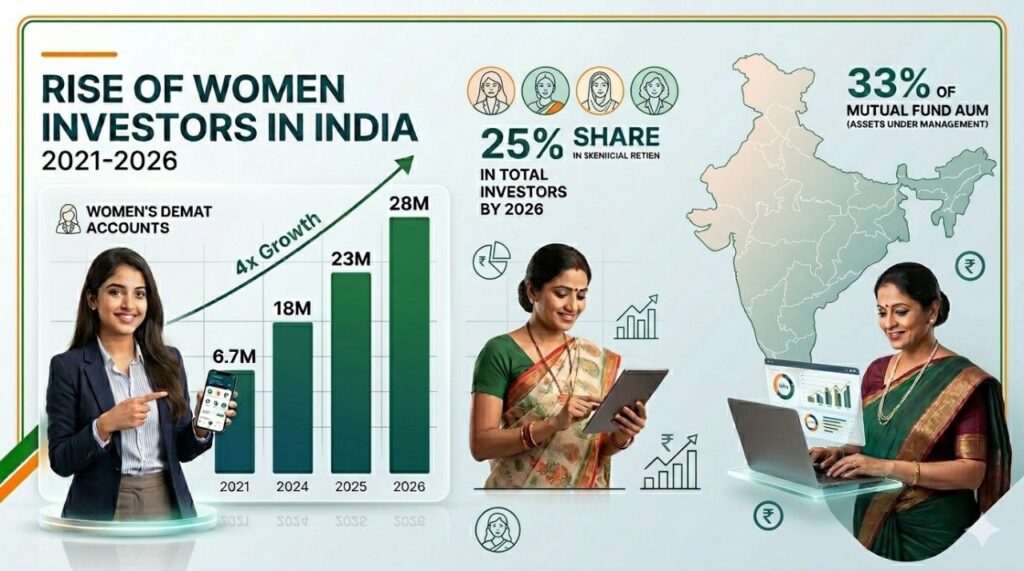
Let’s zoom out with the numbers that matter. Total unique registered investors crossed 12.7 crore by February 2026. Women’s share in mutual funds hit 25.1% of unique investors but a whopping 33.2% of AUM—proof they’re not just participating; they’re committing capital effectively. Mutual fund assets held by women more than doubled from ₹4.59 lakh crore in 2019 to over ₹11.25 lakh crore by 2025.
On brokerage platforms, women user growth is hitting 40% year-on-year. In states like Goa (33.2% female participation), Mizoram, Chandigarh, Sikkim, and Delhi, over 30% of investors are women—beating the national average and showing the trend isn’t limited to metros. Even in smaller cities, platforms report 72% of new women investors coming from places like Varanasi or Ranchi.
SEBI studies add another layer: women often show better outcomes in intraday trading profitability compared to men, with lower average losses. They’re disciplined, long-term focused, and less prone to panic selling. 56% of women now make household investment decisions independently—up from 44% just a few years ago.
This isn’t luck. It’s the result of better financial literacy campaigns, relatable social media content, and peer networks where women share wins (and lessons) openly.
The HNI Wave: High-Net-Worth Women Leading with Confidence

For India’s high-net-worth women, the shift is even more pronounced. Knight Frank and Capgemini reports highlight that 28% of HNI women with portfolios above ₹10 crore now manage investments independently. In family offices, 35% of trustees are women—a quiet power shift in governance.
These women aren’t just parking money in safe assets. They’re tilting toward equities, alternatives, and even international opportunities. 72.8% hold domestic equities, the biggest increase across any category. They absorb volatility better, viewing dips as buying opportunities rather than threats. This risk appetite, paired with sophisticated research, is helping them build generational wealth faster.
Yet it’s balanced: many still maintain a core of debt or gold for stability, reflecting that classic Indian prudence blended with modern boldness.
Challenges That Still Linger: The Persistent Gender Gap
No revolution is without hurdles. Despite the surge, women hold only about 37% of direct equity portfolios in some segments and face lingering stereotypes. Financial literacy gaps persist in smaller towns—many women still seek “permission” or family approval before investing. Time constraints from juggling careers and home responsibilities can delay deep research. And while apps have simplified entry, complex products sometimes overwhelm beginners.
Behavioral factors play a role too: women often exhibit higher loss aversion, preferring steady SIPs over aggressive trading. The good news? This very caution has helped many outperform during volatile periods.
The gap is closing, but not closed. Initiatives by AMCs, fintechs, and even NSDL’s women-focused plans are pushing harder for inclusion.
Real Stories: Triumphs from Across India

Let’s hear from women living this change.
Meena’s story (from our opening) is common in tech hubs. After her first SIPs delivered 18-20% annualized returns in select funds, she expanded to sectoral ETFs. “The market taught me patience,” she shares. Today, her corpus funds family vacations and an emergency buffer.
Ritu from Lucknow started small but scaled smartly. She focused on value stocks and hybrid funds, growing her inheritance 35% in 18 months. “I feel in control for the first time,” she beams.
Then there’s Priya, 26, a marketing executive in Delhi. She joined a women-only investment community on Instagram and began with ₹2,000 monthly SIPs. By 2026, she’s debt-free and eyeing her first independent home purchase. “No more waiting for Prince Charming to handle finances,” she jokes.
And for inspiration at the professional level, women like Sunaina Da Cunha (Co-CIO Debt at Aditya Birla Sun Life), Meenakshi Dawar (Senior Fund Manager at Nippon India), and Rajasa Kakulavarapu (Portfolio Manager at Franklin Templeton) are managing billions, proving women excel at the highest levels of fund management with disciplined, research-driven strategies.
These aren’t outliers. They represent thousands quietly building empires, one SIP at a time.
Strategies for Aspiring Female Investors: Your Roadmap to Dominance

Ready to join the movement? Here’s how to do it right:
- Start Small and Consistent: Begin with a 12-month SIP of even ₹1,000-5,000 in diversified equity or hybrid funds. Apps make it effortless.
- Build Knowledge First: Read beginner books, follow credible finance educators on YouTube or apps, and join women-focused webinars. Aim for 30 minutes weekly.
- Diversify Smartly: Mix large-cap stability, mid-cap growth, and some international exposure. Don’t put everything in one stock or sector.
- Embrace Risk Gradually: Once comfortable, allocate 60-70% to equities if your horizon is 7+ years. Track volatility tolerance.
- Use Tax-Efficient Tools: ELSS funds for Section 80C benefits, or focus on long-term capital gains tax rules.
- Review Regularly but Don’t Obsess: Quarterly check-ins keep you informed without emotional trading.
- Seek Community and Experts: Join local or online women investor groups. Consult a SEBI-registered advisor for personalized plans.
- Mindset Shift: Treat investing like self-care. It’s not gambling—it’s future-proofing your dreams.
Bonus desi hack: Link investments to life goals—daughter’s wedding, retirement, or that dream Europe trip. It makes the process emotional and sustainable.
Expert Insights: What the Pros Say
Fund managers and wealth experts agree: women’s long-term focus and lower churn rates give them an edge. “Discipline beats timing,” says one leading female portfolio manager. Government data and AMFI reports back this—women who stay invested through cycles often see superior compounded returns.
The message is clear: financial independence isn’t a luxury; it’s a necessity in 2026’s dynamic economy.
Wrapping It Up: She Is on Top—And You Can Be Too
In 2026, Indian women aren’t just participating in the stock market—they’re dominating it with confidence, strategy, and results. From 25% investor share to commanding one-third of MF wealth, from HNI risk-takers to young SIP warriors, the rise is undeniable. Yes, challenges like literacy and confidence gaps remain, but the momentum is unstoppable.
The stock market no longer feels like a boys’ club. It’s your arena too. Start today—open that demat account, set up your first SIP, and watch your wealth (and self-belief) grow. What’s stopping you? Share your investing journey or first step in the comments below. Let’s celebrate every win, big or small, and lift each other up. Your financial freedom story starts now.
You May Like This
Advertisement

You May Like This








Advertisement

Advertisement

Advertisement