

Advertisement

- Updated on April 17, 2026
- IST 9:19 am

Imagine this: It’s a humid February evening in Bengaluru, 2026. The Davis Cup crowd is roaring like it’s a cricket final at Eden Gardens. A lanky 6’5” Indian kid from Madurai, ranked outside the top 500 just months ago, steps onto the hard court. He’s not supposed to be the hero—veterans like Yuki Bhambri were meant to carry the load. But Dhakshineswar Suresh stares down higher-ranked Dutch opponents, wins two singles matches, teams up for a doubles thriller, and seals a historic 3-2 upset. India advances. The nation erupts. Social media explodes with “DK is the future!” Meanwhile, back in a small Madurai neighborhood, 17-year-old Arjun, who trains on cracked public courts with a second-hand racket, watches on his phone and whispers, “If he can do it, so can I.”
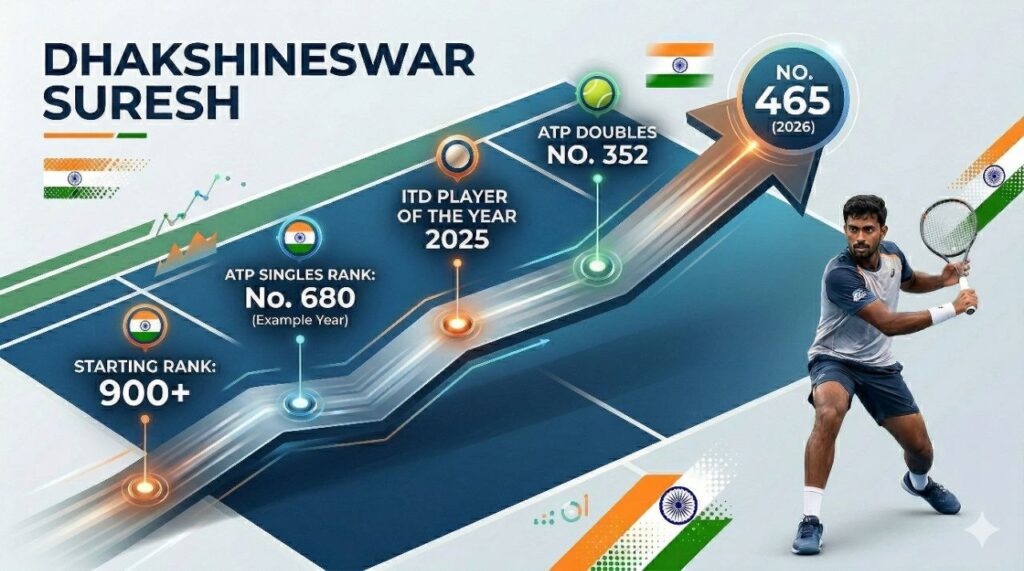
Now picture the flip side. Arjun’s cousin, 19-year-old Priya from Chennai, dreams of tennis glory too—but her family pushes engineering instead. “Tennis? Too risky, beta,” they say. No sponsorships, no fancy academies, just sweat and hope. Dhakshineswar Suresh’s story bridges that gap. In January 2026, he smashed his career-high ATP singles ranking of No. 468 (peaking at No. 465 by early February). His doubles high hit No. 352 in August 2025. Domestically, he was crowned ITD Male Player of the Year in 2025. Suddenly, India has a fresh face in men’s tennis—not a flash-in-the-pan, but a steady rocket fueled by American college grit and Tamil Nadu roots.
So, what’s the real story behind this young Indian athlete? Is Dhakshineswar Suresh just another promising name, or the spark that could reignite India’s tennis flame? In this deep dive, we’ll trace his journey from dusty courts in Madurai to ATP stages, unpack the rankings climb, celebrate his Davis Cup heroics, weigh the challenges every young Indian faces, and explore what his rise means for the next generation. We’ll mix real stats, heartfelt anecdotes, and practical tips rooted in our desi reality. Let’s serve up the truth—ace by ace.
Dhakshineswar Suresh: From Madurai Roots to Global Spotlight
Born on March 29, 2000, in Madurai, Tamil Nadu, Dhakshineswar Suresh Ekambaram grew up in a world where cricket reigns supreme. Tennis? It was a quiet side hustle for most families. Yet young Dhakshineswar—fondly called DK by fans—picked up a racket early. Picture him: tall even as a kid, with a powerful serve that echoed off temple walls during evening practice. His parents, like many middle-class Indian families, balanced support with practicality. No silver spoon here—just determination and local coaches who spotted his height and two-handed backhand as weapons in the making.
Madurai’s public courts weren’t Wimbledon. They were sun-baked, uneven, shared with kids playing gully cricket. But that built resilience. Suresh honed his game amid Tamil Nadu’s humid heat, learning to outlast opponents not just with power but with smart footwork and mental toughness. By his late teens, he made the bold leap many Indian talents dream of: heading to the United States for college tennis. First at Georgia Gwinnett College (where he earned NAIA All-America honors in 2023), then transferring to Wake Forest University. There, he paired with Holden Koons to form the nation’s top-ranked college doubles team and grabbed ITA Doubles All-American status.
This wasn’t just a scholarship—it was a masterclass in modern tennis. American colleges offered structured coaching, top-notch fitness labs, video analysis, and matches against future pros. Suresh thrived. He climbed the Intercollegiate Tennis Association rankings while balancing studies. It’s like turning a street fighter into a chess grandmaster: raw talent refined by science. For Indian fans aged 15-45 who grew up idolizing Leander Paes and Mahesh Bhupathi, this path feels fresh. No more relying solely on the All India Tennis Association grind; college abroad adds polish and exposure.
The Rankings Rocket: Breaking into the ATP Top 500
Let’s talk numbers—because in tennis, rankings are the ultimate scoreboard. Before 2025, Suresh hovered around the 800-900 mark in ATP singles. Limited pro schedule, focus on college, and then boom: he climbed over 300 spots in a single year, hitting career-highs that turned heads. His singles peak hit No. 468 in January 2026, with a doubles best of No. 352 earlier in 2025. Prize money crossed $50,000—not superstar cash yet, but proof he’s earning on the Challenger and ITF circuits.
What fueled the surge? Consistency in lower-tier events, smart scheduling, and that college-honed fitness. Recent highlights include deep runs in U.S. Challengers like Knoxville and Charlottesville in late 2025. He’s not winning Slams overnight, but he’s knocking on the door of the top 400. Critics might say, “Still outside the top 200—big deal?” True, but remember: Indian men’s tennis has been starved of depth since the Paes-Bhupathi era. Sumit Nagal cracked the top 100 briefly; now Suresh joins the conversation as a realistic hope for sustained presence.
Think of rankings like a marathons—not a sprint. Every point on hard courts in Bengaluru or clay in Europe adds up. Suresh’s right-handed game, with that booming serve (thanks to his 196 cm frame), suits fast surfaces. Paired with steady groundstrokes, it’s a complete package. His inclusion in the ATP Next Gen Accelerator program in 2025 was the official seal: the tour sees him as one to watch.
Davis Cup Glory: The Moment India Fell in Love with DK
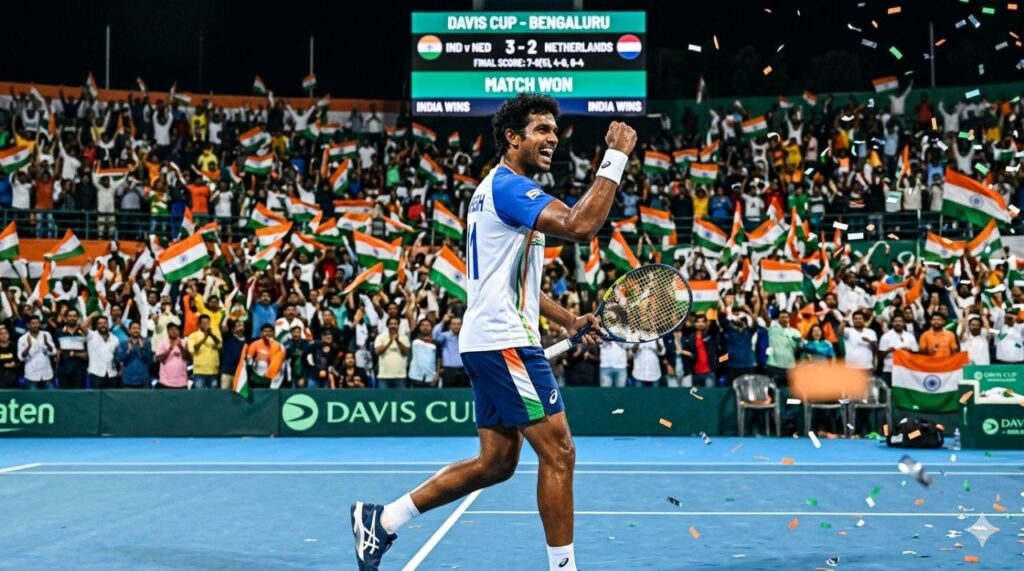
February 2026, Bengaluru. India vs. Netherlands in the Davis Cup qualifiers. Suresh wasn’t the marquee name—Yuki Bhambri and others carried expectations. But he delivered like a Bollywood hero in the final act. He upset No. 162 Guy den Ouden 6-4, 7-6(4). He stunned higher-ranked Jesper de Jong in straight sets. Then, teaming with Bhambri, he clinched the doubles decider. Three wins in one tie—the first Indian to pull it off since Leander Paes in 2004 against Japan. India won 3-2. The crowd chanted his name. Social media dubbed him “India’s new Davis Cup hero.”
This wasn’t luck. It was preparation meeting opportunity. Suresh had already stunned fans by leading Wake Forest to strong collegiate results. His Davis Cup debut in 2025 showed promise; 2026 was the explosion. For a nation that celebrates team triumphs like the 1983 World Cup, this felt personal. Young athletes across Gurugram to Guwahati replayed the highlights, dreaming of representing the tricolor.
Yet it sparked debate too. Some veterans praised the college route for building mental steel; others argued India needs more homegrown academies to avoid talent drain abroad. Balanced view? Both. Suresh proves hybrid paths work—desi roots plus global polish.
Challenges on the Court: The Realities of Indian Tennis
No rise is without turbulence. Indian tennis infrastructure lags: few grass courts, funding battles, and visa hassles for overseas events. Suresh faced them too—early travels on a shoestring, homesickness in the U.S., and the pressure of being “the next big thing.” Injuries? Every pro battles them; his tall frame demands smart conditioning to avoid shoulder or back woes.
Compare to peers: Rohan Bopanna thrived in doubles late-career; Sania Mirza conquered mixed. But singles? It’s a lonely battle. Suresh’s story highlights multiple angles—financial hurdles for most families, gender gaps (women’s tennis often gets less spotlight), and the mental toll of rankings volatility. One bad tournament drops you 50 spots. He stayed balanced by focusing on process over results, a lesson for every 15-45-year-old chasing dreams.

The Indian Twist: Tradition Meets Modern Tennis
Tennis in India isn’t new—remember the 1900s Bombay Gymkhana courts or Paes’ Olympic bronze? But today’s desi players blend yoga for flexibility, idli-sambar diets for sustained energy, and tech like apps for serve analysis. Suresh carries that Tamil Nadu fire: discipline from temple visits, resilience from monsoon training disruptions. His college success shows how Indian work ethic (long hours, family support) merges with Western science.
Picture a typical day: early morning rallies under Chennai’s sun (many train there before heading abroad), followed by strength sessions and recovery with turmeric milk. It’s not just talent—it’s cultural grit meeting opportunity. For families in Haryana or Maharashtra, this is inspiring: no need to be born rich; smart choices and hard work suffice.
Real Stories: Fans, Teammates, and the Next Wave
Listen to the voices. “DK showed us rankings don’t define heart,” says a Delhi-based coach whose student gained confidence post-Davis Cup. On Instagram, Suresh’s handle buzzes with messages from Madurai kids: “Bhaiya, aapne dikha diya!” Fellow pro Yuki Bhambri called the doubles win “pure teamwork.” Even international commentators noted his composure under pressure—evoking Paes’ legacy.
One aspiring player in Bangalore shared: “I switched from cricket to tennis after watching him. His college path gave me a roadmap.” These tales prove Suresh isn’t isolated; he’s lifting an entire ecosystem.
Tips for Aspiring Young Indian Athletes: Your Roadmap to the Top
Ready to follow in his footsteps? Here’s how to play it smart:
- Start Local, Think Global: Train at academies in Chennai or Delhi, but research college scholarships early. Sites like ITA track opportunities.
- Build a Complete Game: Focus on serve (leverage height like Suresh), fitness (yoga + gym), and mental coaching via apps or mentors.
- Track Progress Ruthlessly: Use apps for match stats; aim for 10-15% ranking jumps yearly.
- Fund Smart: Seek AITA support, crowd-fund via social media, or target ITF junior events for exposure.
- Balance Life: Studies or a backup plan prevent burnout—Suresh’s college degree is his safety net.
- Network and Learn: Follow pros on X or Instagram; attend camps with ex-players.
Consistency beats talent alone. Hydrate with coconut water during matches, fuel with protein-rich dals and nuts—desi power for endurance.
Desi Fitness and Nutrition Hacks for Tennis Warriors
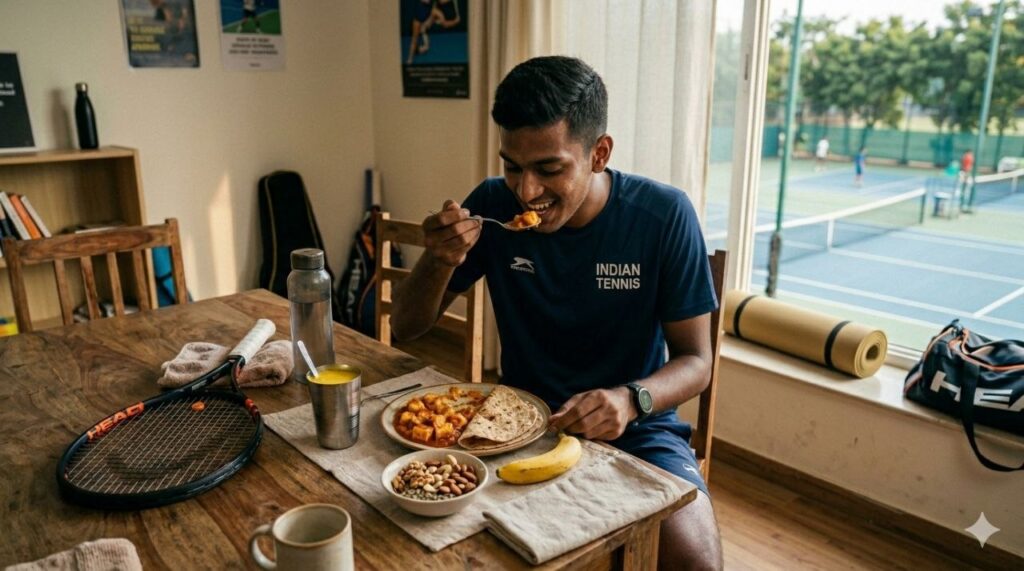
Eating like a pro doesn’t mean fancy imports. Suresh’s success hints at balanced fuel: pre-match bananas and almonds for quick energy, post-match paneer stir-fry for recovery. Avoid heavy rice feasts before play—opt for quinoa-roti hybrids. Incorporate Indian spices: turmeric for inflammation, ginger tea for digestion. Strength? Bodyweight circuits at home (push-ups, squats) plus court sprints. Sleep 8 hours—crucial in our 24/7 culture. These tweaks helped him endure long ties and travel.
Wrapping It Up: To Rise or Not to Rise? Dhakshineswar Suresh’s Legacy Begins Now
Dhakshineswar Suresh isn’t a finished product—he’s 26, ranked in the 460s, but his trajectory screams potential. Career-highs in 2026, Davis Cup heroics, and that ITD award mark him as India’s brightest new tennis hope. For some, he’s proof the college route beats traditional struggles; for others, a reminder that infrastructure must improve at home. Either way, his story balances inspiration with realism: no magic wand, just sweat, strategy, and support.
If you’re 15-45 and love tennis—or just root for underdogs—watch him closely. Next Challengers, more Davis Cup ties, maybe a Grand Slam qualifier soon. What’s your take? Has Dhakshineswar Suresh inspired you to chase your sport? Drop your story or predictions in the comments below—let’s build the conversation and cheer India’s next stars together. Share this with a young athlete in your circle. Who knows? The next DK might be reading right now.
You May Like This
1



Advertisement

You May Like This








Advertisement
Advertisement
Advertisement