

Advertisement

- Updated on May 9, 2026
- IST 7:56 am
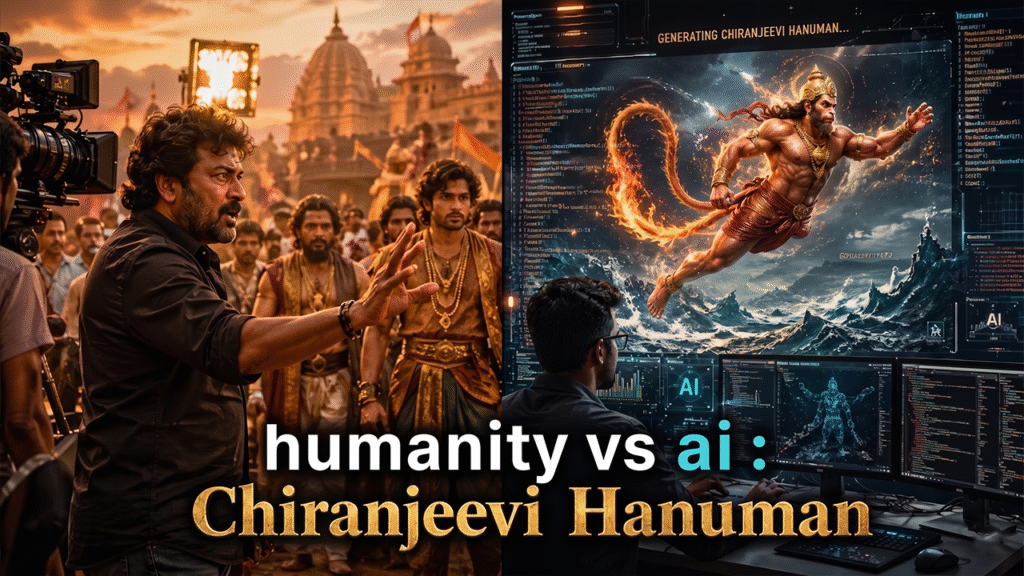
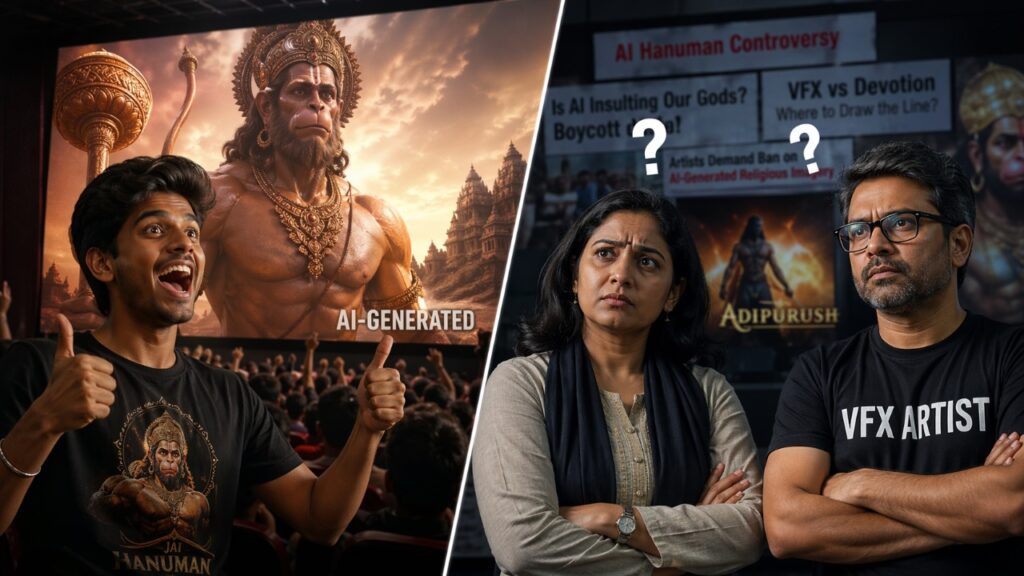
Imagine this: Arjun, a 22-year-old VFX artist from Hyderabad, scrolls through the first-look teaser of Chiranjeevi Hanuman – The Eternal on his phone during a late-night editing shift. His eyes widen as Hanuman leaps across digital oceans with god-like grace—no sets, no green screens, just pure AI magic. “This is the future,” he tells his roommate. “I could finally create epic worlds without begging for budgets.” But weeks later, whispers of layoffs ripple through his studio. He stares at his half-finished reel and wonders if the very tool promising freedom is about to render him obsolete.
Now picture Meena, a 35-year-old schoolteacher and lifelong Hanuman devotee from Lucknow. She watches the same teaser in her living room, surrounded by her family’s Ramayana idols. The visuals are stunning—fiery tail, divine strength—but something feels off. “How can code capture bhakti, the raw emotion of Lord Hanuman’s devotion?” she asks her husband, voice trembling. “This isn’t just a film; it’s our faith on a screen made by machines. What if it cheapens the sacred?”
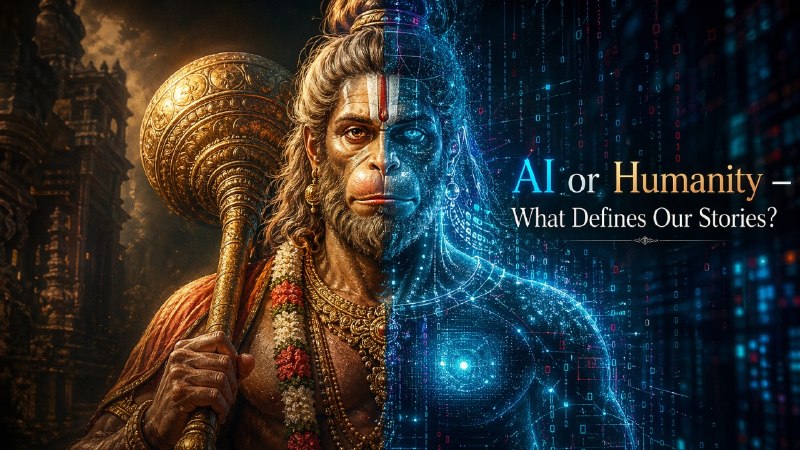
So, what’s the truth? No actors, no traditional cameras, just lines of code birthing India’s first fully AI-generated feature film. Chiranjeevi Hanuman – The Eternal, set for a theatrical release on Hanuman Jayanti 2026, has exploded into the most talked-about movie of the year. Directed by National Award-winning filmmaker Rajesh Mapuskar and produced by Abundantia Entertainment in partnership with Collective Media Network’s Historyverse, it reimagines the eternal tale of Lord Hanuman from the Ramayana and Puranas for a global audience. But with its groundbreaking “Made-in-AI, Made-in-India” tagline, it’s ignited a firestorm: Is this the dawn of cinematic liberation or the death of the human soul in storytelling? In this deep dive, we’ll unpack the technology, the risks, the rewards, and the very Indian emotions swirling around it. Let’s leap into the debate together—because this isn’t just about one film. It’s about the future of our stories, our jobs, and our faith.
Understanding Chiranjeevi Hanuman: India’s AI Leap into Mythology
First, let’s set the scene. Chiranjeevi Hanuman – The Eternal isn’t your average mythological retelling. It draws from sacred texts to chronicle Hanuman’s journey—from his mischievous childhood to his heroic feats in Lanka, embodying strength, devotion, and selfless service. What makes it revolutionary? Every frame, from swirling vaanar sena armies to the blazing tail lighting up the night sky, is powered by advanced generative AI tools. No massive film sets in Hyderabad or Mumbai, no thousands of extras in costume, no months of manual VFX polishing. Instead, AI algorithms, guided by human creatives, craft photorealistic visuals that promise to rival Hollywood blockbusters at a fraction of the cost.
Director Rajesh Mapuskar, known for heartfelt films like Ventilator and Ferrari Ki Sawaari, calls it a “divine opportunity.” In interviews, he emphasises that AI isn’t replacing the storyteller—it’s a powerful buddy helping realise an internal emotional journey that traditional methods might struggle to scale. The team includes writers, AI artists, engineers, musicians, and editors working with proprietary systems like Galleri5’s Tinify AI operating system. The goal? A theatrical experience that feels awe-inspiring on the big screen, blending ancient bhakti with cutting-edge tech for audiences aged 15 to 45 who grew up on Baahubali and RRR but crave something fresh.
Yet this isn’t happening in a vacuum. Bollywood and Indian cinema have been flirting with AI for years—de-ageing actors, AI storyboarding, voice cloning. Chiranjeevi Hanuman takes it to the extreme: a full-length feature film positioned as India’s first truly AI-generated theatrical release. The stakes? Enormous. If it succeeds, it could democratise epic filmmaking for regional languages and independent voices. If it falters, it might confirm critics’ worst fears about soulless cinema.
AI-Generated Filmmaking Explained: Code Over Crew?
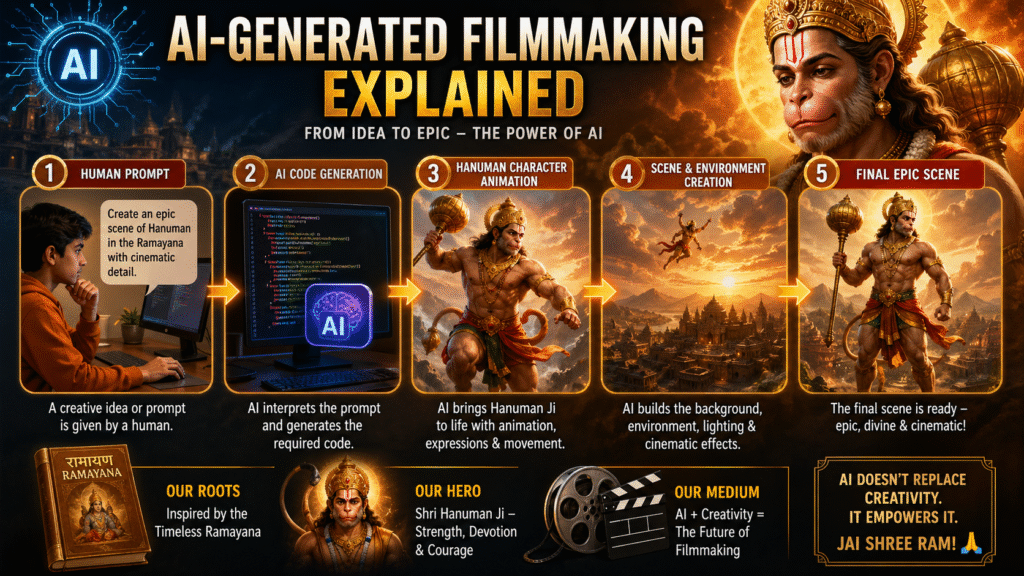
Unlike traditional movies that rely on human actors emoting under lights or VFX teams painstakingly compositing shots for months, AI filmmaking flips the script. It’s all about prompts, datasets, and iterative generation. Think of it like Hanuman’s leap across the ocean: one mighty bound powered by intelligence rather than brute physical effort.
Here’s how it works in simple terms:
- Script to Screen via Algorithms: Human writers craft the core story, but AI generates dialogue variations, scene visualizations, and even character animations based on vast training data from Indian epics, real-world references, and cinematic history.
- Visual Odyssey: Generative AI tools create photorealistic environments, characters, and action sequences. No need for physical sets in hot sun or costly CGI farms—AI renders it all in hours or days.
- Audio and Music Magic: AI can synthesize voices, compose background scores inspired by classical ragas or devotional bhajans, and even lip-sync mythical figures with uncanny realism.
- Post-Production on Steroids: Editing, color grading, and effects happen in tandem with AI assistance, slashing timelines from years to months.
The pitch? Faster, cheaper, infinitely scalable storytelling. For cash-strapped Indian producers battling ballooning VFX budgets (often 30-40% of a big film’s cost), this is a game-changer. But for women with PCOS—wait, no—for the thousands of artists, technicians, and crew members who’ve built careers in Mumbai’s film ecosystem, it raises a chilling question: Where do humans fit when machines can do the heavy lifting?
The Big Debate: Does AI Elevate Cinema or Erase Its Heart?
Here’s where it gets juicy—filmmakers, fans, and industry veterans are divided like never before. Let’s break it down with fresh eyes.
The Pros: Why This Could Be a Blessing
- Democratisation and Innovation: AI lowers barriers. Young talents from Tier-2 cities or even villages could create world-class epics without studio gatekeepers. Imagine more diverse Hanuman stories or regional myths brought to life globally.
- Visual Spectacle at Scale: The teaser already hints at breathtaking sequences—Hanuman’s vanar army marching across digital landscapes, Lanka ablaze in hyper-real detail. For a generation raised on smartphones and gaming, this hyper-immersive style feels native.
- Cost and Speed Savings: Traditional VFX in Bollywood can cost crores and take forever. AI could free up budgets for better storytelling or more films, boosting employment in new AI-specialised roles. Director Mapuskar insists it’s not job theft but evolution: “Either AI eats you up, or you make it your buddy.”
- Global Reach for Indian Culture: A film like this could introduce Hanuman’s timeless values—courage, loyalty, humility—to international audiences who discovered Indian cinema via Netflix.
The Cons: Where AI Might Backfire
- Job Displacement in VFX and Beyond: India’s VFX industry employs lakhs, with Bollywood alone pumping billions into it annually. If AI handles 80-90% of visuals, what happens to the artists perfecting those shots late into the night? Early signs of studio shifts have many worried.
- Loss of Emotional Depth and Authenticity: Critics like Anurag Kashyap didn’t mince words, slamming the producer and warning of a “dangerous future” for “spineless artists.” Vikramaditya Motwane echoed it: “Who needs writers and directors when it’s ‘Made in AI’?” Can algorithms truly convey the subtle quiver of devotion in Hanuman’s eyes or the raw human struggle behind mythological heroism?
- Cultural and Faith Sensitivities: Mythology isn’t just entertainment in India—it’s sacred. Detractors fear AI trained on mixed global data might dilute Indian aesthetics or introduce unintended cultural mismatches, risking backlash from devotees who see it as sacrilege.
- Creative Homogenization: Over-reliance on AI could lead to formulaic outputs, where every epic looks “perfect” but lacks the imperfect human touch that makes films memorable.
Meena’s concern isn’t isolated—social media is flooded with similar sentiments, while Arjun’s excitement represents the hopeful side of hustling to upskill in AI tools.
The Indian Twist: AI Meets Devotion, Culture, and Collective Psyche
Fasting isn’t new—wait, in our context, AI isn’t alien to Indian innovation either. From ancient rishis envisioning flying machines in epics to modern IT hubs powering the world, we’ve always blended the divine with the disruptive. Hanuman himself symbolizes the ultimate bridge: between mortal and divine, strength and surrender.
Our cinema has long been a temple of storytelling—Ramayana adaptations, Mahabharata serials, and big-screen devotionals have shaped generations. But in 2026’s fast-paced, post-pandemic India, where youth juggle UPSC dreams, startup hustle, and social media validation, Chiranjeevi Hanuman taps into something deeper. It’s not just tech; it’s a modern avatar of our cultural resilience. Yet the “desi” lens adds complexity: family-run VFX studios, freelance artists in Andheri, and temple-going audiences who want their gods to feel alive, not algorithmically generated.
The controversy mirrors broader societal shifts—AI in education, jobs, even creative fields—raising questions about what makes us human in an automated world.
Real Voices: Triumphs, Tumbles, and Theatre-Ready Reactions
Let’s hear from those living it.
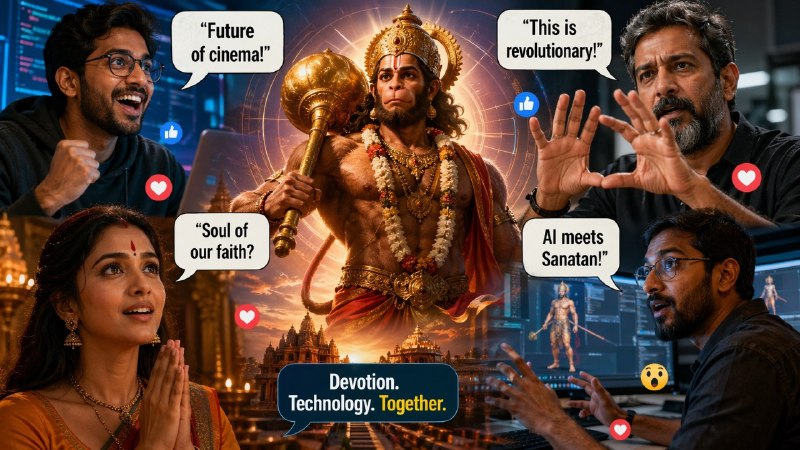
- Rajesh Mapuskar, Director: “I feel chosen for this. We have to welcome AI and shake hands with it. It’s about Hanuman’s internal journey, not replacing anyone.”
- Anurag Kashyap & Vikramaditya Motwane: Fierce critics highlighting the threat to human artistry and calling for resistance against AI overreach.
- Ranveer Singh: Showed public support for the producers, sparking fan debates on Instagram.
- Arjun (VFX Artist, 22): “Exciting for visuals, terrifying for my paycheck. I’m learning AI prompts now—adapt or perish.”
- Meena (Devotee & Teacher, 35): “Stunning trailer, but my heart says we need human hands touching our gods. Let’s not rush the sacred.”
- Social Media Echo: Teaser comments range from “Boycott AI film 🚩” to “Finally, next-level cinema!”
These stories prove one thing: Chiranjeevi Hanuman isn’t just pixels—it’s a mirror reflecting our hopes and fears.
Navigating the AI Wave: Practical Tips for Filmmakers, Artists, and Audiences
Thinking this revolution is unstoppable? Here’s how to ride it wisely:
- Upskill Smartly: VFX pros—learn AI prompting alongside traditional skills. Hybrid expertise will be gold.
- Prioritise Human Storytelling: Use AI for visuals, but guard the script, emotions, and cultural nuance with human oversight.
- Support Ethical AI: Demand transparency in training data and fair transitions for displaced workers.
- Audience Power: Watch critically. Celebrate innovation but call out when soul is missing. Vote with tickets and feedback.
- Cultural Safeguards: For mythological films, involve pandits, historians, and community voices early.
- Balance and Iterate: Experiment like Mapuskar, but iterate based on real audience emotions—not just metrics.
Wrapping It Up: To Code or Not to Code the Future?
So, does Chiranjeevi Hanuman – The Eternal mark AI’s triumphant leap into Indian cinema or a cautionary tale of humanity left behind? It’s not black-and-white. For some, it’s a thrilling bridge to global stardom and efficient storytelling. For others, it’s a stark reminder that machines can mimic but rarely match the messy, heartfelt core of art—especially when that art carries the weight of faith and culture.
The film arrives at a pivotal moment for India: as a tech superpower embracing AI everywhere, yet rooted in ancient wisdom. Whether it soars or sparks needed course-correction, one thing’s clear—this debate will shape not just Bollywood but how we define creativity itself.
If you’re as fascinated (or worried) as we are, what’s your take? Excited for the AI Hanuman or boycotting for the human touch? Have you upskilled in AI tools, or seen jobs shift in your circle? Drop your story in the comments below—let’s swap notes, learn from each other, and maybe even influence the next chapter of Indian cinema. Share this if it made you think, tag a filmmaker friend, and stay tuned for more on how tech is rewriting our favorite tales. Your voice could be the real hero here!
You May Like This
1



Advertisement

You May Like This








Advertisement
Advertisement
Advertisement