

Almost every film award in India works the same way. A panel is assembled, the panel watches, the panel deliberates, and the panel decides. The audience finds out who won at the same time as everyone else — on the night, from the stage.
IFTA was built to work the other way round.
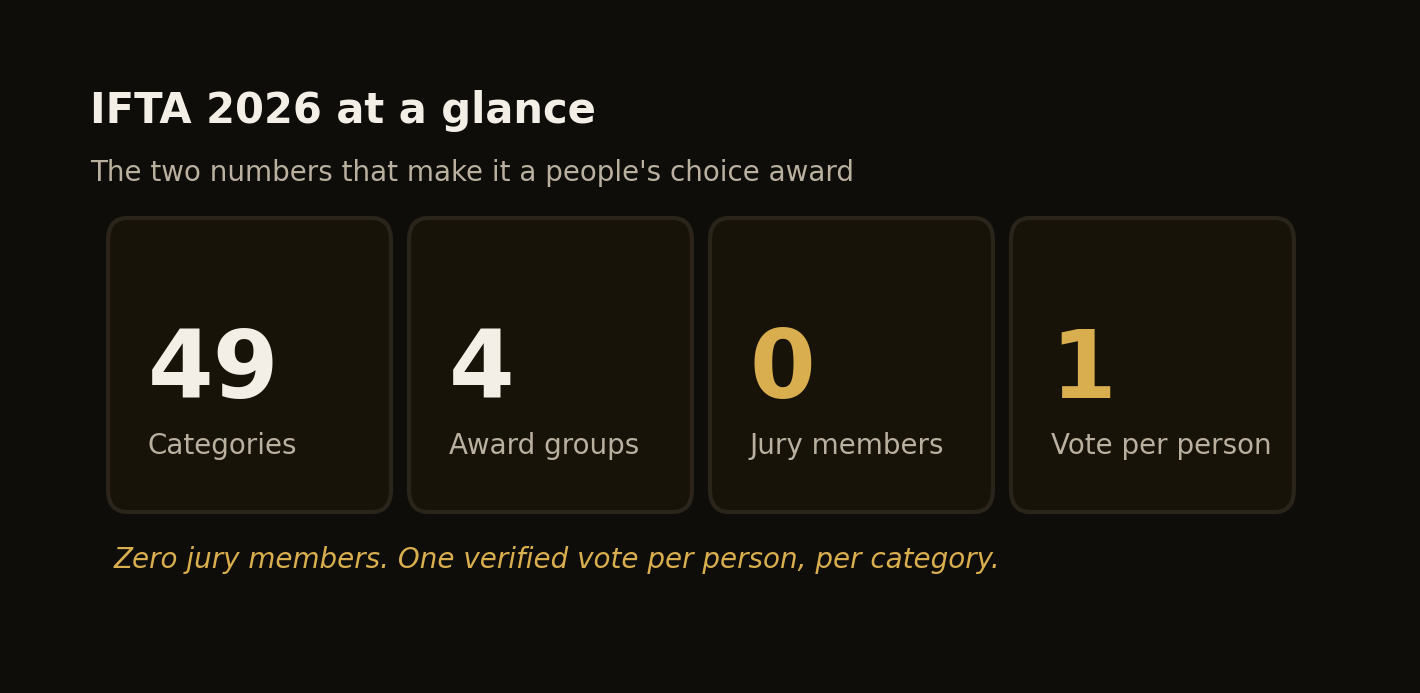
No jury. That is the whole idea.
The Indian Film and Television Awards has no jury and no selection panel deciding winners. Not a small one. Not an advisory one. None. Every IFTA winner is decided by public vote, and the count is the count.
That single decision changes what the award actually measures. A jury award tells you what a room of industry professionals admired. A people’s choice award tells you what the country watched, argued about, rewatched and forwarded to the family group chat. Those are different things, and both are worth knowing — but only one of them has been missing from Indian awards for a long time.
So where do the nominees come from?
This is the part people usually ask next, and it is a fair question. If the public decides the winner, who decides the shortlist?
IFTA runs a dedicated market research process for every category. Nominee lists are built from primary and secondary research — viewership data, release performance, public conversation and category-specific analysis — rather than from submissions or lobbying. Nobody buys a nomination. The research produces the list, the list goes public, and from that point the audience takes over.
For 2026 there is an additional step at the front. Before the nominee lists are locked, IFTA is asking the country directly: who deserves to be on it? Suggestions come in, the research team verifies each name against independent sources, and only then does it reach the ballot.
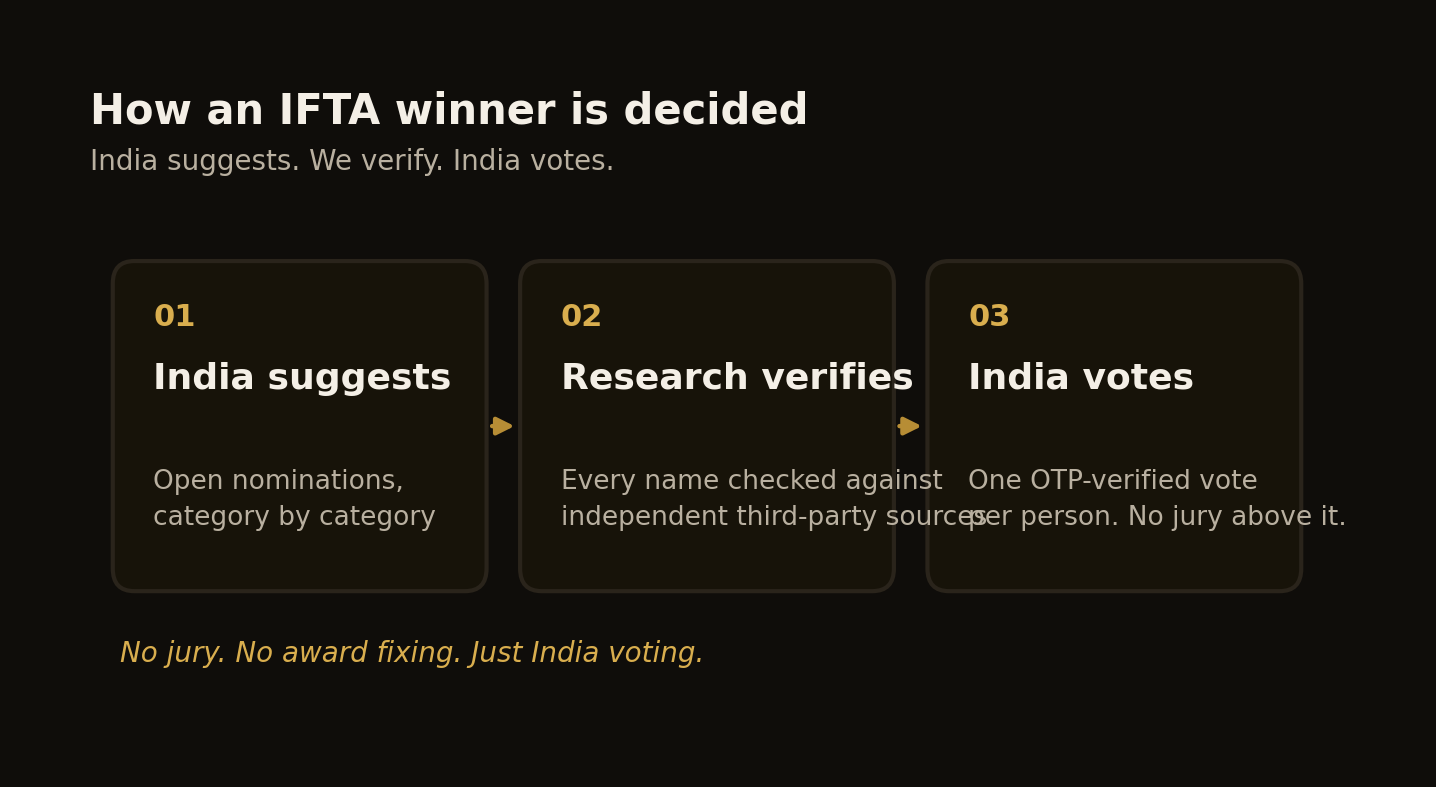
The sequence, plainly:
- India suggests. Open nominations, category by category.
- Research verifies. Every suggested name checked against independent, third-party sources.
- India votes. One verified vote per person. No jury sits above the result.
Why the voting is OTP-verified
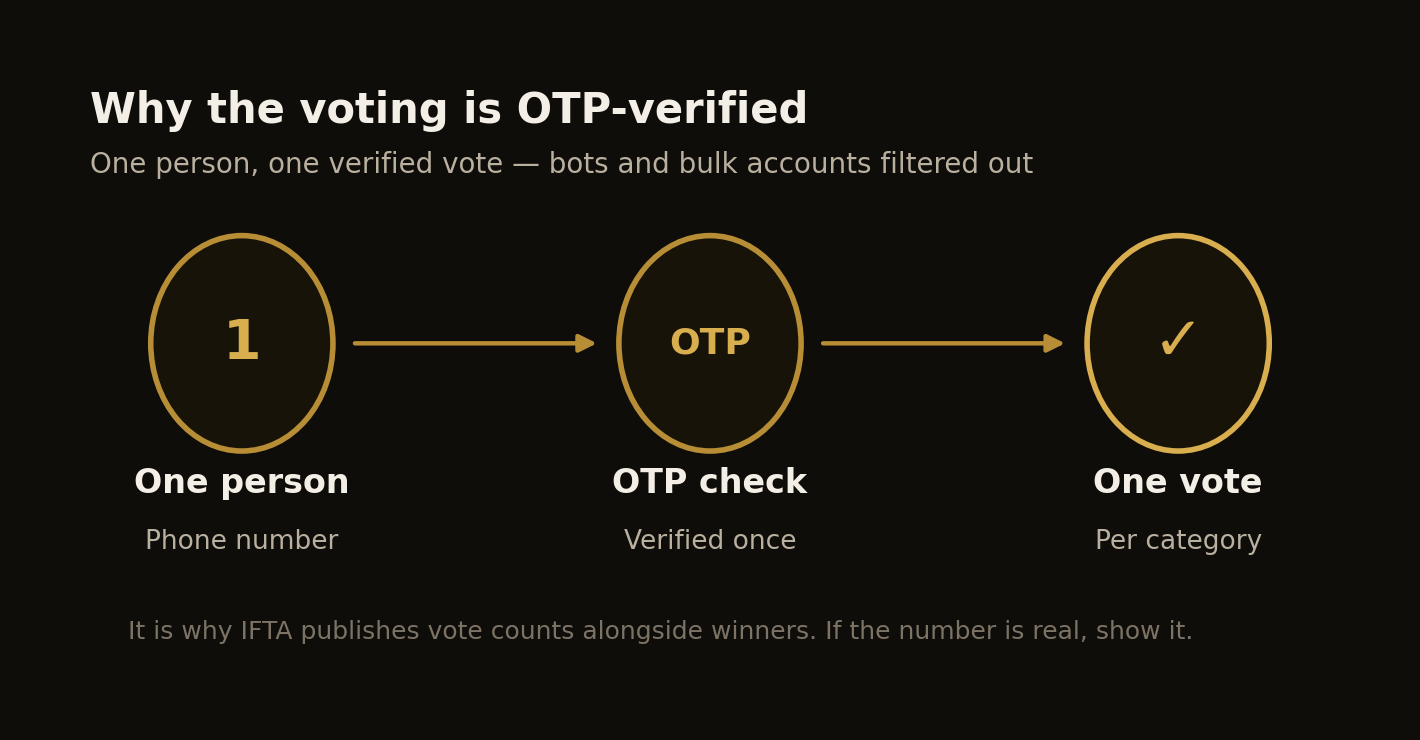
A public vote is only worth something if it is actually public. Open ballots get gamed — by bots, by bulk accounts, by whoever has the largest fan army and the least patience.
IFTA voting is OTP-verified: one person, one verified vote, per category. It is a small amount of friction that does a large amount of work. It is also why IFTA publishes vote counts alongside winners rather than hiding them. If the number is real, there is no reason not to show it.
What is on the ballot in 2026
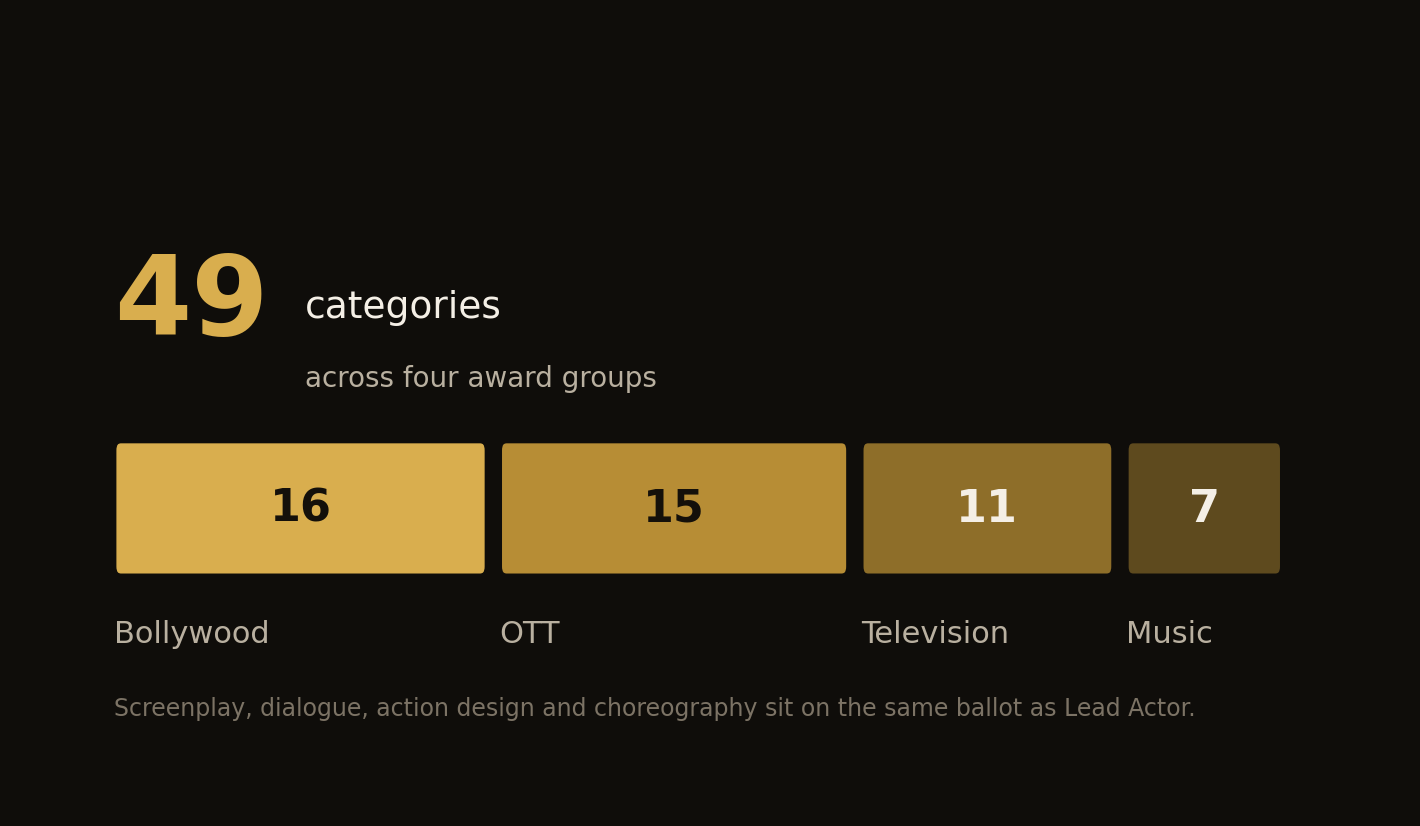
IFTA 2026 runs across 49 categories in four groups.
Bollywood — 16 categories. Film, Lead Actor, Lead Actress, Supporting Actor, Supporting Actress, Comic Role, Negative Role, Male Debut, Female Debut, Director, Screenplay, Story, Dialogue, Choreography, Action Design and Cinematography.
OTT — 15 categories. Series, Film, Lead Actor, Lead Actress, Supporting Actor, Supporting Actress, Negative Role, Comic Role, Breakthrough Male, Breakthrough Female, Director, Showrunner, Documentary, Non-Fiction and Ensemble Cast.
Television — 11 categories. Serial, Lead Actor, Lead Actress, Supporting Actor, Supporting Actress, Negative Role, Comic Role, TV Jodi, Reality Show, News Anchor and Show Host.
Music — 7 categories. Male Playback Singer, Female Playback Singer, Music Album, Bollywood Song, Party Song, Dance Track and Romantic Song.
The spread matters. Screenplay, dialogue, action design and choreography sit on the same ballot as Lead Actor — crafts that jury awards often bury inside a technical block get voted on directly by the people who noticed them.
Has this produced interesting results?
Yes, and the record is public. In the last edition, Shershaah took Most Popular Bollywood Film on 5,201 votes, with Sidharth Malhotra taking Lead Actor on 3,744 for his portrayal of Captain Vikram Batra. Rohit Shetty won Director on 1,760. Pankaj Tripathi took Comic Performance on 988. Shreya Ghoshal won Female Playback Singer on 2,167, and Samantha Ruth Prabhu took OTT Lead Actress on 1,424.
Put that list beside the jury awards from the same period and the overlap is partial, not total. That gap is the entire point of a people’s choice award.
How to take part in IFTA 2026
Nominations are open now. You can suggest a nominee in any of the 49 categories, and when voting opens the ballot will be built from names the country put forward and the research team verified.
No jury. No award fixing. Just India voting.