Most awards publish a winner. IFTA publishes a winner and a number.
That second detail turns out to be the interesting one. Because IFTA is decided entirely by public vote, every result from the last edition came attached to a vote count — and read side by side, those counts say something about Indian viewing habits that the trophies alone do not.
Shershaah did not just win. It swept.
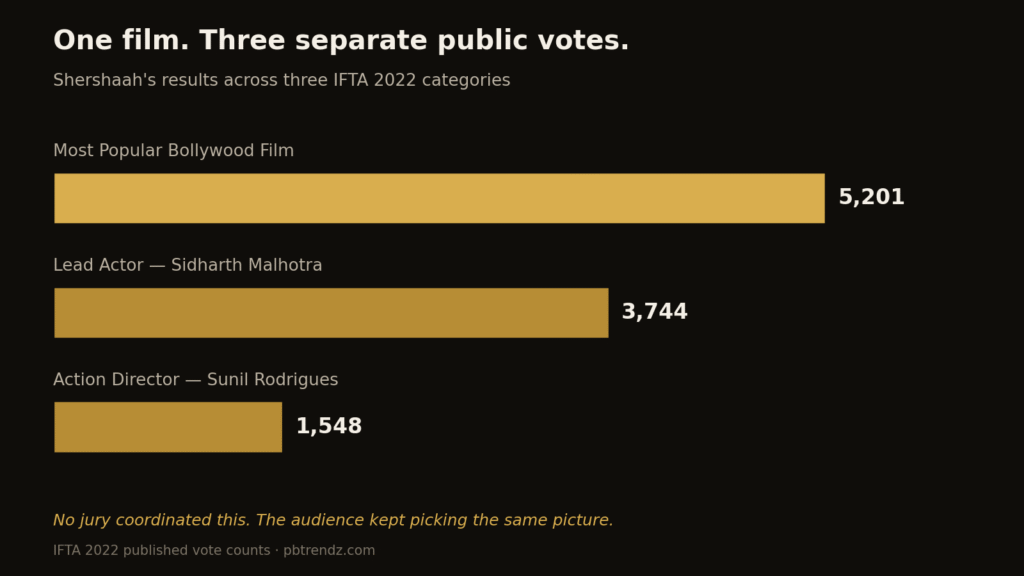
The clearest story of the edition was a single film. Shershaah took Most Popular Bollywood Film on 5,201 votes, the highest count in the film categories. Sidharth Malhotra took Lead Actor on 3,744 for his portrayal of Captain Vikram Batra. Sunil Rodrigues took Action Director on 1,548 for the same film.
Three categories, one film, decided by three separate public votes. No jury coordinated that. The audience simply kept picking the same picture.
Television out-voted Bollywood
Here is the result that should genuinely change how people think about Indian awards.
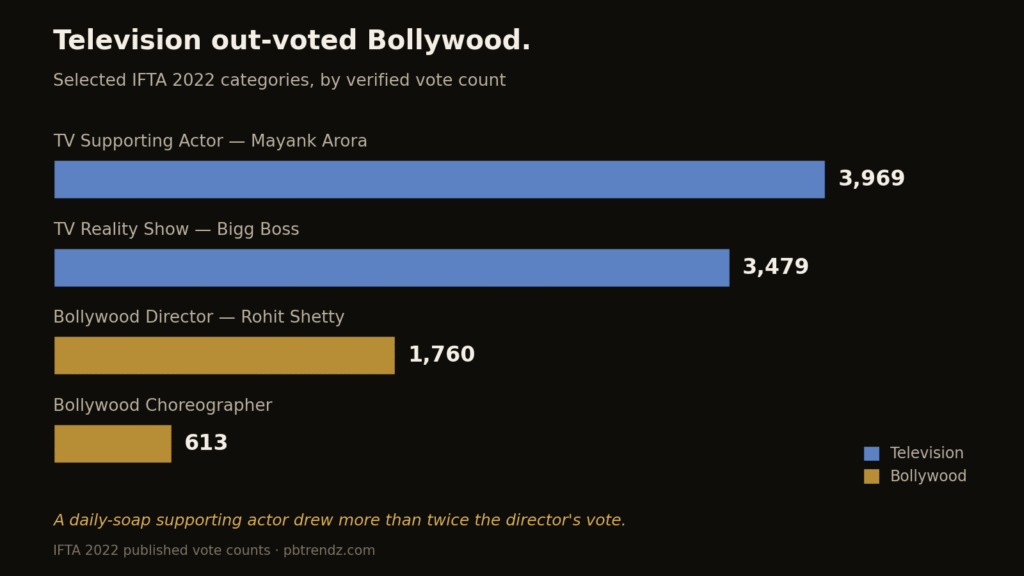
Most Popular Television Supporting Actor went to Mayank Arora for Yeh Rishta Kya Kehlata Hai on 3,969 votes. Most Popular Bollywood Director went to Rohit Shetty on 1,760.
A supporting actor on a daily soap pulled more than twice the votes of the year’s most popular Bollywood director. Not because the director was unpopular — but because television audiences in India turn up, and they turn up in numbers that film-first awards rarely bother to measure.
The same pattern repeats. Bigg Boss took Most Popular Television Reality Show on 3,479 votes. Bollywood Choreographer was decided on 613. Both are legitimate results. They just describe different-sized rooms.
A debut beat almost every established name
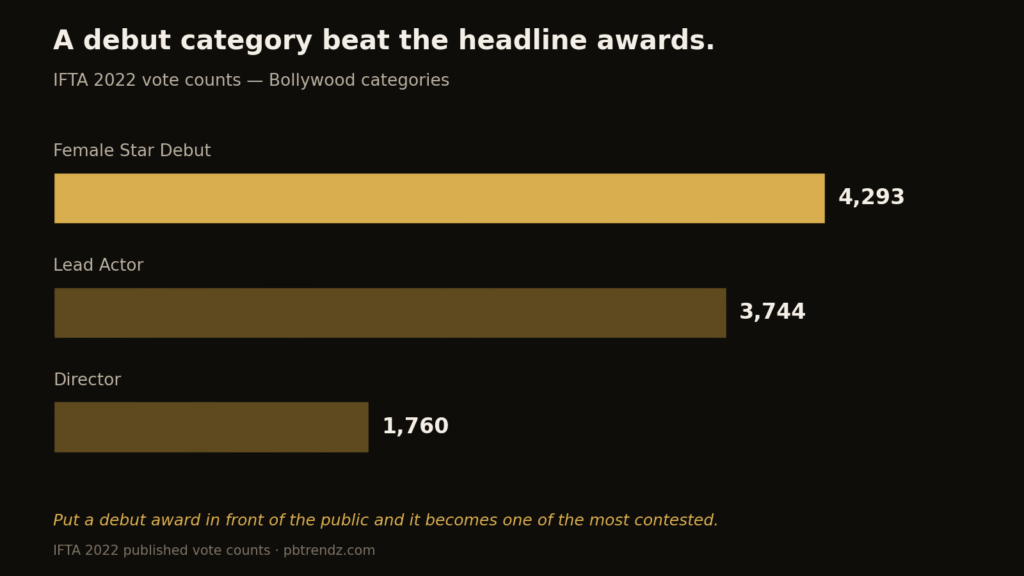
Most Popular Bollywood Female Star Debut drew 4,293 votes — higher than Lead Actor, higher than Lead Actress, higher than Director.
Debut categories are usually an afterthought at jury awards, slotted in near the end of the night. Put the same category in front of the public and it becomes one of the most contested on the ballot. New faces mobilise audiences in a way that established stars, already secure, often do not.
Where the music vote landed
Shreya Ghoshal took Most Popular Female Playback Singer on 2,167 votes. Tanishk Bagchi took Music Composer on 1,032. Most Popular Music Album went to Yo Yo Honey Singh in collaboration with Neha Kakkar on 2,507.
Ganesh Acharya took Choreographer for O Antava from Pushpa — a South Indian production winning a Bollywood-facing category, which tells its own story about how Indian audiences had already stopped drawing that border.
OTT was still finding its scale
Manoj Bajpayee took Most Popular OTT Lead Actor on 834 votes. Samantha Ruth Prabhu took OTT Lead Actress on 1,424.
Those are the smallest headline counts of the edition — and they are the numbers most likely to look unrecognisable next time. Streaming has moved a long way since, and the OTT block on the 2026 ballot has grown to fifteen categories, including Showrunner, Ensemble Cast and separate Breakthrough awards. If the vote counts there do not multiply, something odd has happened.
Why publish the numbers at all?
Because a people’s choice award that hides its counts is asking for trust it has not earned. IFTA has no jury, no panel and no closed-door deliberation — so the vote is the entire argument. Showing it is not a flourish. It is the proof.
IFTA 2026 is open for nominations now, across 49 categories. Same model, no jury, and the counts will be published again.