

Advertisement

- Updated on April 18, 2026
- IST 5:22 am
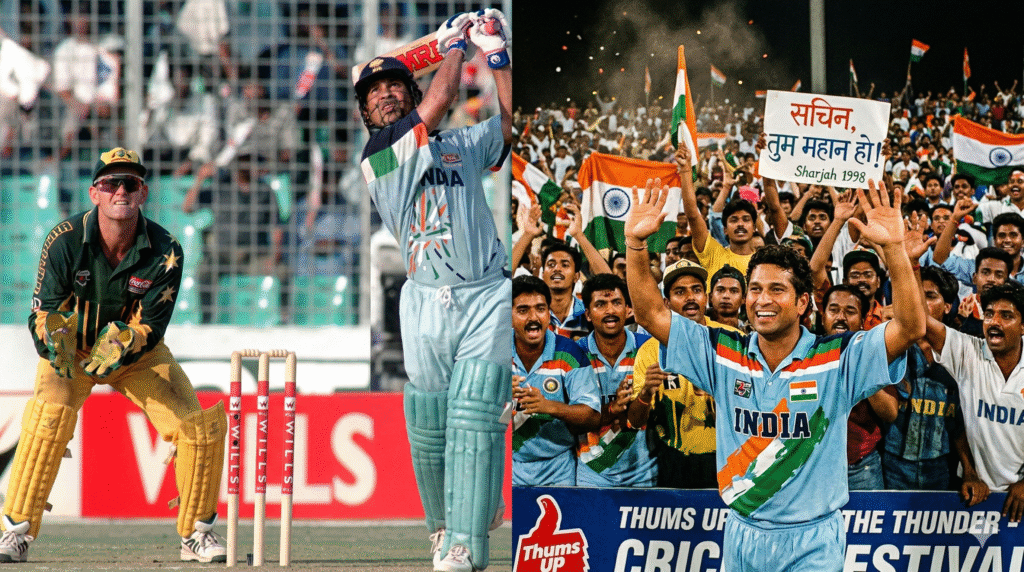
Imagine this: It’s April 22, 1998. A 15-year-old cricket-crazy kid named Rohan from a small Mumbai chawl is glued to his family’s tiny black-and-white TV. The living room is packed—uncles, cousins, even the neighbor auntie who usually complains about the noise. Australia have piled up 284/7, and India are chasing 285 in a must-win league clash in Sharjah to stay alive in the Coca-Cola Cup tri-series. Then, out of nowhere, a swirling sandstorm engulfs the stadium. Play stops for 25 minutes. The target is revised to 276 in 46 overs. Rohan’s heart sinks. “Bas, ab kya hoga?” he whispers. The Australian bowlers—Shane Warne, Damien Fleming, Tom Moody—are licking their lips. India look doomed.
Now, picture Arjun, a 28-year-old office-goer in Delhi, watching the same match on a borrowed color TV with friends. He’s seen Sachin Tendulkar grow from a curly-haired teen to a 24-year-old phenomenon, but nothing prepares him for what unfolds next. In the choking desert heat and dust, one man turns the game into poetry in motion. Sachin decimates the world-class attack, scores a breathtaking 143 off just 131 balls, and single-handedly drags India past the revised net-run-rate threshold needed to qualify for the final against New Zealand. India lose the match by 26 runs, but Sachin’s genius ensures they’re in the title clash. Two days later, on his 25th birthday, he slams another 134 and lifts the trophy. For Arjun, it’s pure magic. “Sachin ne kiya, India jeet gayi!”
So, what’s the truth behind that unforgettable night in Sharjah? Was Sachin Tendulkar’s Desert Storm innings a once-in-a-lifetime miracle forged in sand and sweat, or the defining masterclass of the greatest ODI batsman ever? With India’s hopes hanging by a thread in 41-degree heat, swirling dust, and boos from a packed stadium, could one 24-year-old really silence a superpower like Australia and rewrite cricket history? In this blog, we’ll relive the tension, the shots, the heartbreak, and the glory. We’ll unpack the risks, the rewards, and the real-life impact on millions of Indian fans who grew up worshipping the Little Master. Plus, we’ll share lessons from that night that still inspire every cricket lover today. Let’s step into the desert and relive the storm together!
The Backdrop: High Stakes in the Sharjah Desert – The 1998 Coca-Cola Cup
To understand why Sachin’s 143 was legendary, you first need the full picture. The 1997-98 Coca-Cola Cup was a three-team tri-series in the UAE featuring India, Australia, and New Zealand. Australia, the No.1 side in the world, had dominated the league stage. India and New Zealand were scrapping for the second final spot on net run rate (NRR). The April 22 match against Australia was India’s last league game—a virtual knockout. Lose badly, and they’d be packing their bags. Win or stay close enough, and they’d face New Zealand in the final.
Australia won the toss and batted first under blazing lights. Mark Waugh and Michael Bevan (who smashed an unbeaten 101) powered them to 284/7 in 50 overs. The Sharjah Cricket Association Stadium was a cauldron—intense heat, hostile crowd, and those tricky, slow pitches that favored spinners like Warne. India needed a near-perfect chase. Early wickets fell: Sourav Ganguly lbw for 17, then Nayan Mongia (35) and Mohammad Azharuddin (14) couldn’t build a platform. At 107/2, pressure was mounting. Enter the sandstorm. Play halted. Target revised to 276 in 46 overs. Suddenly, every run mattered more. India had to score at nearly 6 runs per over while protecting wickets. Most teams would crumble. But one man had other ideas.
Think of it like a seesaw in a cyclone—India’s hopes teetering on the edge, Australia’s bowlers ready to push it over. That’s when Sachin stepped up, bat in hand, eyes locked on destiny.
Sachin Tendulkar: The 24-Year-Old Phenomenon Ready to Explode
At 24, Sachin wasn’t yet the “God of Cricket” to the world—he was still building his legend. Already a Test centurion at 17 and an ODI mainstay, he had 14 ODI hundreds but carried the weight of a billion dreams. Indian cricket in the late 90s was a rollercoaster: no T20s, limited sponsorships, and constant pressure to beat Australia, the ultimate benchmark. Sachin had faced Warne before, but never in conditions this brutal.
He walked in at No.3 with the score at 38/1. The crowd—mostly Indian expats mixed with Aussies—was electric yet tense. Boos rang out when he arrived (Australia’s fans weren’t shy). But Sachin? He just smiled that calm, focused smile. No helmet drama, no theatrics—just pure intent. His technique was textbook yet explosive: light feet, heavy bat, and an uncanny ability to read bowlers before they released. Against Fleming’s swing, Warne’s guile, Kasprowicz’s bounce, and Moody’s cutters, he looked like a man playing a different game. This wasn’t just batting; it was a statement. India’s hopes rested on his shoulders, and he knew it.
The Desert Storm Unfolds: Timing, Chaos, and Genius
The innings didn’t start with fireworks. Sachin eased into it, respecting the new ball and building quietly with Mongia. But once the storm hit and the target tightened, he shifted gears like a Formula 1 driver spotting an opening. The revised equation demanded aggression without recklessness. Sachin delivered both.
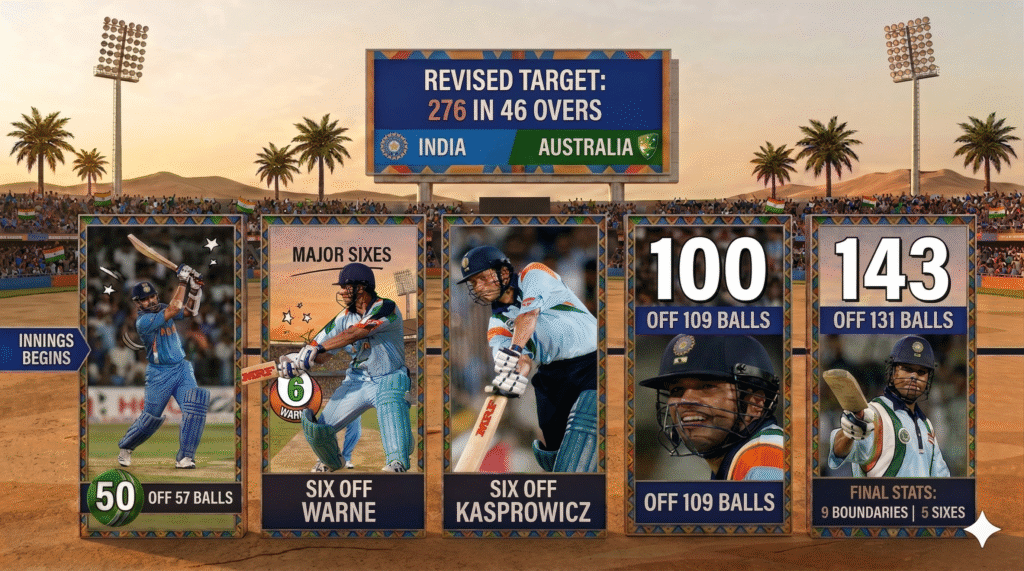
He reached his fifty off 57 balls with a mix of elegant drives and powerful pulls. Then came the acceleration. Against Warne—the king of leg-spin—he danced down the track repeatedly, turning good lengths into half-volleys and launching them into the stands. One six over long-on still gives goosebumps to anyone who watched it live. Against Kasprowicz, he pulled and hooked with disdain. Fleming’s short balls were dispatched to the boundary with a flick of the wrist. By the time he brought up his hundred off 109 deliveries, the Australian attack looked ordinary. India were flying at nearly 9 runs per over in the death overs—a rare feat in 1998.
Key partnerships kept the innings alive: with Azharuddin briefly, then Jadeja. But it was Sachin who faced the brunt—131 balls, 9 fours, 5 sixes, strike rate 109.16. He even bowled 5 overs and took a wicket earlier, showing all-round class. When he finally edged Fleming to Gilchrist for 143 (India at 242/5 in 42.5 overs), the crowd stood in stunned silence before erupting. India fell short at 250/5, losing by 26 runs under D/L, but Sachin’s heroics boosted NRR enough to pip New Zealand and qualify for the final.
The Big Debate: Was This the Greatest ODI Innings Ever?
Here’s where opinions divide cricket fans even today. The pros are crystal clear. Weight of the occasion? Massive—qualification on the line. Conditions? Brutal heat, sand in eyes, revised target pressure. Opposition? World-class attack led by Warne at his peak. Execution? Flawless pacing, footwork against spin, power against pace. Studies and fan polls (even decades later) often rank it among the top 5 ODI knocks. It wasn’t just runs; it was a masterclass in crisis management that inspired an entire generation.
Yet, balanced views exist. Some argue Sachin’s 134 in the final two days later (on his birthday, chasing 273) was equally epic—India won the trophy that night. Others compare it to later masterpieces like Kohli’s chases or Sehwag’s blitzes. Critics point out India still lost the league match, but that misses the point: without Sachin’s 143, there would’ve been no final. As one Australian player reportedly said later, “We lost to a man called Sachin.” Emotional connection? For Indian fans aged 15-45 today, it’s personal—it was the innings that made us believe one man could carry a nation.
The Indian Twist: How the Desert Storm Echoed in Every Desi Home
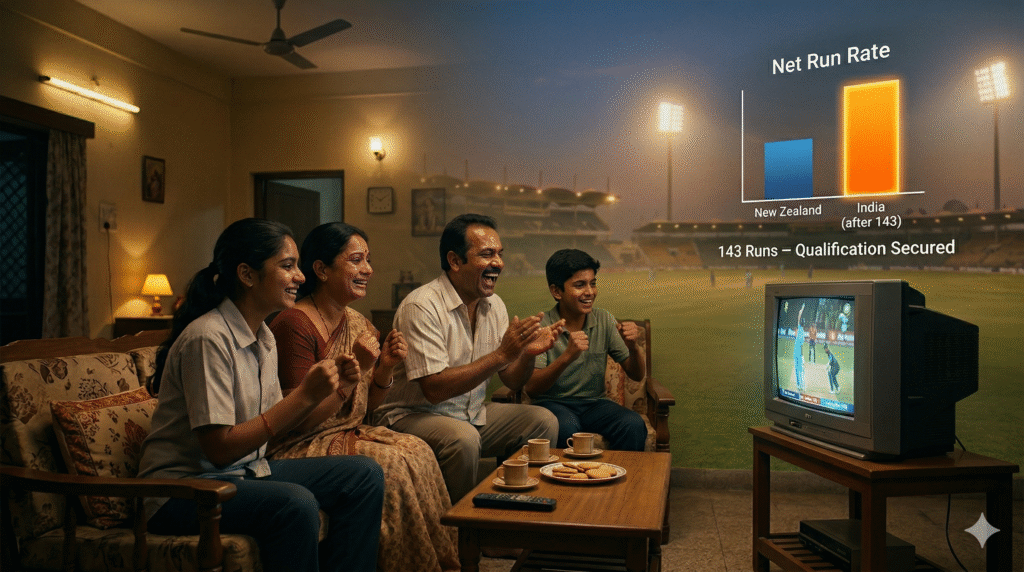
Fasting isn’t new to Indians, but cricket in the 90s was our religion. Sharjah matches were midnight affairs for families across India—rooftop antennas, power cuts, and collective prayers. The sandstorm felt like a metaphor for India’s struggles: unpredictable, harsh, yet full of hidden opportunity. Sachin’s knock wasn’t just cricket; it was a cultural moment. Kids skipped school the next day to replay highlights. Offices buzzed with debates. It fueled the “Sachin ka jadoo” era, where every boundary lifted national pride amid economic liberalization and satellite TV boom.
Our diets of chai and samosas paired perfectly with late-night cricket. But that night, the real fuel was hope. Sachin turned a desert into a stage for Indian resilience. It wasn’t about carbs or proteins—it was about heart, just like our festivals where one hero (think Rama or a local dada) carries the day.
Real Stories: Triumphs, Heartbreaks, and Lifelong Memories
Let’s hear from the fans who lived it.
- Rahul, 42, Bangalore: “I was in college hostel. TV in the common room. When Sachin hit that six off Warne, we all jumped and the tube light fell! Next day, we qualified. That innings taught me never to give up, even when the storm hits.”
- Priya, 38, Chennai: “As a girl in a conservative family, staying up for cricket was rare. But Dad let us watch. Sachin’s grit showed us women could dream big too. I still replay the highlights when life gets tough.”
These tales prove one thing: the Desert Storm wasn’t just Sachin’s story—it became ours.
Lessons from the Masterclass: Timeless Tips for Every Cricket Lover
Thinking of drawing inspiration from Sachin’s night? Here’s how to channel that Desert Storm spirit—whether on the field or in life:
- Ease Into Pressure: Start steady like Sachin’s first 50 balls. Build, then explode when the moment demands.
- Fuel Up Right: Face every challenge with preparation—technique, fitness, and mindset. Sachin read bowlers early; you read situations smartly.
- Adapt to the Storm: When conditions change (like the sandstorm), revise your plan instantly. Flexibility wins.
- Listen to Your Instincts: Track your “symptoms”—energy, focus, execution. If something’s off, adjust without panic.
- Get Expert Eyes: Seek guidance from mentors, just as Sachin learned from seniors. Teamwork amplifies individual brilliance.
- Chill Out and Enjoy: Stress kills joy. Sachin smiled through boos—keep the love for the game alive.
Desi Cricket Hacks: Reliving the Glory in Your Backyard
Want to recreate that magic? Gather friends for a gully cricket session under streetlights. Play “Desert Storm rules”—chase revised targets with handicaps. Watch the original highlights with family, analyze every shot over chai. Teach kids the footwork drills Sachin mastered. And remember: it’s not about winning every match, but playing with the heart of a champion.
Wrapping It Up: To Storm or Not to Storm? The Legend Lives On
So, does Sachin Tendulkar’s 143 in the 1998 Desert Storm worsen the debate on greatest innings or help settle it forever? It’s not black-and-white. For some, it’s the pinnacle of skill under impossible odds—slimming Australia’s ego and taming a fierce attack. For others, it’s one chapter in an unmatched career. The difference lies in how you view it: slowly, smartly, and with the eyes of a true fan.
If that night tempts you to revisit old highlights, dip your toes in. Start with the ball-by-ball videos, watch your body (and heart) react, and lean on fellow fans for stories. Cricket is a marathon, not a sprint, and Sachin showed us we’re tougher than any storm. What’s your take? Where were you when Sachin unleashed the Desert Storm? Drop your memories in the comments below—let’s swap notes, relive the glory, and keep the legend alive! Share this with your cricket gang and tag a friend who still gets chills thinking about that night. #SachinTendulkar143 #DesertStorm1998 #IndiaCricketHistory
You May Like This
1



Advertisement

You May Like This








Advertisement
Advertisement
Advertisement