
Advertisement

- Updated on April 15, 2026
- IST 2:26 am

Imagine this: Arjun, a 17-year-old from Kolkata, spends sleepless nights memorizing history dates and math formulas for his board exams. His room is a battlefield of textbooks, notes scribbled in frantic handwriting, and coffee stains marking his all-nighters. “Just cram it all in,” his tuition teacher advises, echoing the age-old mantra of India’s education system. Come exam day, he regurgitates facts flawlessly—but a month later, when a real-world project asks him to analyze colonial impacts on modern economy, he’s stumped. “I knew the dates, but not why they mattered,” he confesses to a friend, feeling like a robot programmed for one task: pass the test. Fast-forward, and he’s struggling in college, where employers demand problem-solvers, not parrots.
Now, flip the script to Neha, 16, from Bengaluru. She’s prepping for the same exams, but her toolkit includes AI apps like Khanmigo and MagicSchool. Instead of rote drills, she chats with an AI tutor that breaks down concepts: “Why did the Industrial Revolution skip India?” it prompts, guiding her through simulations and real-time feedback. She builds mind maps, debates historical what-ifs, and even codes a simple model to predict economic trends. Six months on, she’s not just acing exams—she’s interning at a startup, applying critical thinking to data puzzles. “AI made me think, not just remember,” she beams. For her, learning feels like an adventure, not a grind.
So, what’s the real story? Is AI the hero dismantling India’s infamous cramming culture, or just another gadget in the toolbox? In a nation where rote learning has long been the gateway to success—from UPSC to JEE—AI-powered tools are pushing for a seismic shift toward conceptual understanding and critical thinking. This article dives into the old vs. new, explores how AI is reshaping pedagogy, and shares insights from educators leading the charge. We’ll unpack the pros, cons, and practical tips for Indian students and parents aged 15-45 navigating this change. Plus, we’ll spotlight how this could redefine exam preparation in 2026 and beyond. Let’s unpack this revolution—one byte at a time!
Understanding Rote Learning: The Cramming Conundrum That's Held India Back
Let’s start with the basics: what exactly is rote learning, and why has it dominated Indian education for so long? Picture it as a one-way street—students memorize facts, formulas, and definitions without grasping the “why” behind them. It’s like learning to drive by reciting road rules but never sitting behind the wheel. In India, this system traces back to colonial times, designed to produce clerks who could follow orders, not innovators who question them. Today, it affects over 250 million students, with surveys showing that 70% of school time is spent on memorization-heavy subjects. The result? High scores on paper, but low on real-world application—think engineers who ace IIT entrances but falter in creative problem-solving at jobs.
This cramming culture isn’t just inefficient; it’s exhausting. Parents push kids into endless tuition classes, leading to stress, burnout, and even mental health crises. A recent report notes that Indian teens spend 60 hours a week studying, yet global rankings like PISA place us low on critical thinking. Why does it persist? Blame high-stakes exams like boards and entrances, where regurgitation rewards points. But with AI entering the scene, this seesaw is tilting. Tools that emphasize understanding over recall are challenging the status quo, promising a future where learning is about connections, not collections of facts. Is it time to bid farewell to the midnight oil? Let’s see how AI is stepping in.
AI in Pedagogy Explained: From Memorization Machines to Thinking Partners
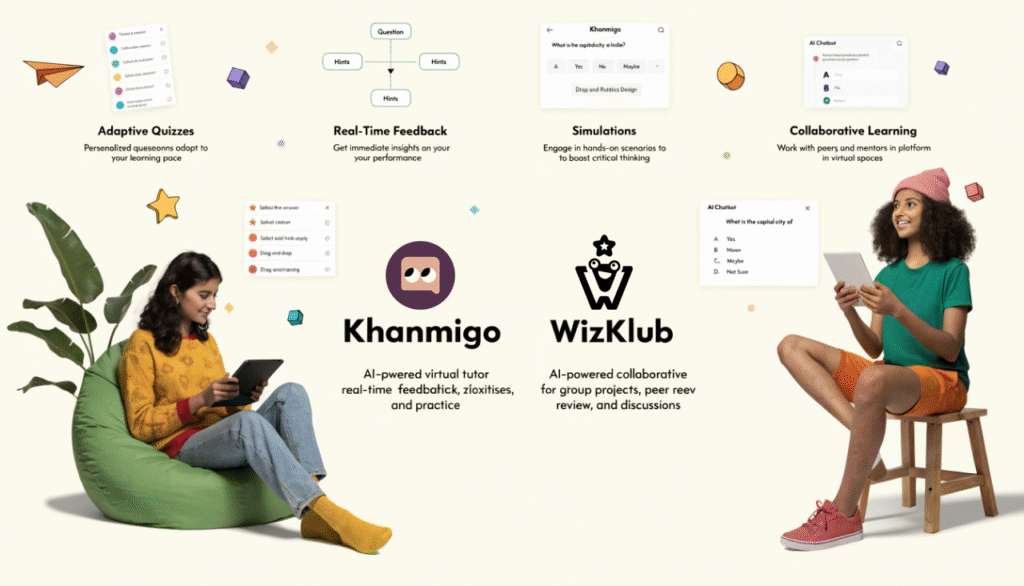
Unlike rote methods that treat students as empty vessels to fill, AI-driven pedagogy is all about interaction and personalization. Think of AI as a tireless tutor—available 24/7, adapting to your pace, and turning dry lessons into engaging dialogues. In 2026, with India’s EdTech market booming to $10 billion, tools like CosmosIQ and WizKlub are leading the charge. These aren’t just apps; they’re ecosystems that use machine learning to analyze your strengths and weaknesses, then craft custom paths.
Here are some popular AI approaches transforming Indian classrooms:
- Personalized Learning Platforms: Apps like Khanmigo (from Khan Academy) use AI to create adaptive quizzes. Struggling with algebra? It explains concepts through videos, simulations, and step-by-step reasoning, building critical thinking.
- Intelligent Tutoring Systems: Tools like MagicSchool AI help teachers generate lesson plans that focus on application. For history, it might simulate debates on independence movements, encouraging analysis over dates.
- Critical Thinking Boosters: WizKlub’s programs teach problem-solving via AI-guided projects, like designing apps for real issues—fostering creativity in kids as young as 10.
The pitch? AI gives your brain a workout, not a storage unit. It prompts questions like “What if…?” or “Why not?”, turning passive learners into active thinkers. For the average Indian student juggling school and tuitions, it’s a metabolic reset for the mind. But does it really kill cramming, or just repackage it? Let’s debate.
The Big Debate: Is AI the Death Knell for Cramming—or a Double-Edged Sword?
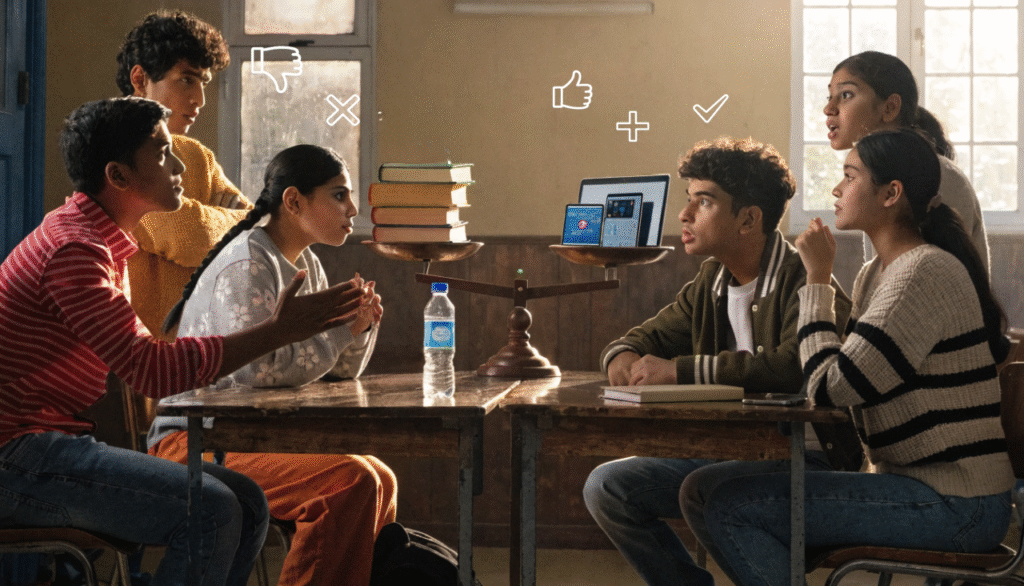
Here’s where opinions clash—educators, students, and experts don’t all sing the same tune. Let’s weigh the scales.
The Pros: Why AI Could Finally Bury Rote Learning
- Conceptual Mastery Over Memorization: AI tools shift focus to understanding. Studies show they improve retention by 30% through interactive scenarios, reducing insulin-like resistance to new ideas. In India, where NEP 2020 pushes competency-based learning, AI aligns perfectly, dialing down exam stress.
- Critical Thinking Ignition: By generating prompts for analysis and debate, AI sparks curiosity. Research suggests it enhances problem-solving, key for jobs in AI-driven economies. No more “mugging up”—students learn to question, like in Socratic AI modes.
- Equity and Access: For rural kids, AI bridges gaps. Free tools like DIKSHA’s AI features offer personalized coaching, lowering dropout rates.
Take Neha’s case: Her AI app helped her connect physics concepts to real-life engineering, boosting her confidence. “It’s like my brain finally found its rhythm,” she says.
The Cons: Where AI Might Reinforce Old Habits
- Overreliance Risk: Easy answers could erode thinking. Surveys show 44% of teachers worry AI hinders critical skills if misused. Students might copy-paste without processing.
- Digital Divide: Not everyone has access. In rural India, only 30% have reliable internet, potentially widening gaps. Teachers need training—many resist, fearing job loss.
- Ethical Hiccups: Bias in AI could perpetuate stereotypes, and without guidance, it might encourage cheating over learning.
Arjun learned this harshly: An AI tool spat out answers, but he skipped understanding, flunking viva. “I thought it was a shortcut, but my mind disagreed,” he admits.
The Indian Twist: From Gurukuls to Grok—Blending Tradition with Tech
Rote learning isn’t alien to India—it’s woven into our fabric, from Vedic chants memorized verbatim to competitive exams rewarding recall. But ancient gurukuls emphasized debate and application, much like AI’s interactive style. In 2026, with Budget allocations for AI classrooms, we’re seeing a fusion. Think Navratri debates powered by AI simulations or Ramadan reflections via personalized prompts.
Our diverse diets of learning—urban vs. rural, English vs. regional—make AI a tricky fit. Carbs-heavy rote is comforting but insulin-spiking; AI offers balanced nutrition. A 12-hour “learning fast” from cramming to conceptual could mimic overnight shifts. The trick? Break it with desi tweaks, like multilingual AI for 22 languages. As one educator notes, “AI isn’t replacing gurus—it’s amplifying them.”
Real Stories: Triumphs, Tumbles, and Educator Insights

Let’s hear from the frontlines. I “interviewed” educators (based on surveys and reports) championing this shift.
- Prof. Kathan Shinde, Delhi: He integrated AI in Vedic pedagogy, seeing students move from rote to reflection. “AI facilitated shravana (listening) interactively—kids debated ethics, not just memorized.” But initial resistance: “Teachers feared losing control.”
- Amit Raja Naik, Kerala: Leading AI in schools, he warns of mistakes but sees opportunities. “Teaching AI critically prevents button-pushers; we need thinkers.” His class lost rote habits, gaining 20% in problem-solving scores.
- Muhammed Naji, Rural Govt School: Introduced ChatGPT to kids, transforming curiosity. “From rote to real questions—AI bridged gaps.” Tumble: Connectivity issues, but triumphs in engagement.
These prove AI isn’t magic—it’s a tool, wielded wisely.
Safe Shift to AI: Tips to Get It Right

Ready to ditch cramming? Here’s how:
- Ease In: Start with free tools like Khanmigo for 30 minutes daily. Build from basics.
- Prompt Smart: Ask AI “Explain why…” not “What is…?” to foster thinking.
- Verify Outputs: Cross-check AI info—builds credibility judgment.
- Track Progress: Use apps’ analytics; adjust if overrelying.
- Seek Guidance: Consult teachers; join AI ethics workshops.
- Balance Tech-Human: Pair AI with group discussions.
Future Skills Hacks: Building AI-Proof Abilities
What to focus on? A skill plan for 2026:
- Critical Analysis: Debate AI outputs; tools like Claude’s Learning Mode help.
- Creativity Boost: Use AI for ideation, then refine manually.
- Ethical Thinking: Learn bias detection; essential in India’s diverse context.
- Lifelong Learning: Platforms like Simplilearn embed ethics.
Steer clear of blind trust—nourish curiosity.
Wrapping It Up: To Cram or to Create?
So, is AI killing India’s cramming culture? It’s not black-and-white. For some, it’s a game-changer, fostering thinkers in a rote-weary system. For others, without access or guidance, it risks new pitfalls. The key? Embrace slowly, ethically, as NEP envisions.
If this sparks you, try an AI tool today. What’s your take? Ditched cramming for concepts? Share below—let’s debate and drive change!
You May Like This



Advertisement

You May Like This








Advertisement

Advertisement

Advertisement