

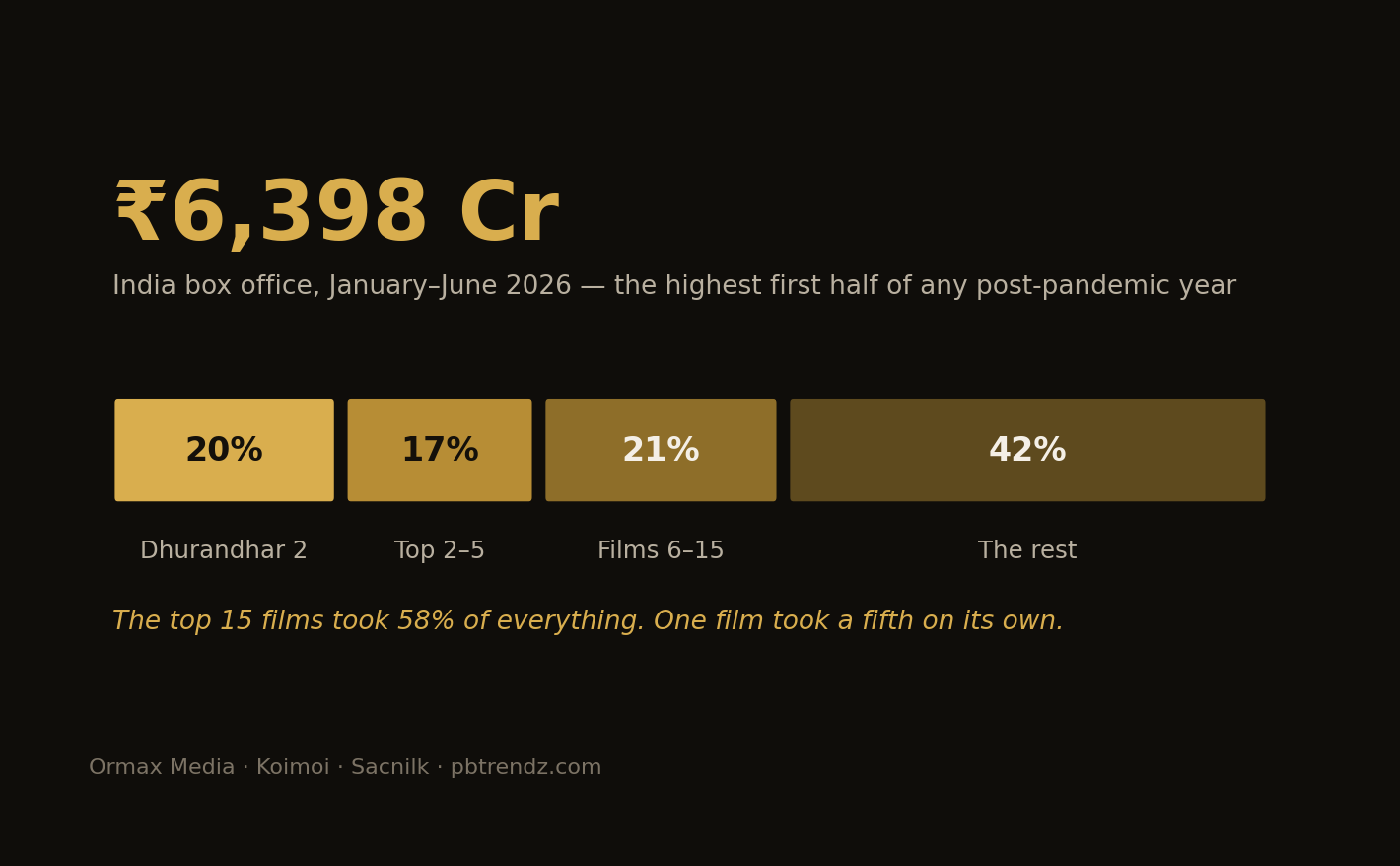
Half of everything India spent at the cinema in the first six months of 2026 came from fifteen films. One film took roughly a fifth of the entire market on its own.
The interesting question is not which film won the year. We know that. It is whether winning the year and being the year’s favourite are the same thing — because nothing about a box-office table answers that.
The year was big, and it was narrow
India’s box office took ₹6,398 crore in the first half of 2026, according to Ormax Media’s half-year report. That is the strongest first half of any post-pandemic year, around ₹650 crore ahead of the same period in 2025.
Two numbers inside that matter more than the headline. Footfalls reached 37.8 crore, up 5 per cent — the first increase after three straight years of decline. People came back to cinemas, not just to higher ticket prices. And the Hindi share of the national box office rose to 44 per cent from 39 per cent.
The third number is the one nobody puts in a press release. Six films crossed ₹200 crore. The top fifteen films accounted for 58 per cent of all collections. When a market is that top-heavy, the gap between attendance and affection gets wide enough to drive a bus through.
The six that carried it
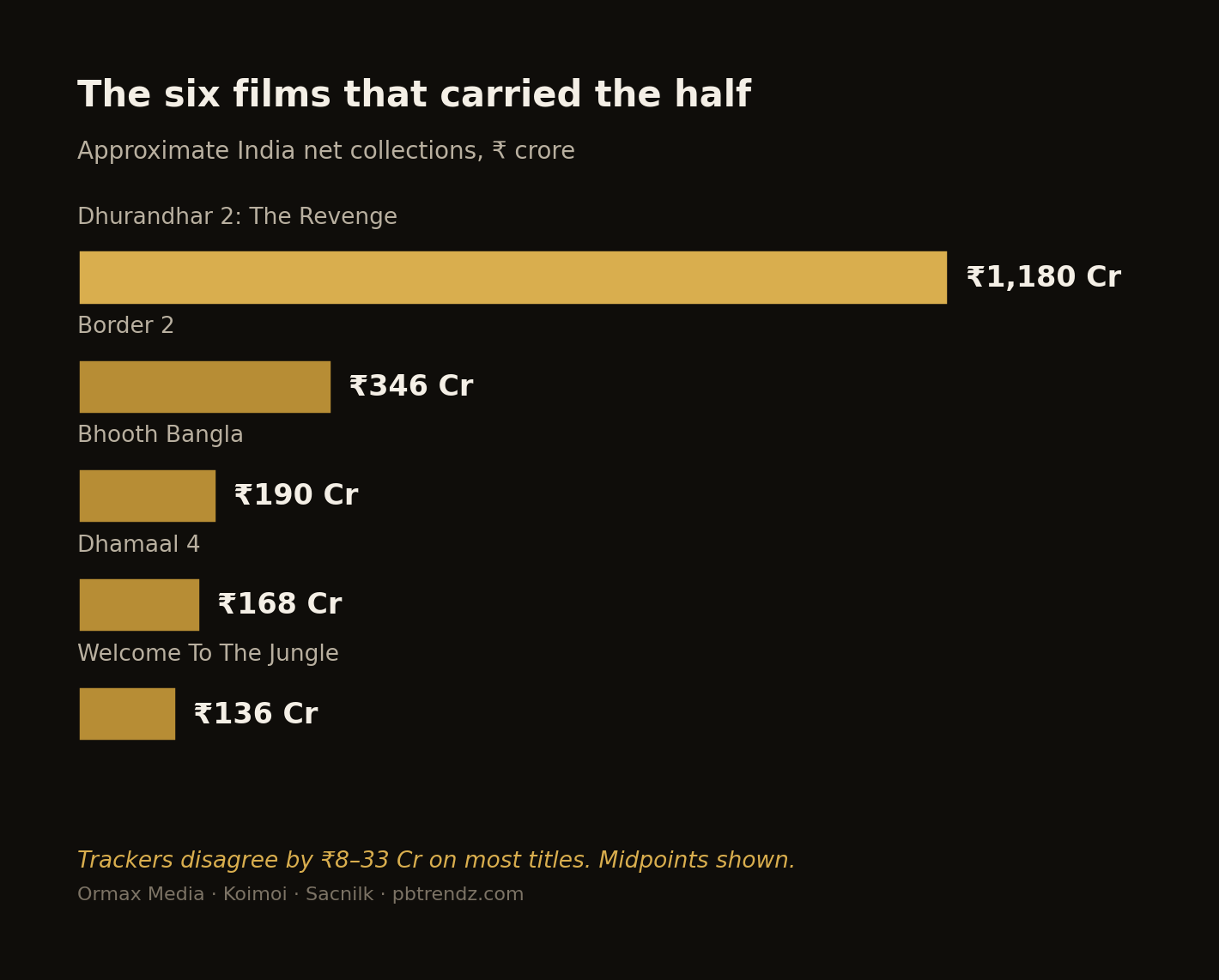
Dhurandhar 2: The Revenge (Aditya Dhar; Ranveer Singh, Arjun Rampal, Sanjay Dutt, R. Madhavan; 19 March) is the film that reshaped the half. Roughly ₹1,180 crore India net — Koimoi puts it at ₹1,186 crore, Sacnilk at ₹1,149 crore — and around ₹1,830 crore worldwide, on a reported ₹225 crore budget. It opened at approximately ₹145 crore on day one, the biggest Hindi opening ever recorded in India. On its own it accounts for about 20 per cent of all-India collections for the half.
Border 2 (Anurag Singh; Sunny Deol, Varun Dhawan, Diljit Dosanjh, Ahan Shetty; 23 January) landed between ₹330 and ₹363 crore net depending on which tracker you read, with worldwide numbers in the ₹422–450 crore range against a ₹175 crore budget. A clean success.
Bhooth Bangla (Priyadarshan; Akshay Kumar in a dual role, Tabu, Wamiqa Gabbi; 17 April) did ₹182–199 crore net and ₹260–271 crore worldwide. That makes it Priyadarshan’s highest-grossing film ever and Akshay Kumar’s third-biggest of the post-pandemic period, with over a crore of footfalls in India alone.
Dhamaal 4 (Indra Kumar; 10 July) took ₹164–173 crore net, around ₹225 crore worldwide — the highest-grossing entry in the franchise domestically.
Welcome To The Jungle (Ahmed Khan; 26 June) came in at ₹134–138 crore net and ₹193–196 crore worldwide against a ₹125 crore budget.
Those are the films that made the year’s arithmetic work. None of that tells you which one anybody loved.
The two films that won on love
The most interesting stories of the half are not in the top five.
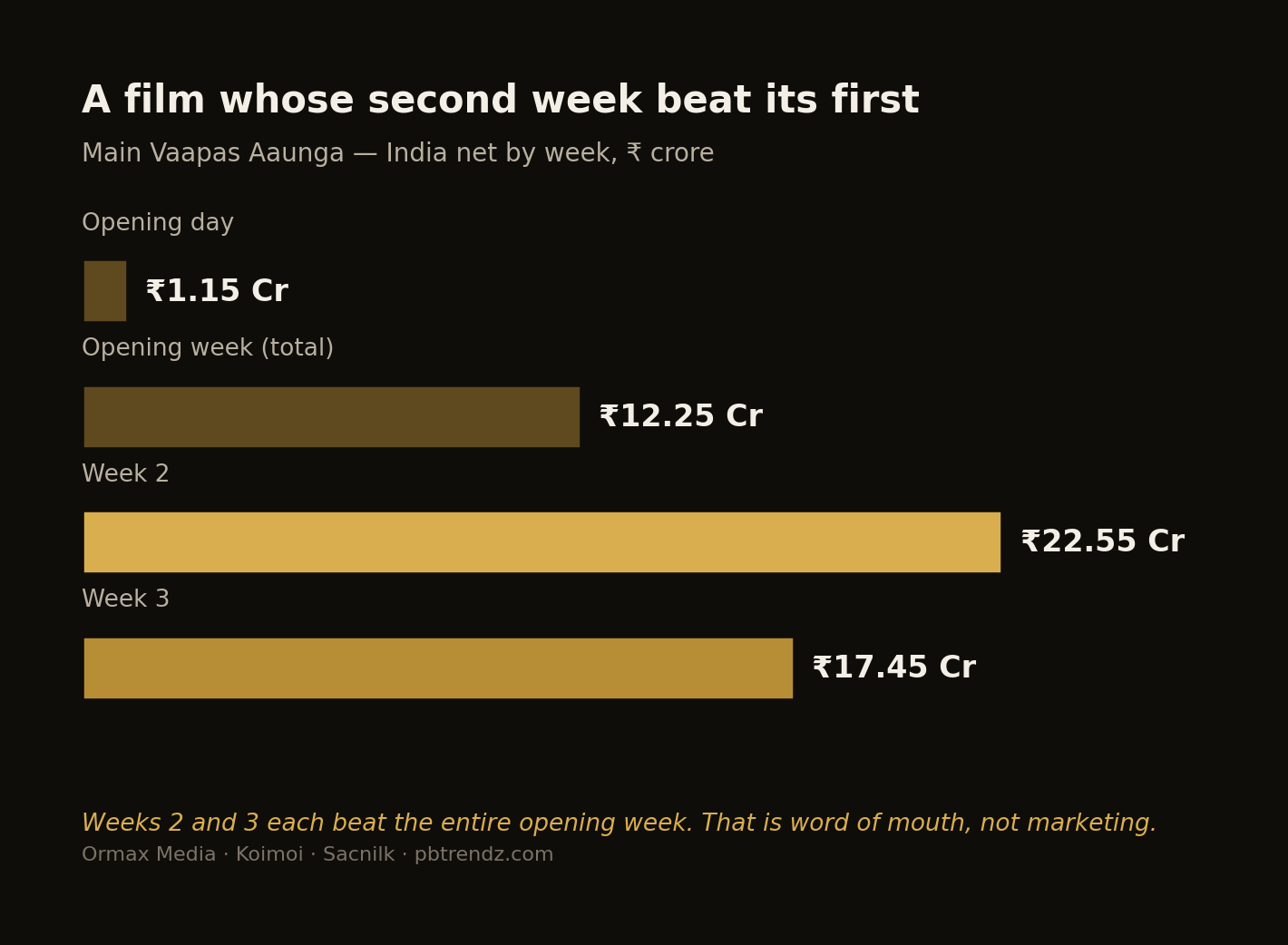
Main Vaapas Aaunga (Imtiaz Ali; Diljit Dosanjh and Naseeruddin Shah, with a score by A.R. Rahman) opened at ₹1.15 crore. One crore, fifteen lakh, on day one. By any normal reading that is a film that has already failed.
Then week two took ₹22.55 crore and week three took ₹17.45 crore — each of them individually larger than the entire opening week’s ₹12.25 crore. It closed at roughly ₹99 crore worldwide. Almost nothing behaves like that. It is the shape of a film that people saw and then told other people to see.
And even here the trackers cannot agree. Sacnilk classes it as a sleeper hit. Koimoi’s profitability table marks it as losing. Both are looking at the same film.
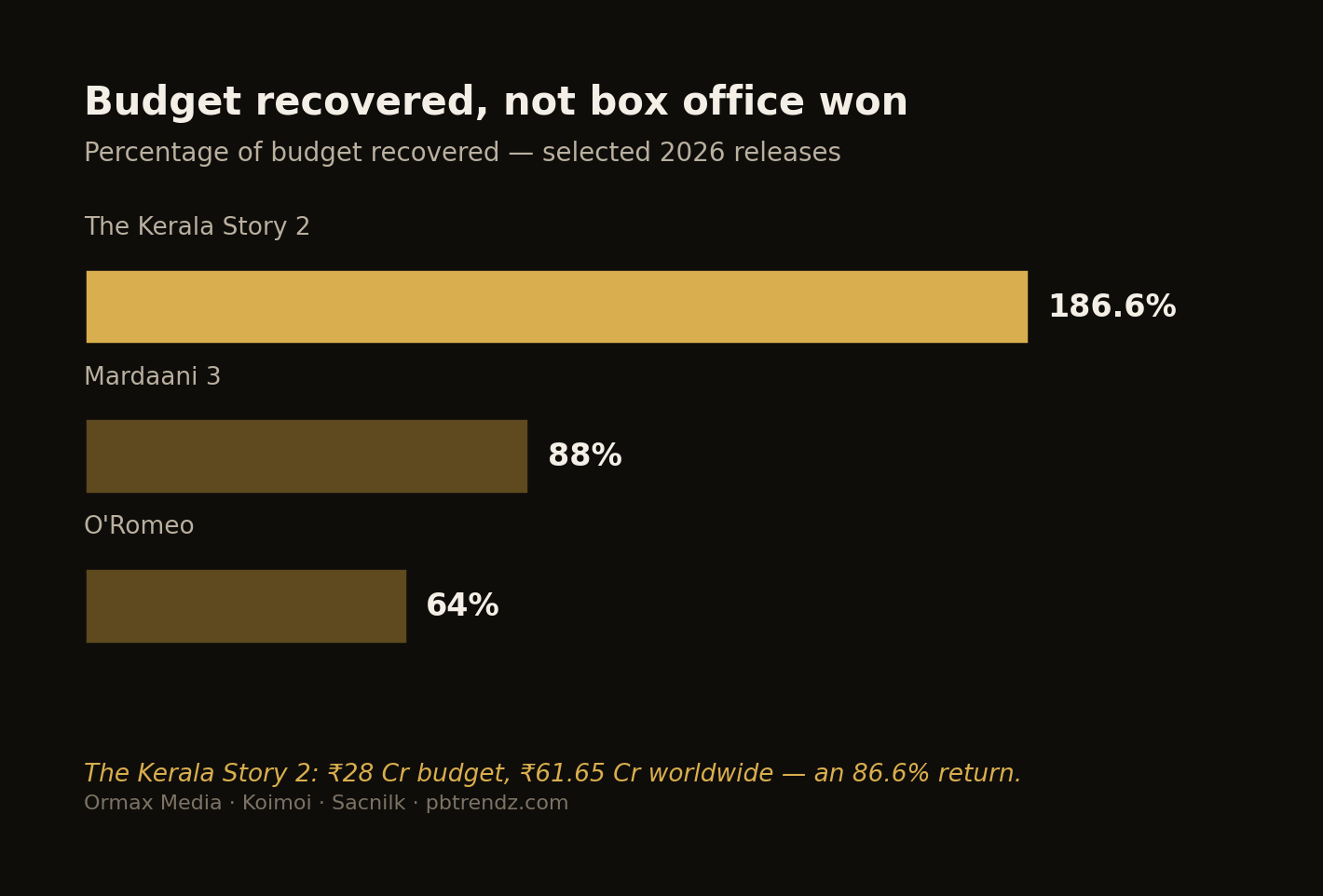
The Kerala Story 2 is the year’s cleanest return-on-investment story: a ₹28 crore budget against ₹61.65 crore worldwide, an ROI of 86.6 per cent, achieved despite a Kerala High Court interim stay that damaged its opening day.
Neither film will win a category on collections. Both are exactly the kind of film a public vote surfaces and a spreadsheet buries.
The failures, without the euphemisms
A year is not honestly described by its winners alone.
O’Romeo, Vishal Bhardwaj’s film with Shahid Kapoor, cost around ₹130 crore and recovered 64 per cent of it. Alpha cost ₹100 crore, recorded the lowest opening in the history of the YRF Spy Universe, and missed ₹100 crore worldwide by under a crore. Mardaani 3 recovered 88 per cent. Cocktail 2 underperformed against expectations set by its own soundtrack.
Some of these films have real defenders. O’Romeo‘s cinematography was praised by critics who disliked everything else about it. That is a genuine tension, and it is precisely the sort of thing a craft category exists to resolve.
What the box office cannot tell you
A ticket is a decision made before you have seen the film. It is a bet on a trailer, a star, a Friday, a friend who was free. By the time you know whether the film was any good, the money has already been counted.
That is the whole limitation. Box office measures anticipation with great precision and appreciation not at all. It cannot separate the film you queued for from the film you would defend in an argument. It cannot tell you that a film which opened at ₹1.15 crore ended up meaning more to the people who saw it than one that opened at ₹145 crore.
Only asking answers that. IFTA’s sixteen Bollywood categories are decided by public vote, with the counts published alongside the winners — and this year’s ballot has an unusually clear question at the centre of it: was the biggest film of the year also the best-liked one?
Nominations for IFTA 2026 are open. Tell us which films belong on the ballot — comment on the nomination post for your category at @ifta.official on Instagram. Voting opens 30 August.
Half-year market figures from Ormax Media’s India Box Office Report, January–June 2026. Individual film collections as reported by Koimoi and Sacnilk, which differ; ranges are given where they disagree.