

Advertisement

- Updated on August 24, 2026
- IST 12:01 am
Public voting for IFTA 2026 opens on 30 August. Forty-nine categories, four award groups, and no jury sitting above any of it.
If you have only ever watched awards happen to you — a winner announced, a speech, an argument on social media the next morning — this is the part where you get a say. Here is exactly how it works, what is being decided, and what you need to do.
The three stages
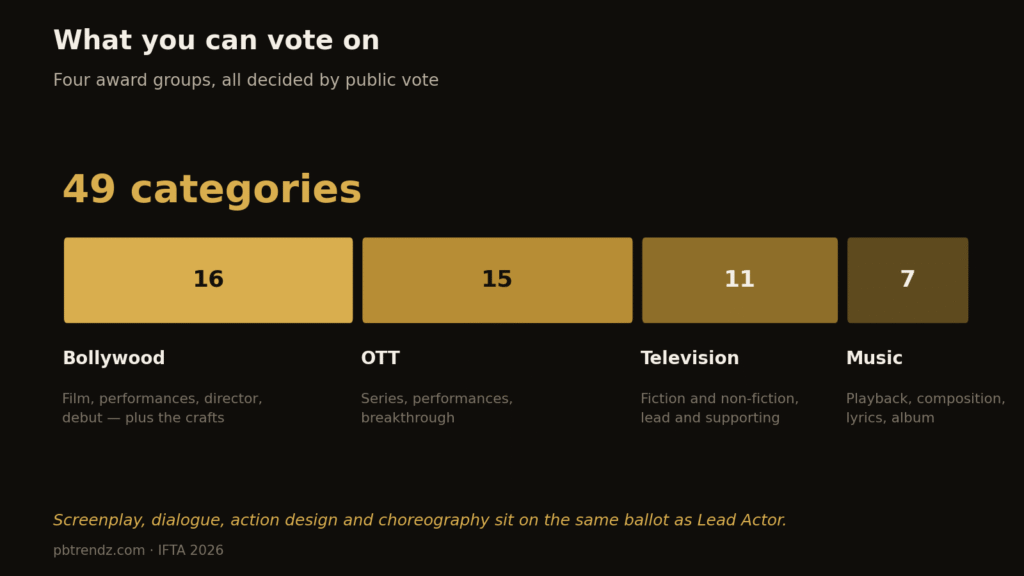
Stage one: India suggests. Nominations are open right now, and they are collected in public. Each category gets its own nomination post on @ifta.official on Instagram. You comment with the name you think belongs on the ballot. There is no form, no login, no fee, and no shortlist you have to choose from.
Stage two: research verifies. Every suggested name is checked against independent third-party sources before it reaches the ballot — release dates, credits, eligibility, the basic facts. This is the only stage where a small group of people is involved, and its job is verification, not judgement. Nobody at this stage decides who deserves to win.
Stage three: India votes. From 30 August, voting opens. One OTP-verified vote per person, per category. When it closes, the winners are announced with the vote counts printed next to them.

What you can vote on
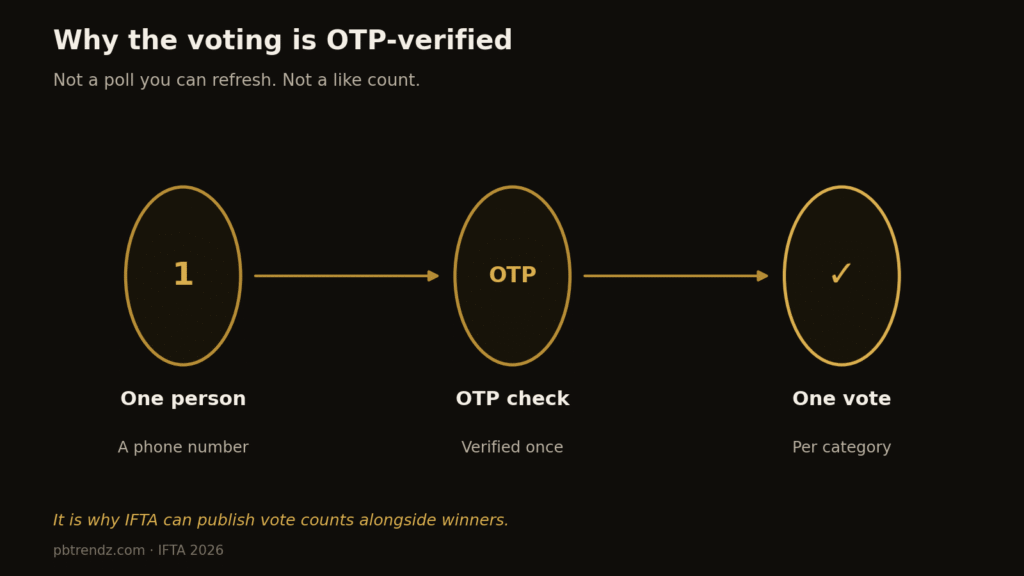
Forty-nine categories, split across four groups.
Bollywood — 16 categories. The full film slate: film, lead performances, supporting performances, director, debut. And, unusually, the craft awards sit here on the same public ballot — screenplay, dialogue, action design, choreography, cinematography.
OTT — 15 categories. The fastest-growing group. Series, performances, breakthrough. This is where the measurement problem is worst: Netflix reports views, Ormax reports Indian viewers, Prime Video reports nothing. A vote is the only currency that works across all three platforms identically.
Television — 11 categories. Fiction and non-fiction, lead and supporting. Worth knowing that BARC ratings have been suspended since mid-June, so for the length of this blackout a public vote is the only live measurement of the Indian television audience that exists.
Music — 7 categories. Playback, composition, lyrics, album.
Why the OTP
The single most common objection to a public award is that it can be gamed — bots, bulk accounts, fan armies with a hundred logins each.
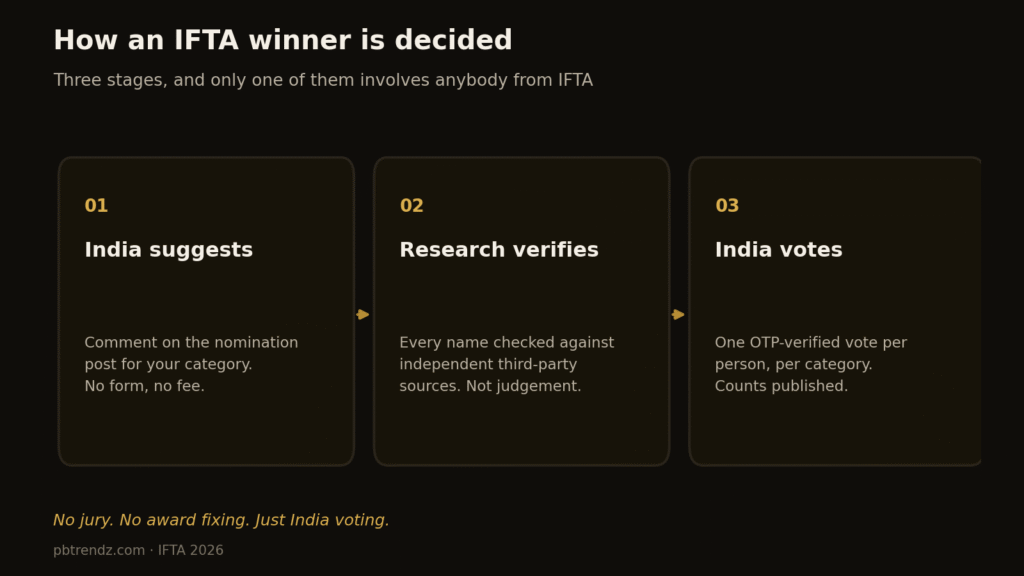
Voting is verified by one-time password against a phone number. One number, one verified identity, one vote per category. It is not a poll you can refresh. It is not a like count. That verification is the reason IFTA can publish its arithmetic in the first place: a number is only worth showing if it means something.
And IFTA does publish it. In 2022, Shershaah won Most Popular Bollywood Film on 5,201 votes. Sidharth Malhotra took Lead Actor on 3,744. Rohit Shetty took Director on 1,760. Mayank Arora, a supporting actor on a daily soap, drew 3,969 — more than twice the director’s count.
You are free to disagree with every one of those results. You cannot say you don’t know how they were reached. No other award in India shows that working.
What makes this different from every other award
Not a better jury. No jury.
That distinction matters more this year than usual, because four separate juried ceremonies have already ruled on the most recent completed cycle of Indian film — and they disagreed with each other. Three different Best Films between them. Three different Best Actors. Zee Cine Awards ran a Viewer’s Choice category alongside its jury categories and produced different winners in the same building on the same night.
None of that means the juries were wrong. It means “expert consensus” is not what these awards are actually measuring. A public vote at least says plainly what it is: the opinion of everyone who turned up, counted honestly, and shown to you.
The dates
Now — nominations open. Comment on the nomination post for your category at @ifta.official on Instagram. Multiple categories, multiple comments. No limit on how many you suggest.
30 August — voting opens. OTP verification, one vote per person per category, all 49 categories live.
After close — results with counts. Winners announced with the vote totals published alongside them.
Three things worth knowing before you vote
Your vote is worth more in the small categories. The 2022 counts show a spread from 5,201 at the top to 613 at the bottom. Choreography, action design, dialogue — the categories that get cut for a commercial break at every other ceremony — are decided by a few hundred people. If you have an opinion about who actually made a fight scene work, this is the rare place it moves the number.
Debut categories reward what you noticed, not what was announced. In 2022 the Female Star Debut category drew 4,293 votes — more than Lead Actor, more than Director. A jury assesses a newcomer through the prestige of the film around them. You don’t have to.
Nominate before you vote. The ballot is built from what people suggest. If the performance you care about isn’t on it, that is fixable now and not fixable on 30 August. Every category’s nomination post is open.
One last thing
Box office measures tickets bought before anyone had seen the film. Ratings measure a panel of metered homes that never volunteered an opinion — and right now they measure nothing at all. Streaming numbers measure whatever each platform feels like disclosing that quarter.
None of those instruments ask anybody anything. This one does.
Nominations are open now at @ifta.official on Instagram. Voting opens 30 August. No jury, no award fixing — just India voting.
You May Like This
1



Advertisement
You May Like This








Advertisement
Advertisement
Advertisement