

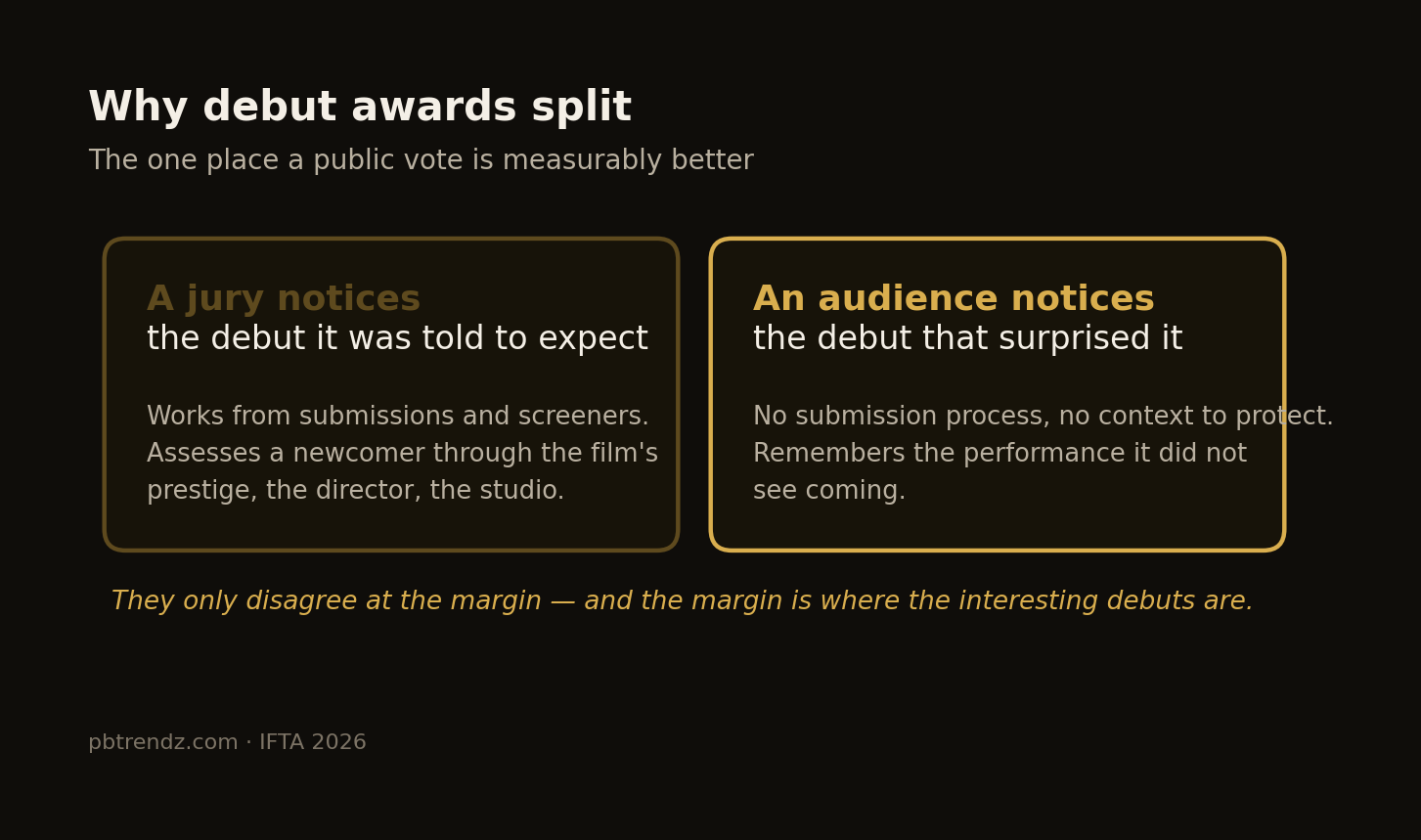
A jury tends to notice the debut it was told to expect. An audience notices the one that surprised it.
Those are rarely the same person, and 2026 has handed us an unusually clean example of both.
The debut nobody engineered
In March, a JioHotstar series called Chiraiya arrived without a star, without a franchise, and with a subject — marital rape — that guaranteed it no easy audience. It opened at two million viewers.
Nine weeks later it was still in the weekly top 50, on its way to becoming, by Ormax Media’s count, the most-watched Indian web series of the year so far at around 20 million viewers.
At the centre of it was Prasanna Bisht, playing Pooja Kumari. By late March, Indian entertainment outlets were running the specific kind of story that cannot be bought: who is she? That coverage sat in mid-tier publications rather than the top-tier trade, which is itself the tell — the trade press writes about debuts it was briefed on in advance. This one arrived from the audience upwards.
Bisht has spoken publicly about the difficulty of the material, and about why it landed: “It’s the experiences that we all have faced as women.”
Now ask what a jury would have done with that performance in February. Nothing. There was nothing to do with it. It had no campaign, no studio pushing it, no precedent. Its entire case was built in public, by viewers, over nine weeks — which is to say it was built exactly the way a public vote measures things and exactly the way a jury calendar cannot.
The debut everyone agreed on
The opposite case is just as instructive.
Saiyaara‘s Ahaan Panday and Aneet Padda swept the newcomer honours at both the Zee Cine Awards 2026 and the Chetak Screen Awards 2026. Padda additionally took Zee’s Viewer’s Choice Actress award — the audience-voted category, running alongside the jury ones.
So when jury and audience agree, they agree completely. That matters, because it disposes of the lazy objection to public voting: that crowds simply pick whoever is loudest. When a debut is genuinely undeniable, both systems find it. The disagreement only shows up at the margin — and the margin is where the interesting performances live.
What juries are actually good at, and what they aren’t
A jury is a small group of experienced people making a considered decision under a deadline. That produces two reliable behaviours.
The first is that juries reward pedigree. Not corruptly — structurally. A jury has to assess a performance in the context of a career, a director’s intent, a body of comparable work. A debutant has no career to be contextualised against, so the assessment falls back on what surrounds them: the film’s prestige, the director’s standing, the studio’s weight, the seriousness of the material.
The second is that juries reward what they have already been shown. Awards bodies work from submissions and screeners. Somebody has to put a performance in front of them. Nobody put Chiraiya in front of anybody in February, because in February it was two million viewers and no conversation.
An audience has neither constraint. It has no context to protect and no submission process. It votes on the thing it did not see coming, because the thing it did not see coming is the thing it remembers.
That is the entire case for putting debut categories in front of the public before you put anything else there.

The rest of the year’s new faces
The theatrical debuts of the half were led by Ikkis, Sriram Raghavan’s film released on 1 January. Agastya Nanda made his theatrical debut as Arun Khetarpal and drew strong reviews against weak numbers — roughly ₹37 crore against a ₹60 crore budget. The role had originally been announced with Varun Dhawan back in 2019, which is its own quiet story about how debuts get assigned. Simar Bhatia made her Bollywood debut in the same film, as Kiran Kochhar.
Shiv Rawail made his feature directing debut with Alpha, the seventh film in the YRF Spy Universe — a debut handed the largest possible platform and the year’s most difficult set of expectations. It recorded the lowest opening in the franchise’s history. Whether that is a director’s failure or an inherited one is precisely the kind of question a ballot forces people to actually think about.
On television, the Zee Kutumb Awards 2026 — which are viewer-voted — named Sheezan Khan, playing Siddhu in Ganga Mai Ki Betiyan, and Sonakshi Batra of Jagadhatri as its new entrants. Worth noting that Ganga Mai Ki Betiyan was the number one show in India in the last week BARC published before ratings went dark.
One caveat we would rather state than hide
There is no credible trade-press breakthrough list for 2026 yet. Those publish in December, which is why every article of this kind that appears in August is really a list of whoever the writer happened to notice.
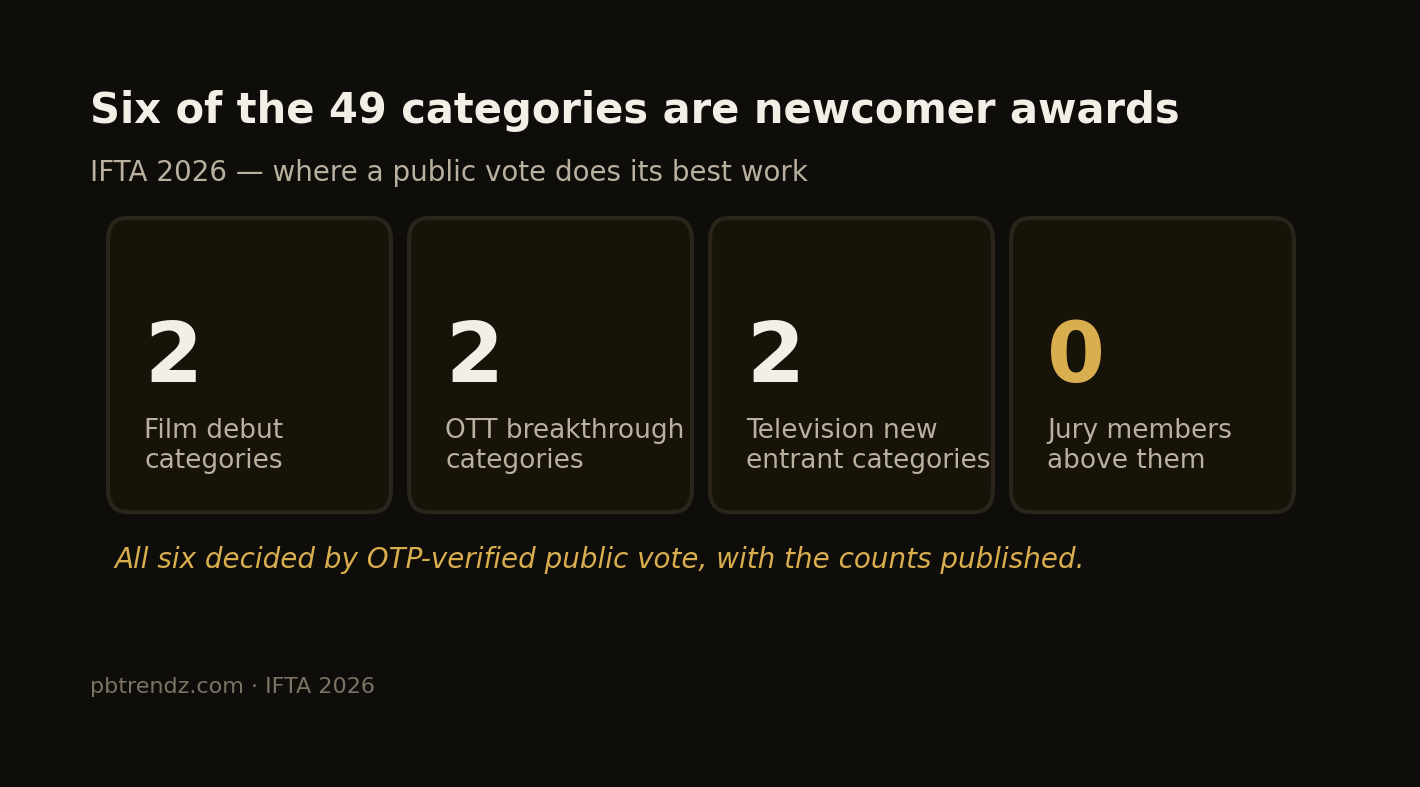
This one is no different in that respect, and we would rather say so. The difference is what happens next: we are not the ones deciding. Six of IFTA’s 49 categories are newcomer awards — male and female debut in film, breakthrough male and female in OTT, and the television new-entrant equivalents — and all six are settled by public vote with the counts published.
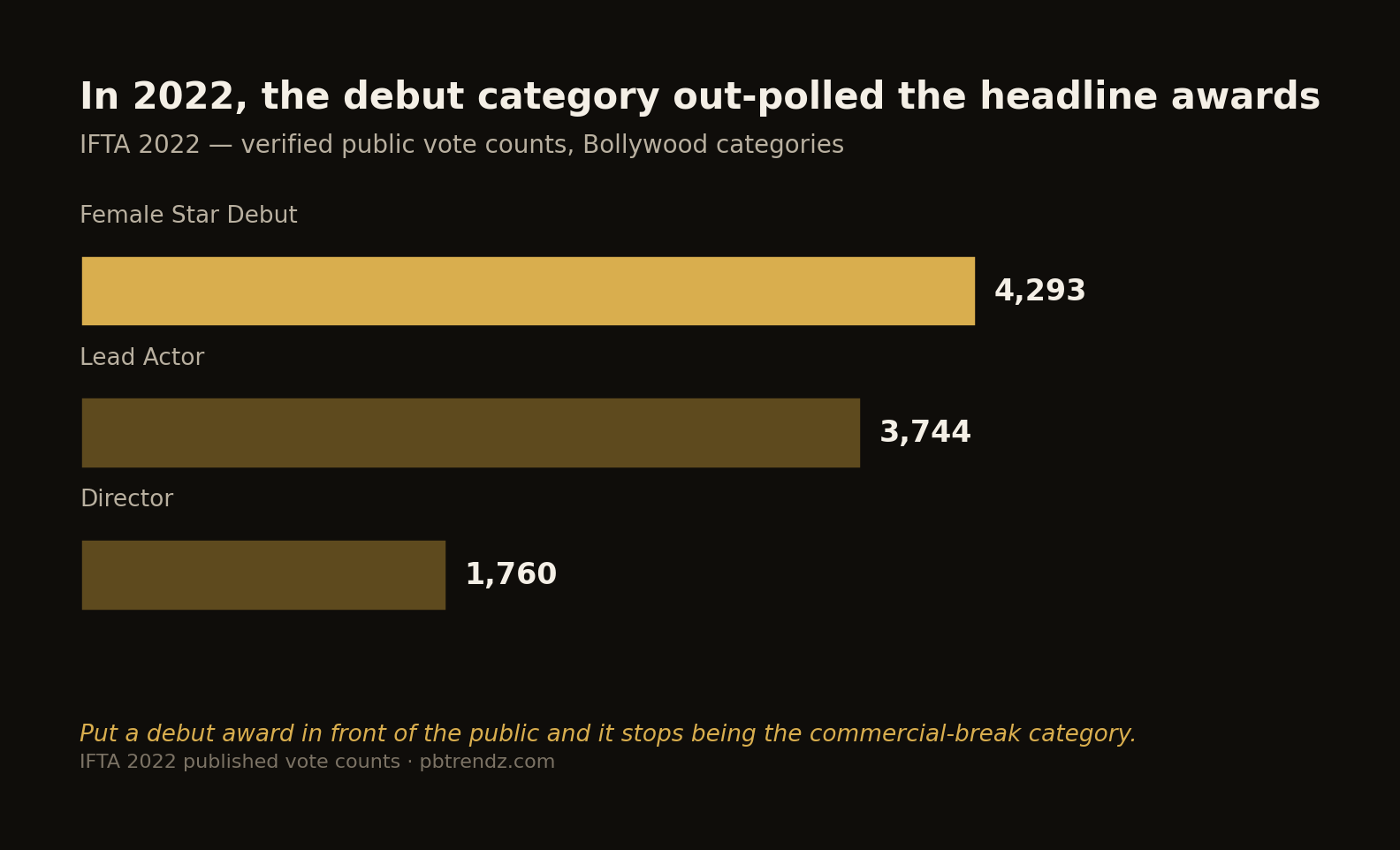
In IFTA 2022, the Female Star Debut category drew 4,293 votes — more than Lead Actor, more than Director, more than almost anything else on that ballot. Put a debut award in front of the public and it stops being the category that plays during the commercial break.
IFTA 2026 nominations are open now. If someone new made you sit up this year, put their name forward — comment on the nomination post for the debut categories at @ifta.official on Instagram. Voting opens 30 August.
Viewership figures from Ormax Media. Award results as announced by the respective ceremonies; Zee Kutumb Awards 2026 results are single-source. Coverage of Prasanna Bisht’s breakout is drawn from mid-tier Indian entertainment outlets and is attributed rather than asserted.