

Since the third week of June, nobody in India has known what the country is watching on television.
Not the broadcasters. Not the advertisers. Not BARC, the body whose entire job is to know. The ratings stopped, and at the time of writing they have not restarted.
This is not a minor administrative pause. Television advertising in India is bought and sold against ratings the way shares are bought and sold against a price. Remove the number and the market does not stop trading — it trades blind. One media buyer, quoted in the trade press, compared it to switching off the stock exchange’s price discovery and asking everyone to keep dealing anyway.
What actually happened
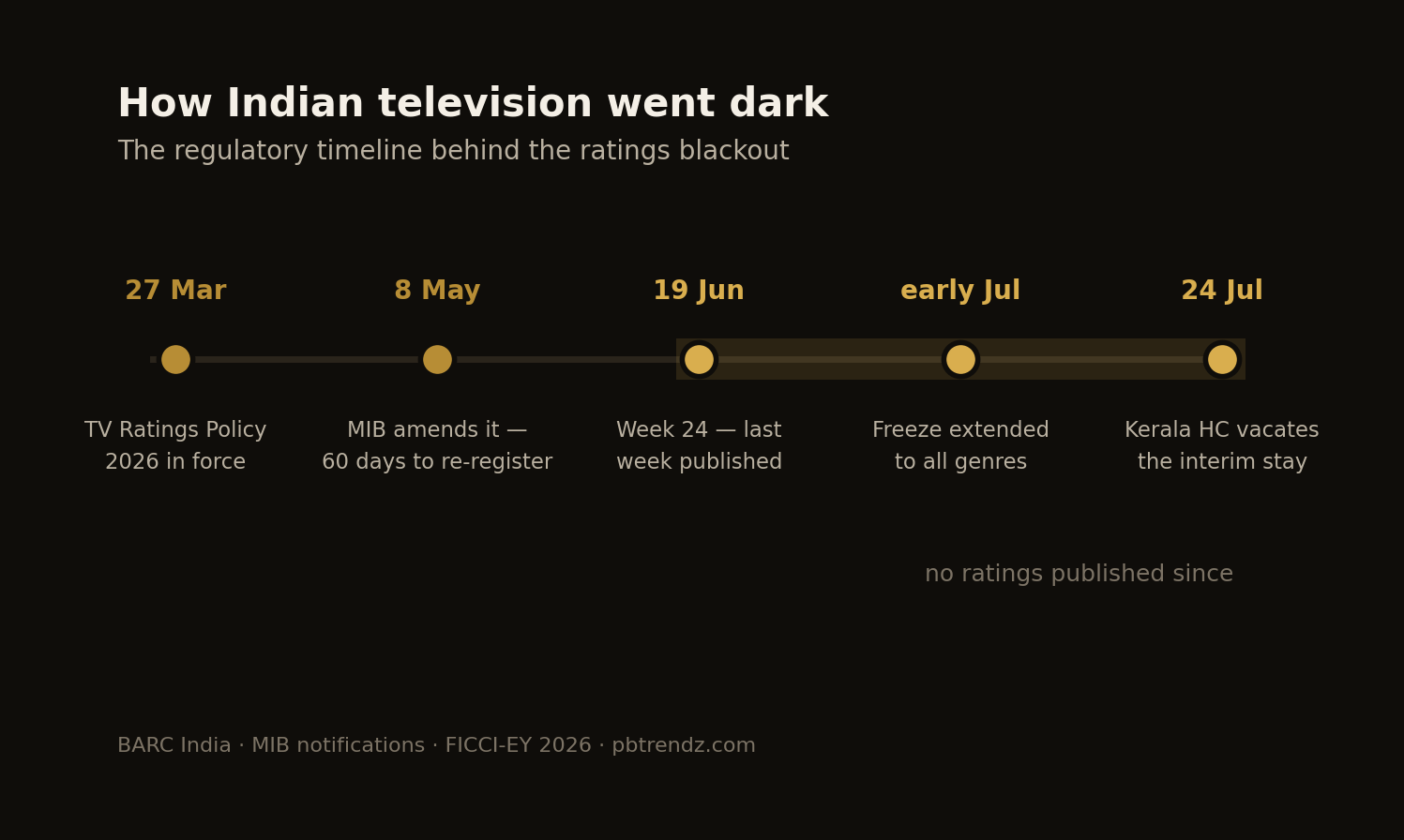
The blackout is the end of a chain of events that began in March.
On 27 March 2026 the government notified the TV Ratings Policy 2026, replacing the framework that had governed television measurement since 2014. The new policy bars landing-page viewership from being counted, requires measurement to be technology-neutral, and raises the mandated panel to 80,000 metered homes.
On 8 May the Ministry of Information and Broadcasting amended it. BARC was given 60 days to re-register under the new rules. The requirement for independent directors on a rating agency’s board was cut from 50 per cent to 33 per cent. The establishment survey moved from annual to once every three years. The deadline for reaching 80,000 homes was pushed out to 27 December 2026.
On 22 May the Kerala High Court, hearing a petition from the All India Digital Cable Federation, stayed the release of news ratings that excluded landing-page data — freezing one genre while the rest continued.
Then the rest stopped too.
The last week India was measured
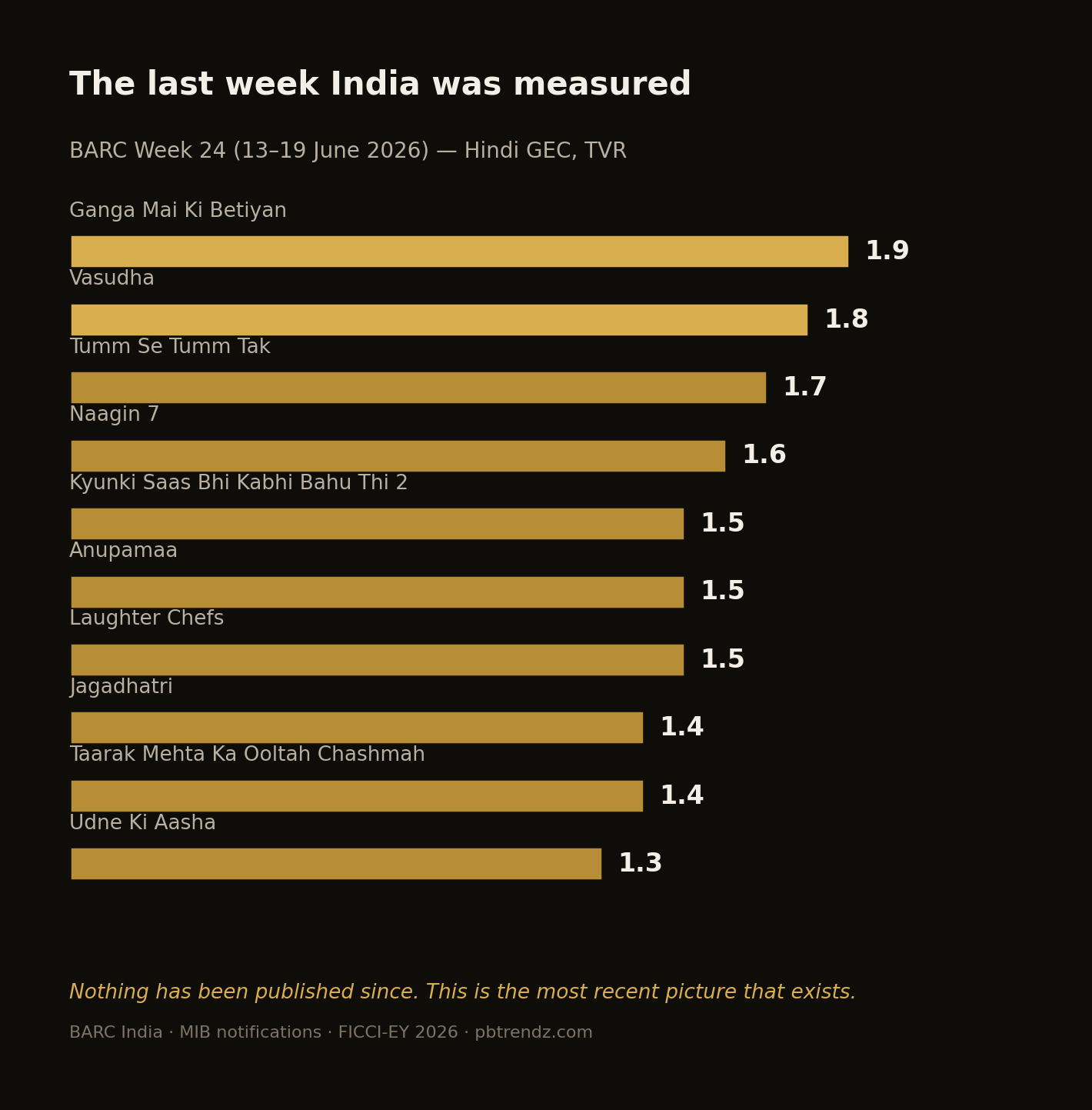
BARC’s published record ends at Week 24 — the week of Saturday 13 June to Friday 19 June 2026. That is verifiable from BARC’s own site, which still carries Week 24 as its most recent release; a request for any later week returns nothing.
In the first days of July, the Ministry extended the freeze from news to every genre — entertainment, sport, movies, regional, infotainment — under Clause 14.2 of the policy, to remain in force until BARC completes re-registration.
On 24 July the Kerala High Court vacated its interim stay, clearing the main legal obstacle. At the end of July, trade publication BestMediaInfo reported that the Ministry’s Broadcasting Policy and Legislation wing had recommended provisional registration for BARC, reviewable in January 2027, with the panel then standing at 70,876 homes against the 80,000 target. That report has not been corroborated by BARC, the Ministry or PIB, and should be read as trade reporting rather than confirmed fact.
The cost of the dark period is not trivial. BARC is estimated to be losing over ₹7.5 crore a quarter against annual revenues of roughly ₹300 crore, and broadcasters are expected to seek billing adjustments for the unmeasured weeks — immediately before the festive season, the most valuable advertising window of the Indian year.
What the last measured weeks showed
The half-year that ended in the dark was, by television’s own standards, unusually eventful.
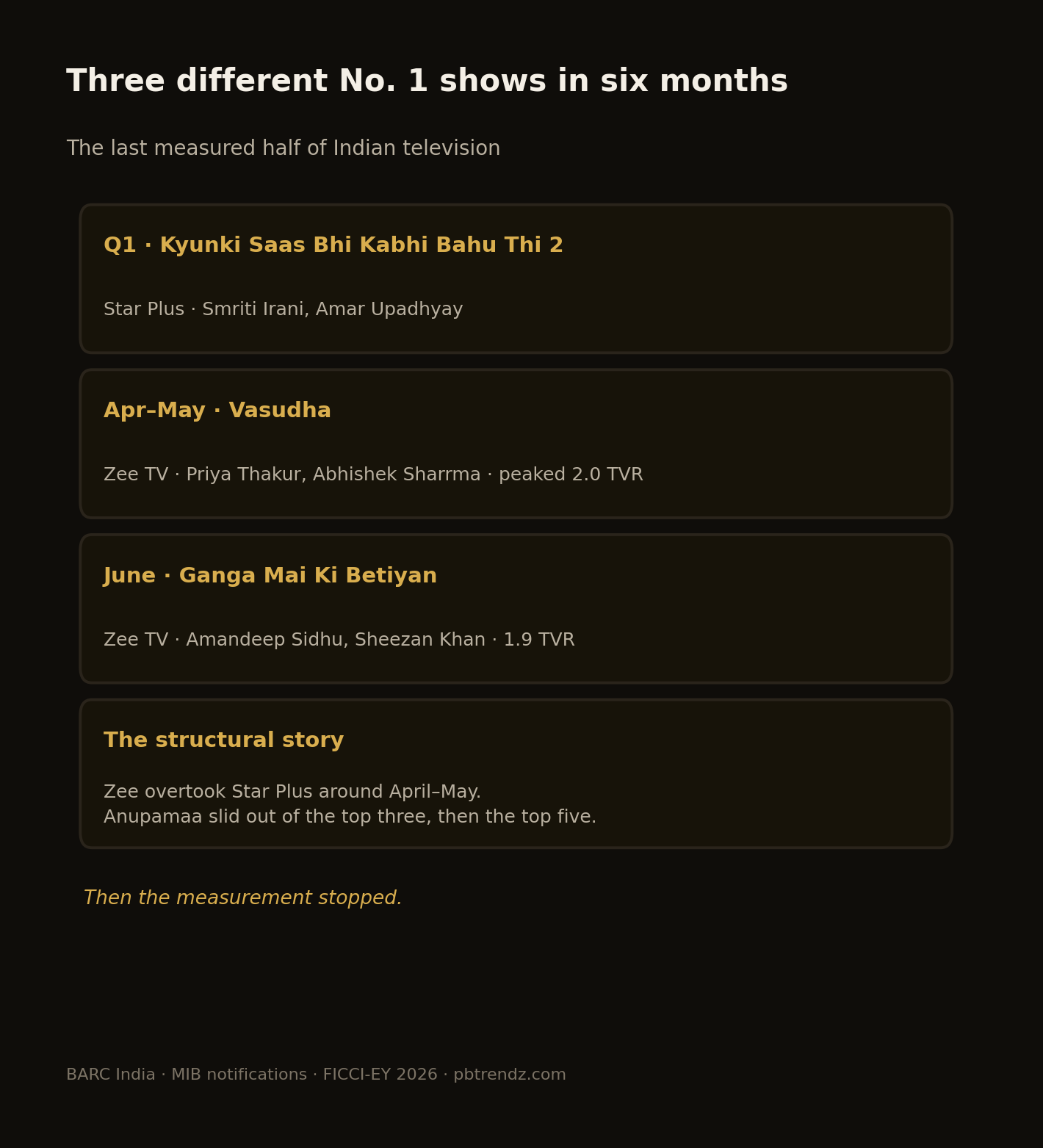
India had three different No. 1 shows in six months. In the first quarter it was Kyunki Saas Bhi Kabhi Bahu Thi 2 on Star Plus, with Smriti Irani and Amar Upadhyay. Through April and May it was Vasudha on Zee TV, which peaked at 2.0 TVR. By June it was Ganga Mai Ki Betiyan, also Zee, at 1.9.
That sequence contains the structural story of the half: Zee overtook Star Plus somewhere around April–May. And Anupamaa — for years the default answer to what India watches — slid out of the top three and then out of the top five.
The final measured week, Week 24, looked like this: Ganga Mai Ki Betiyan 1.9, Vasudha 1.8, Tumm Se Tumm Tak 1.7, Naagin 7 1.6, Kyunki Saas Bhi Kabhi Bahu Thi 2 1.5, Anupamaa 1.5, Laughter Chefs 1.5, Jagadhatri 1.4, Taarak Mehta Ka Ooltah Chashmah 1.4, Udne Ki Aasha 1.3.
In non-fiction, Laughter Chefs season three on Colors, hosted by Bharti Singh, launched at 2.2 TVR as the No. 1 non-fiction show across Hindi general entertainment and held between 1.4 and 1.5 into late June — the most consistently rated unscripted show of the year. Shark Tank India season five ran from 5 January to 17 March and never surfaced in a top ten.
Two of television’s biggest properties sit entirely outside the measured window. Bigg Boss season 19 ended in December 2025 and season 20 launches in September 2026 as a six-language JioStar premiere. Kaun Banega Crorepati season 18 premieres on 10 August with Amitabh Bachchan. Neither will have a comparable rating history to be judged against when they arrive.
The number nobody talks about
Here is the part that gets lost in the regulatory detail.
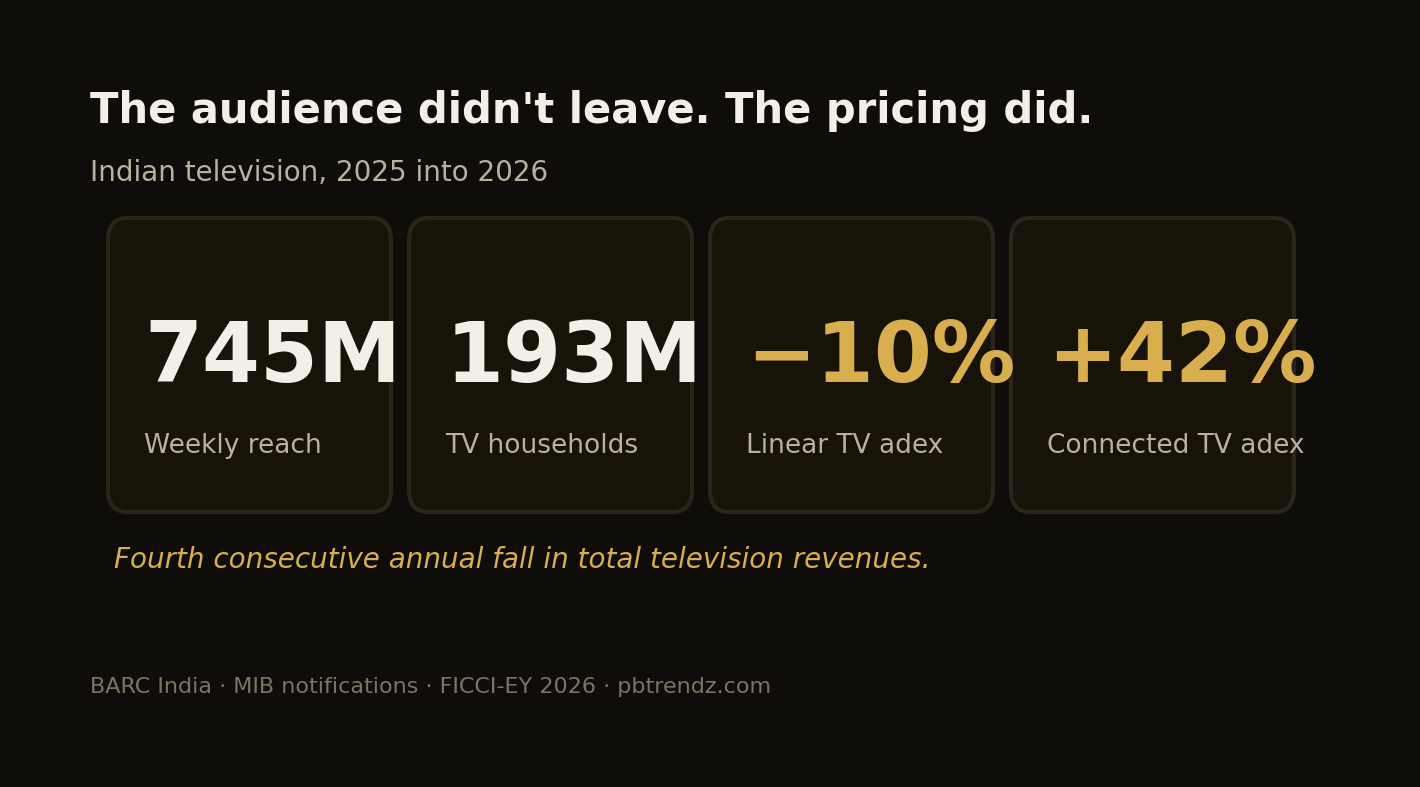
Linear television in India is not shrinking as an audience. Weekly reach is stable at roughly 745 million people, and television households have grown to 193 million. What has shrunk is what that audience is worth: linear TV advertising fell 10 per cent in 2025 and total television revenues declined 9.2 per cent, the fourth consecutive annual fall. Connected TV advertising, meanwhile, grew 42 per cent to ₹99 billion.
The audience did not leave. The pricing power did. And pricing power, in this industry, is downstream of measurement.
Which leaves one instrument still running
A rating is a sample. At full strength the BARC panel is 80,000 homes standing in for 193 million — roughly one household in every two and a half thousand. Those homes never volunteered an opinion. A meter recorded what the set was tuned to, and the industry inferred a preference from it.
A public vote is also a sample. It is self-selecting, and it does not pretend otherwise. But it measures something a meter cannot: not what was on, but what somebody thought was worth standing up for.
For as long as the blackout lasts, that is the only instrument still taking a reading of the Indian television audience. IFTA’s television categories — eleven of them — will be decided this year in a period when no panel data exists to argue with them. That is an accident of timing. It is also, for once, a fair fight.
IFTA 2026 nominations are open now. Suggest the shows and performances you think deserve to be on the ballot — head to @ifta.official on Instagram and comment on the nomination post for your category. Public voting opens 30 August.
Regulatory timeline compiled from Ministry of Information and Broadcasting notifications and trade reporting; Week 24 as the last published week verified directly on barcindia.co.in. Revenue and reach figures from the FICCI-EY India M&E report 2026.