Indian edtech raised US$4.3 billion in 2021.
So far in 2026 it has raised US$214 million.
That is a fall of about 95 per cent — and it is only the most visible of three simultaneous contractions in how Indians buy education.
The funding collapse, in proportion
A 95 per cent decline sounds like sector failure. It is closer to a return to baseline.
2021 was not a normal year for Indian edtech. Schools were shut, every household with a child and a smartphone became a customer overnight, and global capital was cheaper than it had been in a generation. Valuations were set on the assumption that the shift was permanent.
It was not. Schools reopened, engagement fell, and the businesses were left with cost structures built for a demand curve that had disappeared.
What is left standing is smaller, mostly profitable or close to it, and concentrated in test preparation, upskilling and school software — categories with a defined buyer and a measurable outcome. That is a healthier sector than 2021 produced. It is also a fraction of the size.
The Byju's endgame
The clearest illustration of how far the correction went is what has happened to the company that defined the boom.
In insolvency proceedings, assets valued at approximately ₹150 crore were reported as having been sold for around ₹16 crore. The National Company Law Tribunal stayed the sale on 5 September 2026.
Two points of accuracy, because this case generates a lot of loose reporting. A stay is not a finding of wrongdoing; the tribunal has paused a transaction pending scrutiny, and the matter is unresolved. And a distressed sale price legitimately diverges from a book valuation — that is what distress means.
Still, roughly a tenth of assessed value is a wide gap, wide enough that the tribunal wanted to look at it. For a company once valued in the billions, the recovery arithmetic is now being argued in crores.
Kota, at half strength
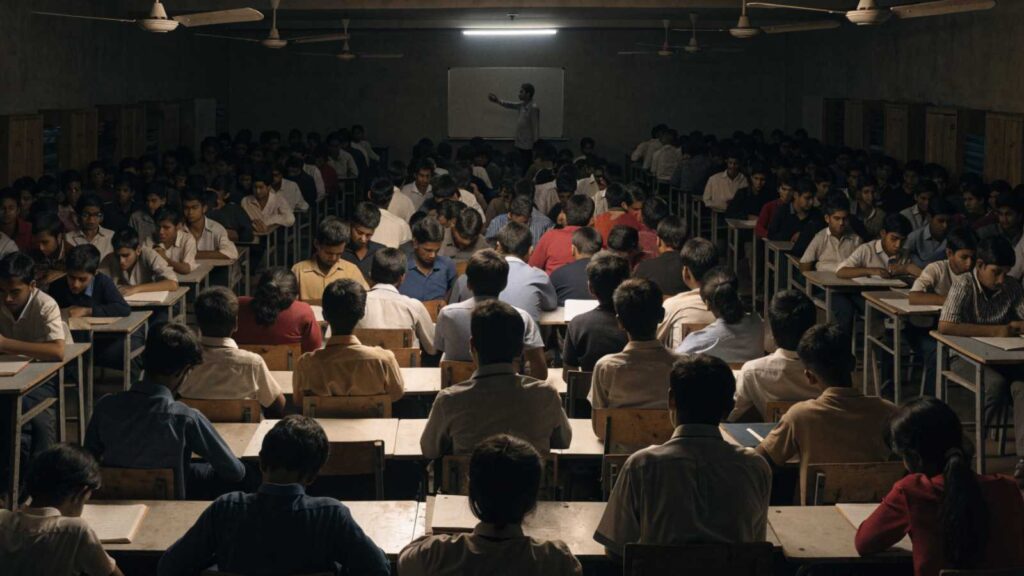
Kota’s coaching enrolment has fallen from 2 to 2.5 lakh students to somewhere between 85,000 and 1 lakh.
Roughly a halving, in a city whose entire economy — hostels, mess kitchens, transport, stationery, rentals — was built on the larger number.
The causes are layered. Online and hybrid coaching removed the necessity of relocating. Coaching chains opened branches in the tier-2 cities that used to supply Kota, keeping students at home. And the sustained reporting on student deaths in Kota changed how families weigh the decision — not universally, but enough to move the aggregate.
The entrance exams have not become less competitive. The number of aspirants has not fallen. What has changed is that the single-city model for preparing them is no longer the default.
Students abroad: down 31 per cent
The number of Indian students going abroad has fallen about 31 per cent over three years.
This one is almost entirely a policy story, and not Indian policy.
Canada capped study permits and tightened the post-graduation work pathway. Australia raised financial requirements and slowed processing. The UK removed the ability of most taught-masters students to bring dependants. The United States tightened visa issuance and the post-study work route became less predictable.
The Indian overseas-education market was never primarily about the degree. It was about the work rights and the pathway attached to it. When four destination countries narrowed that pathway within roughly the same window, the value proposition changed — and the cost of an overseas degree only makes sense against the pathway.
Demand has not vanished; it has redistributed toward Germany, Ireland, the Gulf and, increasingly, domestic options.
What is actually growing
Three things are expanding while the headline categories contract, and they are connected.
Domestic higher education at the upper end. Private universities and the newer IITs and IIMs are absorbing students who three years ago would have gone abroad. Whether capacity and quality have grown to match is a separate and much less settled question.
Vocational and skills training. Unglamorous, cheap, employer-linked, and the one segment where enrolment tracks hiring demand rather than aspiration.
Test-prep, restructured. Hybrid, regional-language, priced at a fraction of the old Kota package, and selling to families who could never afford relocation in the first place.
Why this is not simply a crash
It is tempting to read three contractions as a sector in decline. The more accurate reading is that three expensive intermediaries got squeezed at once.
Venture-funded edtech was an intermediary between students and content. Kota was an intermediary between students and exams. The overseas degree was an intermediary between students and a labour market.
Each charged a substantial premium for that intermediation. Each is now being priced against cheaper alternatives — online delivery, local branches, domestic institutions — that did not exist at scale five years ago.
The underlying demand is unchanged. Indian families are not spending less on education. They are spending it in different places, and the places they left were the expensive ones.
What to watch
Three things will determine whether this is a healthy correction or the start of something worse.
Whether domestic capacity actually absorbs the returning demand. If private universities expand enrolment without expanding faculty and placements, the students who stayed home will have been worse served than the ones who left.
Whether the surviving edtech companies stay disciplined. The sector’s failure mode is buying growth. Cheap capital returning would test that quickly.
Whether destination countries reverse. Immigration policy moves in cycles, and a single change in Canadian or British policy could send the overseas number back up within two admission cycles.
Nothing in the current data says Indian education is shrinking. It says the expensive way of buying it is.
Funding figures are year-to-date 2026 against calendar 2021. Insolvency details reflect proceedings as reported to the National Company Law Tribunal; the matter is pending and no findings have been made. Coaching enrolment figures are industry estimates for Kota specifically and are not precisely audited.