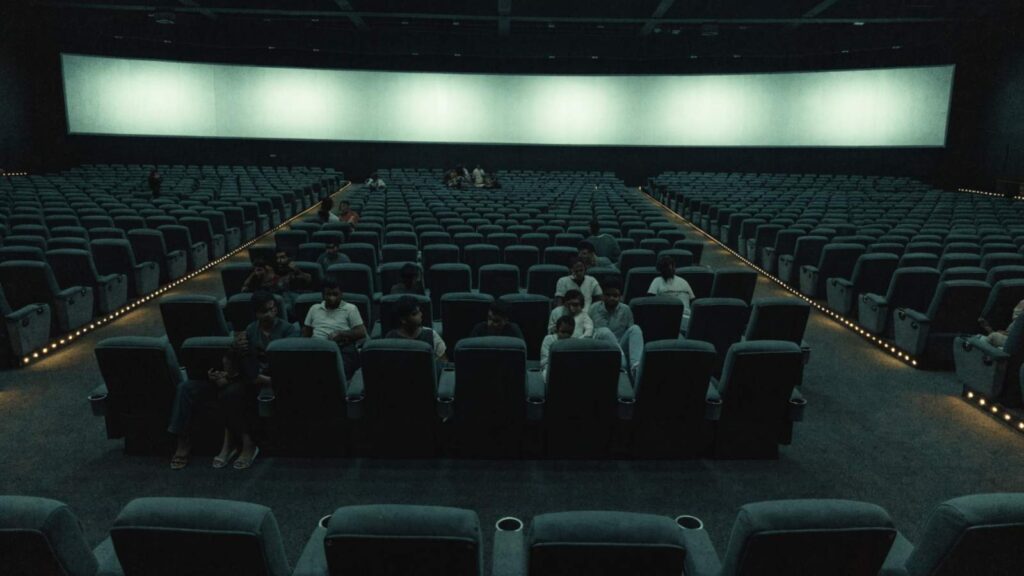
India’s box office took ₹6,398 crore in the first six months of 2026. It is the best half-year the country has ever recorded, up about 10 per cent on the same period last year.
It is also one of the most lopsided.
One film accounted for roughly a fifth of the entire national total. The top fifteen films took 58 per cent. And the number of films clearing ₹100 crore actually fell.
This is what a record year looks like when the growth is all at the top.
One film was a fifth of everything
Dhurandhar: The Revenge did not just win the half-year. It distorted it.
The film has taken about ₹1,363 crore gross in India and roughly ₹1,790 crore worldwide. It became the first Hindi film to cross ₹1,000 crore net in India, and it did it in 18 days. Worldwide, it moved past Baahubali 2 to sit second among all Indian films ever released. In North America it became the first Indian film past $25 million.
Within March, it was responsible for more than three-quarters of the month’s total collections. Across the whole half-year, it was close to 20 per cent of everything every Indian film earned.
Take it out of the calculation and the record disappears.
The monthly chart is violent
The half did not build steadily. It lurched.
January — ₹1,327 crore. Up 30 per cent on January 2025, powered by five Telugu releases around Sankranti.
February — ₹427 crore. The weakest month since February 2023. Not a single film crossed ₹100 crore.
March — ₹1,690 crore. The fourth-biggest month in Indian box office history.
April — ₹787 crore.
May — ₹1,138 crore.
June — ₹1,038 crore.
March earned four times what February did. Four of the six months cleared ₹1,000 crore; one barely cleared ₹400 crore.
For an exhibitor paying rent, staff and electricity in all six of those months, that is the real story of 2026 — not the annual total, but the fact that the calendar has become a series of spikes with dead air between them.
The middle is disappearing
This is the number that should worry the industry most, and it is the one that gets the least attention.
In the first half of 2025, the top fifteen films took 49 per cent of all collections. In the first half of 2026, the top fifteen took 58 per cent.
Films crossing ₹200 crore rose from four to six. But films crossing ₹100 crore fell from 17 to 13.
So: more giants, fewer solid hits. The mid-budget film that used to do ₹120 crore and quietly fund the next three projects is being squeezed out of existence at both ends — it cannot compete with the event releases for screens, and it cannot compete with streaming for the audience that would once have turned up on a Wednesday.
An industry where the top fifteen films take nearly six rupees in every ten is an industry with a very thin safety net.
The problem underneath all of it
India has 10,033 cinema screens. That number grew by 1 per cent last year — 240 opened, 124 closed, and the ones closing are overwhelmingly single screens.
Only 3,150 of India’s roughly 19,500 pin codes have a cinema at all.
India runs about 6.8 screens per million people. France runs 95. The United States runs 109. China runs 64.
Every conversation about Indian box office records is happening inside that constraint. The country is setting revenue records on an exhibition base that has barely grown in a decade and is quietly shrinking outside the metros — Andhra Pradesh alone lost 54 screens last year.
People actually came back
The genuinely good news is buried under all of this.
Footfalls in H1 2026 were 37.8 crore — up 5 per cent on the 36.2 crore of H1 2025. That is the first increase after roughly two and a half years of continuous decline.
This matters because the growth of the last two years has largely been a pricing story. Average ticket prices rose about 20 per cent in 2025 alone, to around ₹161. Revenue was going up because tickets cost more, not because more people were buying them.
This half, more people bought them. Not many more — 37.8 crore is still below the 40 crore of H1 2022 — but the direction changed, and it had not changed in a long time.
Hindi is up. Tamil fell off a cliff.
The language mix moved sharply.
Hindi took 44 per cent of the national box office, up from 39 per cent — almost entirely on the back of one film, and briefly as high as 56 per cent year-to-date after March before settling back.
Tamil fell to 12 per cent, down from 17. That is the biggest single-language decline of the half and it went largely unremarked while everyone counted Dhurandhar‘s crores.
Malayalam held around 9 per cent, with Vaazha 2 and Drishyam 3 both landing in the national top fifteen — remarkable for an industry its size.
Marathi went from about 1 per cent for all of 2025 to 4 per cent in six months, its best showing since before the pandemic.
Telugu remained the clear number two by volume, with four films in the national top fifteen.
What a record year really tells you
₹6,398 crore is a real achievement and it deserves to be reported as one. Footfalls turning positive is a better sign than the headline number.
But the shape underneath is a market becoming more dependent on fewer, larger films, playing in a shrinking number of buildings, to an audience that increasingly waits for streaming — over half of Indian moviegoers say they have skipped a theatre visit because they know the film is coming to a platform soon.
The blockbusters are getting bigger. Almost everything else is getting harder.
Box office figures are from Ormax Media’s India Box Office Report for January–June 2026 unless otherwise stated. Screen counts are from the FICCI-EY 2026 report. India has no official box office reporting body; all figures are industry estimates.