

Advertisement

- Updated on August 26, 2026
- IST 2:58 pm
India gives its reality television a 5.0 out of 10. Dead centre of the scale — which, for an industry that occupies primetime on almost every Hindi general entertainment channel, is a quietly brutal verdict.
PolBol’s Hindsight poll asked 3,695 OTP-verified respondents one question: how much would you rate the quality of Indian TV reality shows?
The shape of a 5.0
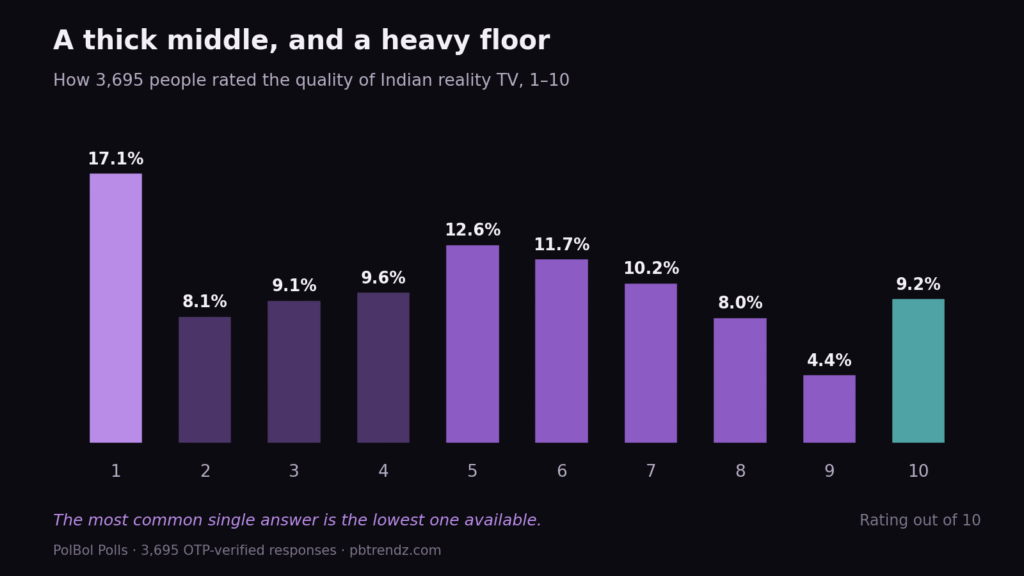
The distribution is more evenly spread than most polls in this series, but it still has a heavy foot at the bottom.
633 people — 17.1 per cent — gave the lowest possible score of 1. That is the largest single block.
The middle is genuinely populated, though: 466 people rated it 5 (12.6 per cent), 431 rated it 6 (11.7 per cent) and 377 rated it 7 (10.2 per cent). And 341 people — 9.2 per cent — gave a perfect 10.
What you have is a genre with a committed core of defenders, a large block of people who think it is worthless, and an unusually thick middle of people who watch it and find it acceptable. That middle is the reason the average lands exactly at 5.0 rather than lower.
The 25–34 collapse
The most striking number in this study is a dip, not a peak.
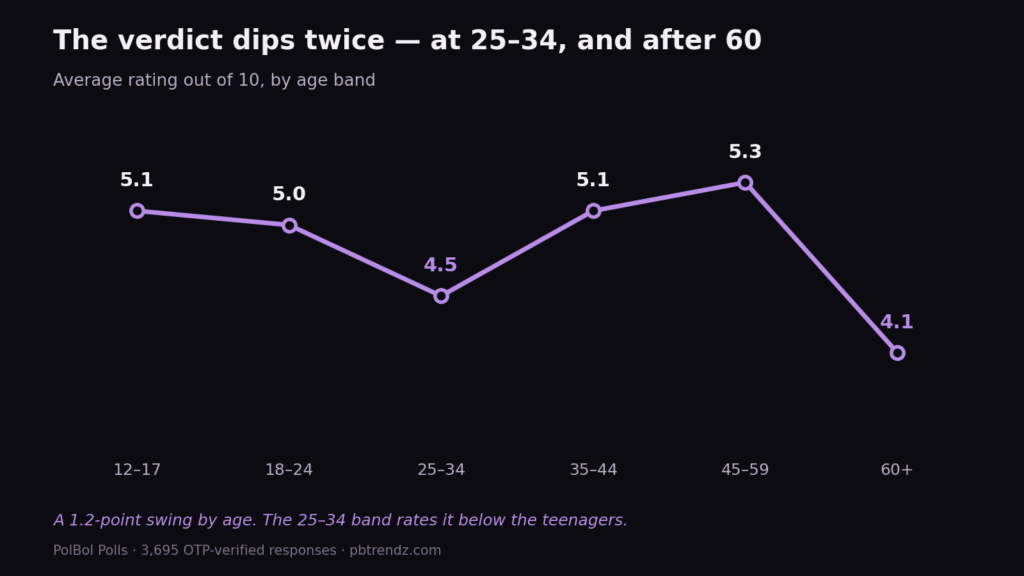
12 to 17-year-olds: 5.1.
18 to 24-year-olds: 5.0. The largest group, at 2,281 respondents.
25 to 34-year-olds: 4.5. A sharp fall.
35 to 44-year-olds: 5.1. Back up.
45 to 59-year-olds: 5.3. The highest of any band.
60 and above: 4.1. The lowest.
Ratings do not decline smoothly with age. They dip in the early thirties, recover through midlife, then fall away sharply after 60. The 25–34 group rates reality TV half a point below the teenagers who are supposedly its most cynical audience.
That band is worth dwelling on. It is the group with the most streaming subscriptions, the most alternatives, and the least reason to settle for what is on at 9pm. It is also the group Indian television has spent a decade losing.
Women rate it higher than men
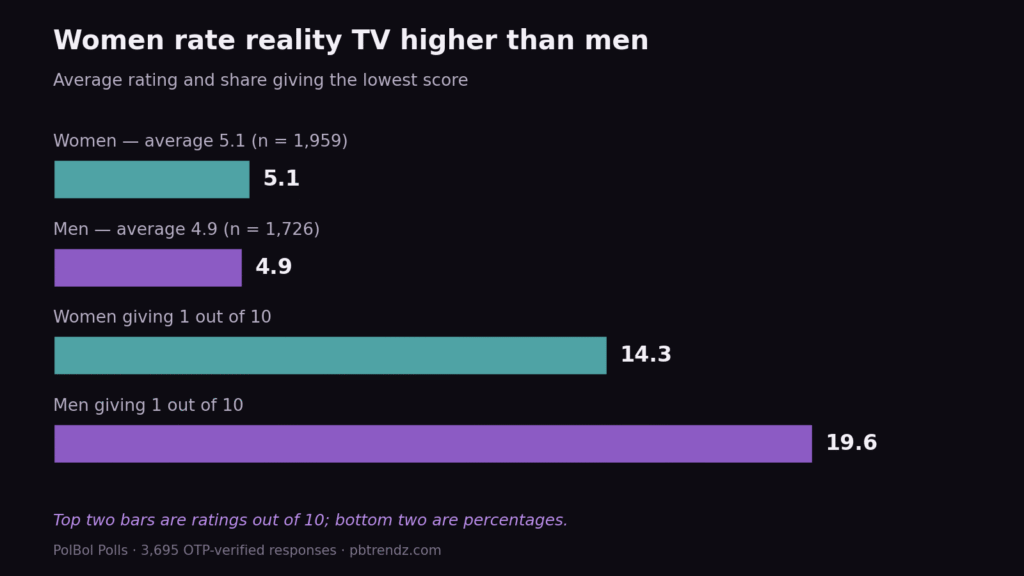
This is the one study in the set where the gender gap on the average is clear rather than cosmetic. Women average 5.1, men 4.9.
19.6 per cent of men gave a 1 out of 10, against 14.3 per cent of women. One in five men reaches for the floor; roughly one in seven women does.
Women also cluster more tightly around the middle — 13.4 per cent rated it 5 and another 13.4 per cent rated it 6.
And again the widest gap sits at 45 to 59, where men average 5.6 and women 5.1 — reversing the national pattern inside that one band.
Midlife is the genre’s home
Both midlife bands sit above the national average, and they are the most forgiving audience in the poll.
Among 35 to 44-year-olds, 46.0 per cent rated the genre 6 or higher, and only 15.0 per cent gave it a 1.
Among 45 to 59-year-olds it goes further: 49.5 per cent rated 6 or higher, and the share giving the lowest possible score falls to 12.8 per cent — the lowest of any age group.
Nearly half of India’s 45 to 59-year-olds are, in this sample, broadly satisfied with what reality television is giving them. No other group comes close.
The oldest group is the harshest
Respondents aged 60 and above average 4.1 — the only band below 4.5 and 1.2 points below the midlife high.
More than a quarter of them, 27.3 per cent, gave the lowest possible score. Their second and third most common answers were a 4 (13.6 per cent) and a 6 (12.1 per cent).
As everywhere in this series, the small print matters: 66 respondents. That is a signal about where the oldest viewers are heading, not a measurement of where they are.
What a 5.0 means for a genre this big
Reality television is not a niche in India. Bigg Boss returns in September as a six-language JioStar premiere. Laughter Chefs was the most consistently rated non-fiction show of the last measured half-year. Indian Idol ran a full season to a July finale. This is a format that occupies enormous amounts of airtime and advertising inventory.
And the audience, asked directly, scores its quality at exactly the midpoint — with the single most common answer being the lowest one available.
That combination — large viewership, mediocre regard — is a familiar one in entertainment, and it is not necessarily a crisis. People watch things they do not rate highly all the time. But it does suggest that reach and esteem have come apart, and only one of those two things is being measured by anybody on a regular basis.
The limits
The sample skews young: 18 to 24-year-olds make up 61.7 per cent of it. The oldest band has 66 people. This is a much stronger reading of young India’s view than of the country’s.
And it measures perception, not production. Nobody here assessed budgets, formats or craft. They gave a number for how good they think Indian reality TV is — which is a real and useful thing to know, and a different thing from how good it is.
Source: PolBol Polls, 3,695 OTP-verified responses. Ratings given on a 1–10 scale. Shares are calculated from vote counts and may not total 100% due to rounding. Based on respondent perceptions, not an assessment of production quality.
You May Like This
1



Advertisement

You May Like This




Advertisement
Advertisement
Advertisement