

Advertisement

- Updated on August 26, 2026
- IST 2:00 pm
Ask a room full of Indians why people get depressed and you will not get one answer. You will get an answer that depends on how old the person answering is.
That is the clearest finding in PolBol’s Hindsight poll on the subject, which put a single question to 5,257 OTP-verified respondents in June 2026: according to you, why do people get into depression?
One thing to be clear about before the numbers. This poll measures what people believe causes depression. It is not a clinical study, it does not diagnose anyone, and the reasons below are perceptions rather than medical findings. That distinction matters, and PolBol carries it on every slide of the study.
What India said, overall
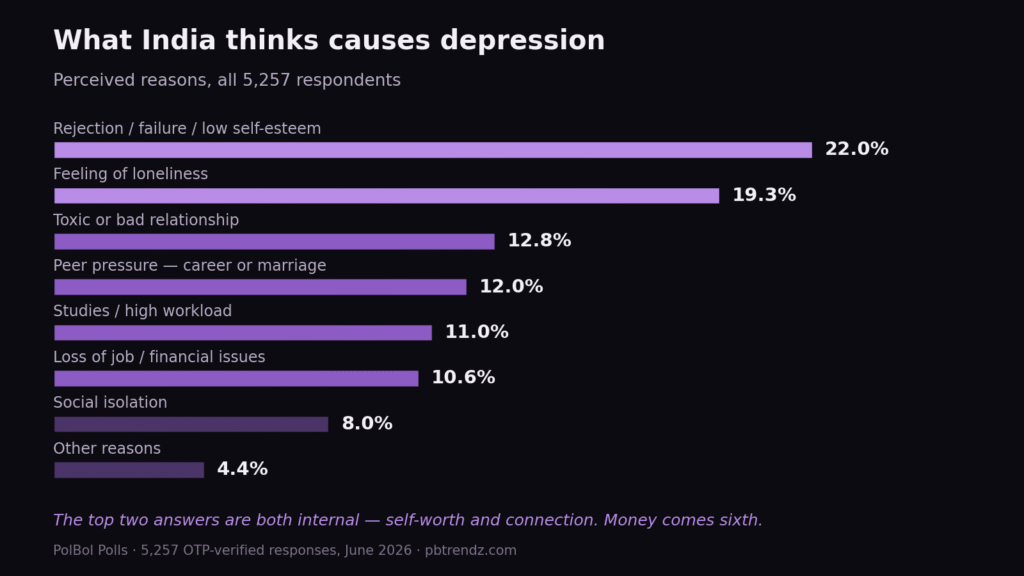
Across all 5,257 responses, the ranking came out like this:
Rejection, failure or low self-esteem — 22.0%. The single most-cited reason.
A feeling of loneliness — 19.3%.
A toxic or bad relationship — 12.8%.
Peer pressure around career or marriage — 12.0%.
Studies or a high workload — 11.0%.
Loss of job or financial issues — 10.6%.
Social isolation — 8.0%.
Other reasons — 4.4%.
Two things stand out. The top two answers are both internal — how a person feels about themselves, and how connected they feel to others. Money comes sixth. And the top two together account for barely 41 per cent, which means the other 59 per cent of respondents pointed somewhere else entirely. There is no consensus here, and that is the finding.
Teenagers say loneliness. Young adults say self-worth.
Split the sample by age and the picture sharpens immediately.
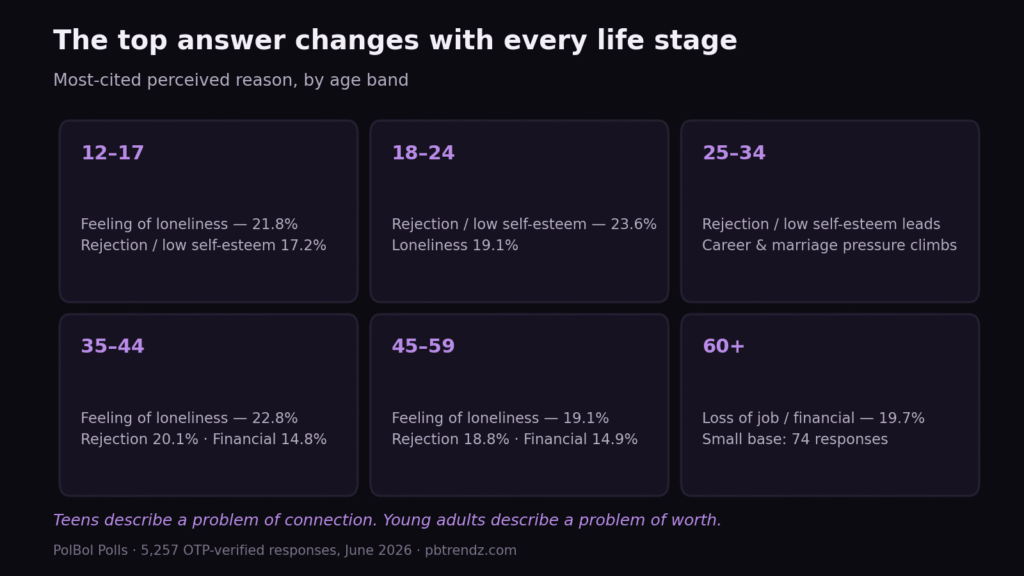
Among 12 to 17-year-olds, the top answer is a feeling of loneliness, at 21.8 per cent. Rejection and low self-esteem come second, at 17.2 per cent.
Among 18 to 24-year-olds, those two swap places. Rejection, failure and low self-esteem jump to 23.6 per cent — the highest single figure anywhere in the study — while loneliness slips to 19.1 per cent.
Teenagers describe a problem of connection. The moment respondents are old enough to be applying for colleges and jobs, they describe a problem of worth.
The pressure years: 25 to 34
Rejection and low self-esteem stay the top answer in this band, but something else climbs underneath it. Peer pressure around career or marriage becomes markedly more visible — cited by 17.0 per cent of women in this age group and 15.2 per cent of men.
It is the only age band where social expectation about being settled — employed, married, established — pushes near the top of the list. Read alongside the teen and young-adult numbers, the study describes a pipeline: loneliness, then self-worth, then the weight of what everyone else expects.
Men and women answered differently
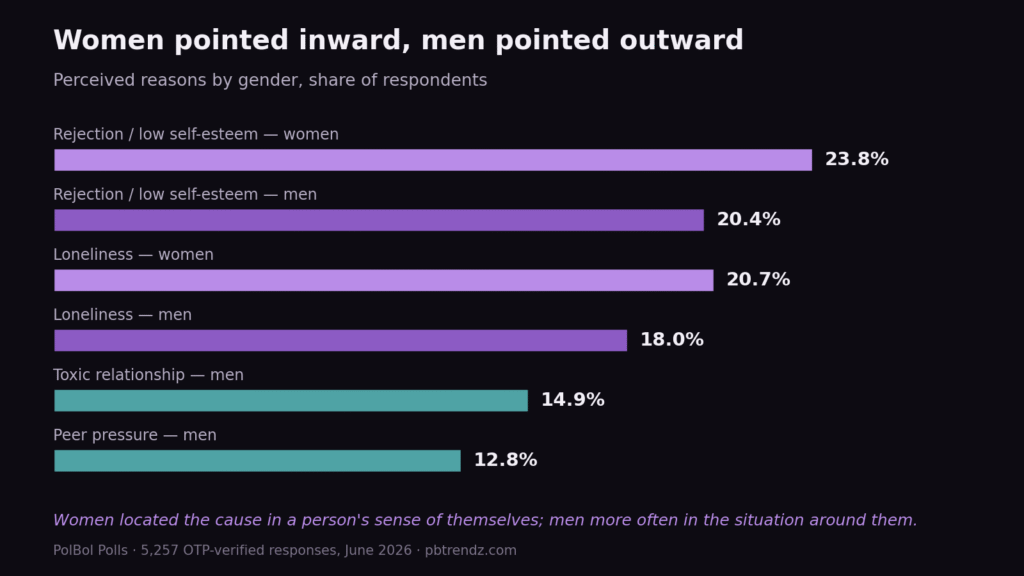
Women were more likely than men to name the emotional reasons. Rejection, failure and low self-esteem was cited by 23.8 per cent of women against 20.4 per cent of men. Loneliness followed at 20.7 per cent among women and 18.0 per cent among men.
Men were relatively more likely to point outward — to a toxic or bad relationship, at 14.9 per cent, and to peer pressure, at 12.8 per cent.
The gap is not enormous. But it runs in a consistent direction: women in this sample located the cause inside a person’s sense of themselves, men more often in the situation around them.
Middle life does not make it go away
There is a common assumption that emotional pressure is a young person’s problem and that older adults worry mainly about money. The data does not support it.
Among 35 to 44-year-olds, loneliness returns to the top at 22.8 per cent, with rejection and low self-esteem right behind at 20.1 per cent. Financial issues are third, at 14.8 per cent.
Among 45 to 59-year-olds, the pattern barely moves: loneliness 19.1 per cent, rejection and self-esteem 18.8 per cent, financial issues 14.9 per cent.
Two decades apart, almost identical answers. Money rises, but it never overtakes the emotional reasons. Loneliness is the most-cited reason in four of the six age bands.
What changes after 60
The one age group where the ranking genuinely breaks is the oldest. Among respondents aged 60 and above, loss of job or financial issues becomes the leading answer at 19.7 per cent — 20.0 per cent among women in that band, 18.5 per cent among men.
An important caution here, and PolBol flags it themselves: this group contains only 74 responses. A handful of different answers would move those percentages several points. Treat it as a signal about direction, not a measurement.
What this study is, and what it isn’t
Two limits are worth stating plainly, because they change how much weight the numbers can carry.
First, the sample skews young. Respondents aged 18 to 24 make up the clear majority of the poll, and the oldest bands contain only a few dozen people each. This is a portrait of what young, online India believes, with older voices present but thinly represented.
Second — and this is the one that matters most — none of this is a finding about what causes depression. It is a finding about what Indians think causes depression. Those are different questions, and the gap between them is itself interesting: a public that ranks self-esteem and loneliness far above clinical or biological explanations is a public with a particular model of the illness in its head.
That model shapes how people respond when someone close to them is struggling. It is worth knowing what it looks like.
This article discusses mental health. If you or someone you know is struggling, Tele-MANAS — the Government of India’s national mental health helpline — is free, confidential and available 24 hours a day on 14416, in English and 20 regional languages. Speaking to a qualified professional is the right step; a poll about public perception is not a substitute for one.
Source: PolBol Polls, 5,257 OTP-verified responses, June 2026. Percentages may not total 100% due to rounding. Based on public responses, not medical diagnosis.
You May Like This
1



Advertisement
You May Like This




Advertisement
Advertisement
Advertisement