

Advertisement

- Updated on August 26, 2026
- IST 3:02 pm
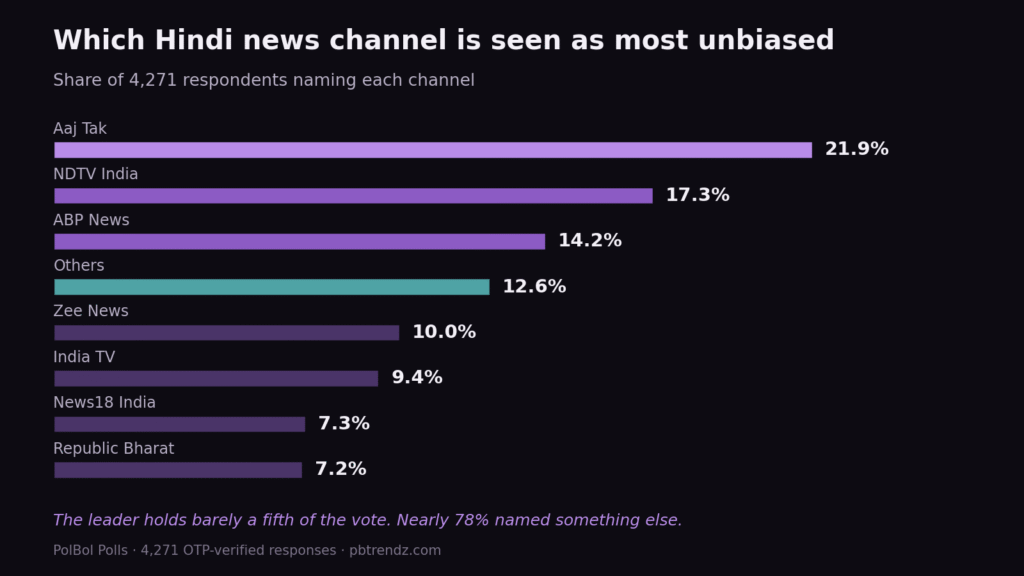
Ask India which Hindi news channel is the most authentic and unbiased and the answer is Aaj Tak — with 21.9 per cent of the vote, and a lead of nearly five points over the next name.
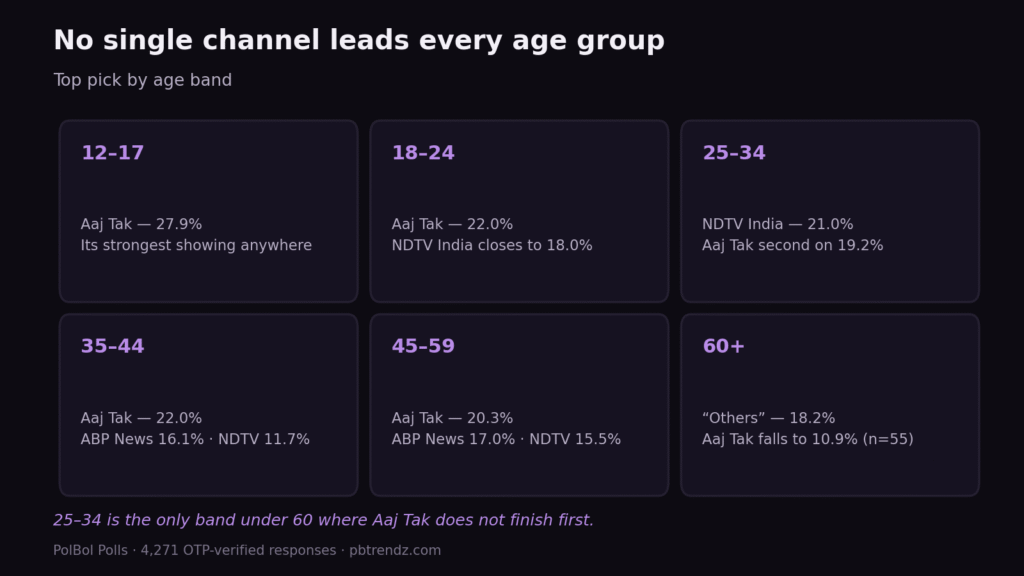
But that headline conceals something more interesting. There is no age group in this study where Aaj Tak’s lead is stable, and there is one where it loses outright.
PolBol’s Hindsight poll asked 4,271 OTP-verified respondents a single question: which Indian Hindi news channel showcases the most authentic and unbiased news?
The overall ranking
1. Aaj Tak — 21.9%
2. NDTV India — 17.3%
3. ABP News — 14.2%
4. Others — 12.6%
5. Zee News — 10.0%
6. India TV — 9.4%
7. News18 India — 7.3%
8. Republic Bharat — 7.2%
Worth noting straight away: the top choice commands barely a fifth of the vote. Nearly 78 per cent of respondents named something other than the winner. In a market this fragmented, “leading” means holding one vote in five, not commanding the room.
The other number to sit with is fourth place. “Others” — a listed option respondents actively chose, not a leftover bucket — took 12.6 per cent, ahead of Zee News, India TV, News18 India and Republic Bharat. More people picked something outside the named list than picked any of the bottom four channels.

Teenagers are Aaj Tak’s strongest constituency
Among 12 to 17-year-olds, Aaj Tak takes 27.9 per cent — its best score in any age band, six points above its national average. ABP News is a distant second at 14.5 per cent.
Among 18 to 24-year-olds, the largest group in the study at 2,840 respondents, Aaj Tak still leads on 22.0 per cent. But NDTV India closes to 18.0 per cent, narrowing the gap to four points.
The trend is already visible: the older the respondent gets within young India, the tighter the race becomes.
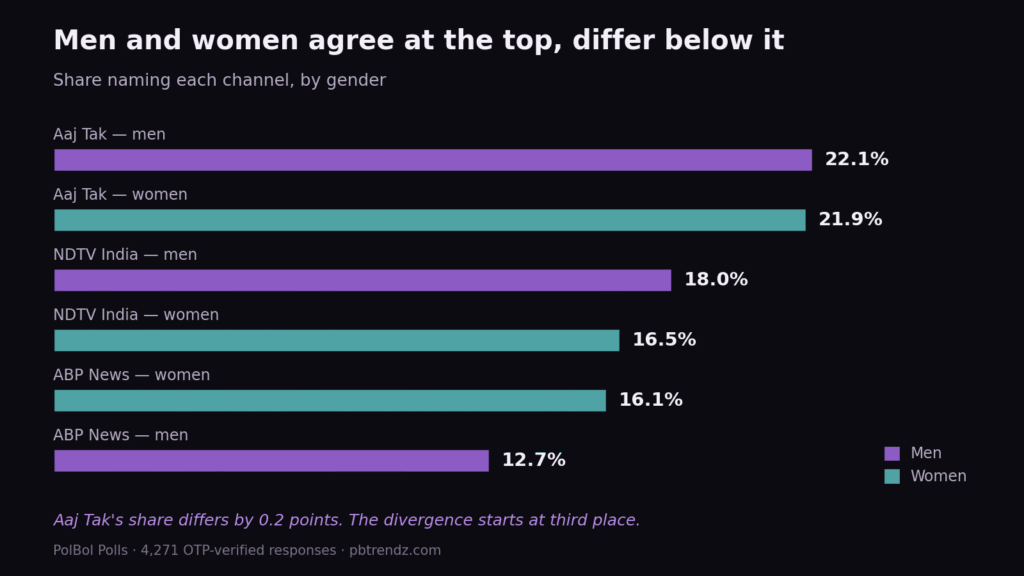
Men and women agree at the top, differ below it
Aaj Tak’s share is essentially identical across genders: 22.1 per cent among men, 21.9 per cent among women. A gap of 0.2 points.
NDTV India is second for both, at 18.0 per cent among men and 16.5 per cent among women.
The divergence starts at third. Women rate ABP News notably higher — 16.1 per cent, against 12.7 per cent among men. Men lean further toward Zee News (10.4 per cent) and India TV (10.1 per cent).
Same podium, different steps behind it.
The switch age: 25 to 34
Here it flips.
NDTV India leads this band on 21.0 per cent — its highest share in any age group — with Aaj Tak second on 19.2 per cent and ABP News third on 14.8 per cent.
A lead of 1.8 points is not a landslide, and this band contains 453 respondents, so it is a finding to hold lightly. But it is the only age group under 60 where Aaj Tak does not finish first, and it is the same band that showed the sharpest dip in the reality TV study. Something about India’s 25 to 34-year-olds is running against the grain of the rest of the sample.
Midlife returns to Aaj Tak
The reversal does not hold.
Among 35 to 44-year-olds, Aaj Tak is back on top at 22.0 per cent, ABP News second at 16.1 per cent, and NDTV India drops to third at 11.7 per cent — a fall of more than nine points from the band immediately below.
Among 45 to 59-year-olds, the order is the same: Aaj Tak 20.3 per cent, ABP News 17.0 per cent, NDTV India 15.5 per cent.
Across both midlife bands, ABP News is consistently second. Its national third place is built on midlife strength, not on breadth.
After 60, nobody leads
The oldest group produces the strangest result in the study, and the winner is nobody.
“Others” comes first at 18.2 per cent, with News18 India and Republic Bharat tied on 14.5 per cent each. Aaj Tak falls to 10.9 per cent — its weakest showing anywhere, less than half its national share.
The caveat is significant: 55 respondents. That is small enough that a handful of answers would rearrange the order. But the dispersion itself is the point — no named national channel gets near a plurality with this group.
What “unbiased” is measuring here
This poll does not assess journalism. It cannot, and PolBol says as much on every slide. It measures which newsroom people believe is straight with them — a perception shaped by which channel they already watch, what their family watches, and which side of an argument they think a channel is on.
That makes the age pattern more meaningful than the winner. A country where teenagers, thirty-somethings and pensioners each name a different most-trusted channel is a country where trust in news has no shared reference point at all. The fragmentation is the story; Aaj Tak’s 21.9 per cent is just the largest piece of it.
The limits
The sample skews sharply young — 18 to 24-year-olds are 66.5 per cent of it, the highest concentration in any of these five studies. The 60+ band has 55 respondents. Read this as a strong picture of young India’s news trust and a thin sketch of everyone else’s.
Source: PolBol Polls, 4,271 OTP-verified responses. Percentages may not total 100% due to rounding. Based on respondent perceptions of authenticity and impartiality, not an assessment of journalistic quality.
You May Like This
1



Advertisement

You May Like This




Advertisement
Advertisement
Advertisement